Domaine Albert Mann

Falstaff Winery - 2 Stars
Domaine Albert Mann is a biodynamic family estate in Wettolsheim, shaped by Alsace’s fractured geology and its long habit of reading vineyard parcels with precision. The draw is terroir expression: 25 hectares split across roughly 100 small plots, seven Grand Cru holdings, hand harvesting, and a portfolio that gives Riesling, Gewurztraminer, Pinot Gris and Alsatian Pinot Noir equal seriousness.

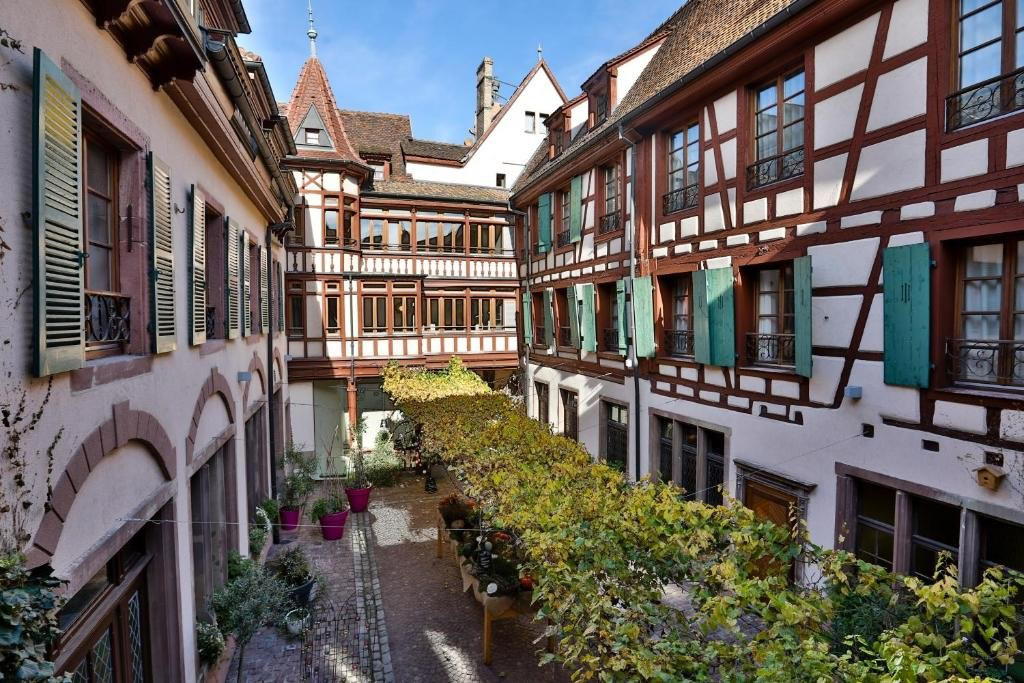
Wettolsheim sits in the quieter grain of Alsace wine country, where the Route des Vins passes through villages that feel less like showpieces than working viticultural maps. Around Domaine Albert Mann, the mood is classic, restrained, family-run and rooted in vineyard rhythms rather than visitor spectacle: Alsace as soils, slope and inheritance, not postcard theatre.
The estate matters because it explains the region’s small-scale complexity. From afar, Alsace can seem simple: aromatic whites, tidy villages and a recognizable bottle shape. Up close, granite, marl, limestone and sandstone appear in tight succession. Domaine Albert Mann works 25 hectares divided into roughly 100 small îlots de culture, a fragmented structure that makes it a useful lens for understanding why Alsace rewards parcel-by-parcel attention.
Granite, marl and the Alsatian case for precision
The estate’s argument is not breadth alone, though the range is wide. Riesling accounts for 40 percent of white plantings, followed by Gewurztraminer at 17 percent, Pinot Gris and Auxerrois at 16 percent each, Pinot Blanc at 10 percent and Muscat at 1 percent. Reds are led by Pinot Noir, 96 percent of red plantings, with a small share of Syrah. The point is how those varieties translate place rather than fill an Alsace checklist.
Seven Grand Cru holdings give the portfolio its backbone, including Wineck-Schlossberg, Furstentum, Hengst and Steingrubler. Wineck-Schlossberg brings granite, often associated in Alsace with line and tension in Riesling. Hengst, with calcareous marl, gives Pinot Noir a firmer frame. Furstentum and Steingrubler add nuance, with marl-limestone influence and a cooler, more acid-driven register across the range. Where Grand Cru names can become collector shorthand, the more useful reading here is geological: each site changes the wine’s architecture.
Biodynamics has shaped the estate since 1997, with BIODYVIN biodynamic certification and AB/EUROFEUILLE organic certification. That matters because Alsace’s dry, semi-continental climate lets growers farm with high intention. The Vosges rain shadow, warm summers and long ripening window support a style in which aromatic maturity can arrive without losing the structural clarity serious Alsace needs.
Hand harvesting across annual production of about 120,000 bottles reinforces the parcel logic. Average vine age is listed at 30 years, mature enough for depth without old-vine mythology. Native yeasts, stainless steel for many whites, open-top wooden barrels for reds and selective barrel aging are the key production details, pointing to a house style built on definition rather than cosmetic weight.
Why the reds matter in a white-wine region
Alsace is still internationally framed by Riesling, Gewurztraminer, Pinot Gris and other white varieties, but a revealing recent shift is its growing confidence with Pinot Noir. Domaine Albert Mann sits inside that movement with unusual authority. Its red bottlings, including Pinot Noir Vieilles Vignes, Clos de la Faille, Grand P and Hengst, show why Alsatian Pinot should not be a sidebar when farming and sites are strong.
The competitive significance is direct: Alsace Pinot Noir asks for different expectations than Burgundy, Germany or the Loire. It can be paler, more transparent and more site-marked, but from warmer, well-chosen parcels it gains structure. Hengst is the clearest example here, where marl gives the grape a muscular spine. The reds are useful for drinkers who know Alsatian whites and want to see how dry summers and limestone-marl sites translate through Pinot rather than Riesling.
The whites remain central. Riesling is the intellectual anchor, especially where granite and Grand Cru exposure sharpen the line. Gewurztraminer and Pinot Gris carry Alsace’s aromatic tradition, but the better examples are not merely perfumed; they need grip, controlled sweetness when present, and enough acidity to avoid feeling static. The estate’s Vendange Tardive work with Gewurztraminer belongs to that older Alsatian conversation around late harvest, concentration and balance.
Recognition has followed the farming and range. La Revue du Vin de France named the Barthelmé family Winemakers of the Year in 2012, and has described the domaine as a locomotive of Alsatian viticulture. The phrase is useful because it captures the estate’s influence: biodynamic farming, detailed parcel work and serious red-wine ambition have helped define contemporary high-end Alsace.
A focused stop for terroir-led Alsace
This is a strong address for travelers who prefer estates with a clear agricultural thesis over broad hospitality programming. The appeal is understanding Wettolsheim through vineyard segmentation: many small plots, several Grand Cru sites, and a family lineage joining the Mann winemaking history in the village with the Barthelmé family’s roots dating to 1654. Maurice and Jacky Barthelmé shaped the modern reputation, with Antoine Barthelmé now associated with the next generation of direction.
Within Wettolsheim, the estate is part of a broader wine conversation rather than an isolated attraction. Readers mapping the village’s character can also look at André Stentz, Domaine Barmès-Buecher, Domaine Saint-Remy and Domaine Saint-Rémy / Ehrhart for a wider sense of how this small commune supports multiple interpretations of Alsace.
For trip planning around the village, EP Club’s city rails collect the broader context: Our full Wettolsheim wineries guide, Our full Wettolsheim restaurants guide, Our full Wettolsheim hotels guide, Our full Wettolsheim bars guide and Our full Wettolsheim experiences guide. For a wider French and European wine trail, see A. Margaine in Villers-Marmery, Abbaye de Fontfroide in Narbonne, Abbotts & Delaunay in Marseillette, Advini in Saint Felix De Lodez, »der Steiner« Hans Steiner in Podersdorf am See and & Handwein in Mannheim.
Frequently asked questions
Is Domaine Albert Mann more formal or casual?
It reads as a casual wine-estate stop rather than a formal dining room, which fits a producer address in Wettolsheim, Alsace. The $$ price range also points to a more approachable visit than a white-tablecloth setting.
What's the cost level for Domaine Albert Mann?
Pricing at Domaine Albert Mann is listed as $$.
What's the address for Domaine Albert Mann?
Domaine Albert Mann is located at Wettolsheim, Alsace, Frankreich, Wettolsheim.
What's the main draw of Domaine Albert Mann?
The draw is the estate’s family lineage in Wettolsheim, with Mann and Barthelmé roots reaching back to the 17th century and 1654. That history matters because it frames the wines as a serious Alsace estate, not a generic tasting stop.
Do they take walk-ins at Domaine Albert Mann?
For a winery estate in Wettolsheim, short-notice visits are more plausible than at a reservation-only restaurant, but advance planning is the safer approach. The address in Wettolsheim, Alsace, signals a destination built around the estate itself.
Who tends to like Domaine Albert Mann most?
It suits travellers who care more about Alsace wine, family estates, and terroir than about polished hospitality theater. The combination of a long family history and a concentrated wine focus will matter most to visitors who want the region’s viticultural side.
Recognition history
Dated appearances from independent guides and award organizations, with the underlying list record or original source where available.
Falstaff Winery - 2 Stars
Falstaff
Enquire about visiting Domaine Albert Mann or buying its wine
Visits to Domaine Albert Mann are usually kept for the estate's regular buyers and the wine trade. Tell us when you would like to go and a little about how you buy, and we put the request to the estate and reply to you by email. For buying, we source directly from the producer or from a licensed seller we know and vouch for, and tell you the route before you pay.
Continue exploring
More in Wettolsheim
Wineries in Wettolsheim
All wineries in Wettolsheim →
Bars in Wettolsheim
Browse all →
Details
- Classic
- Quiet
- Sophisticated
- Rustic
- Wine Education
- Solo Exploration
- Special Occasion
- Group Outing
- Private Tasting
- Historic Building
- Estate Grounds
- Vineyard Tour
- Biodynamic
- Organic
- Vineyard
- Riesling
- Gewurztraminer
- Pinot Noir
- Pinot Gris
- Pinot Blanc
- Auxerrois
- Still White
- Still Red
- Sparkling
- Commented Tasting
- Private Tasting
A biodynamic family estate with a heritage-driven, terroir-focused atmosphere rooted in the Alsace Wine Route and the diversity of Wettolsheim’s vineyards.