Château du Pizay

Château du Pizay reads as Beaujolais in estate form: Gamay, formal gardens, old stone, and a hospitality setup built around wine rather than scenery alone. The appeal is its scale and clarity, with 80 hectares across Beaujolais, Brouilly, Régnié, and Morgon, plus tastings that connect vineyard, cellar, and château setting without turning the region into theatre.
Pearl is the En Primeur Club membership app — saves, bookings, and concierge access live there. Same editors, same standards.
- Address
- Belleville-en-Beaujolais, Auvergne-Rhône-Alpes, Frankreich
 Saves & bookings on Pearl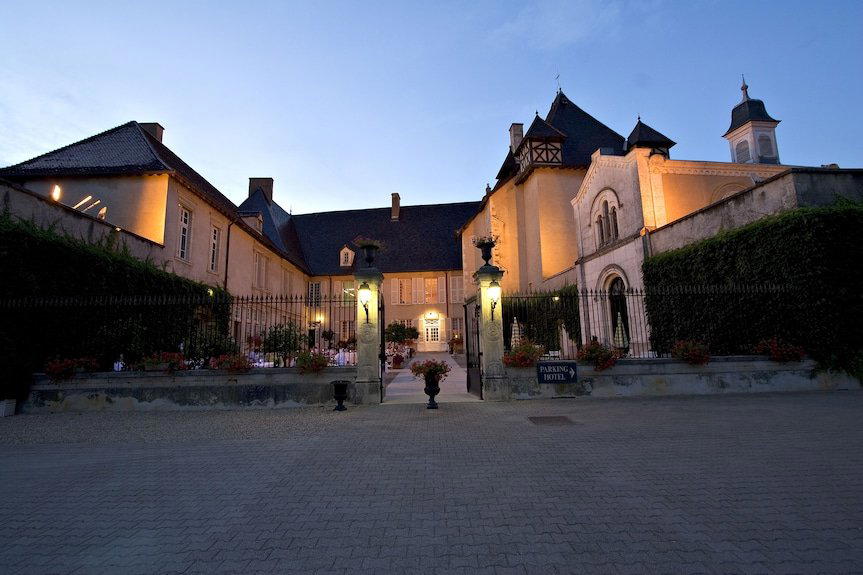
Approaching Château du Pizay, the first argument is architectural before it is vinous: pale stone, clipped French gardens, vineyard rows, and the kind of quiet that makes Beaujolais feel less like a day-trip add-on to Lyon and more like a wine country with its own gravity. The estate format matters here. In a region often reduced abroad to youthful, quick-drinking Gamay, a château-hotel-spa-restaurant-œnothèque complex makes a different case: Beaujolais can be generous, historic, and structured enough to hold a full stay.
The land is the point. Château du Pizay works from around 80 hectares across Beaujolais, Brouilly, Régnié, and Morgon, which gives the estate a broad view of the region’s internal differences rather than a single-village argument. That breadth is useful for visitors who want to understand why Gamay changes so sharply from one slope and soil type to another. Morgon brings the firmer, more age-capable side of the grape; Brouilly and Régnié pull the conversation toward perfume, fruit, and lift; Beaujolais provides the more immediate register. The estate’s red wines are built around Gamay, with Chardonnay and Pinot Noir also listed among the plantings, so the tasting frame is regional without being narrow.
Gamay, granite and the château scale of Beaujolais
Beaujolais has spent years correcting a reputation problem. Nouveau culture made the region famous, then flattened the way many outsiders read it. The more serious story lies in cru Beaujolais, where granite, schist, clay-limestone pockets, exposition, and cellar choices make Gamay speak in different accents. Château du Pizay is useful because it places several of those accents under one estate umbrella. Its appellation spread across Beaujolais, Brouilly, Régnié, and Morgon turns a visit into a compact regional seminar rather than a single-label tasting.
The production language is estate-led: vinification, élevage, and bottling take place at the château, with aging in open cellars. That matters in a region where the distinction between grower, négociant, and estate can shape both style and expectation. The domaine is also certified Agriculture Biologique and Haute Valeur Environnementale, two practical signals in a vineyard zone where soil life and biodiversity are not decorative concerns. Organic certification speaks to farming inputs; HVE points to broader environmental performance, including biodiversity and resource management. For travelers comparing French winery visits, those certifications carry more weight than vague sustainability language.
Pascal Dufaitre, an agronomist and oenologist, has managed the domain since 1981. That tenure is relevant not as biography, but as continuity: Beaujolais has gone through fashion cycles, export swings, and a reevaluation of its crus during that period. Long stewardship in this context suggests a property that has had time to refine vineyard decisions across multiple appellations rather than simply follow the current taste for lighter reds.
An oeno-sensorial format rather than a quick pour
The tasting experience is built around an oeno-sensorial parcours with eight thematic ateliers, a format that suits the estate’s hybrid identity. Many winery visits in France still divide into two camps: technical cellar walk-throughs for the already converted, or casual pours for travelers passing through. This estate sits between them, using structured stations to explain history, appellation, and sensory cues without requiring guests to arrive fluent in Beaujolais taxonomy.
That format also helps separate the château from simpler caveau tastings. The grounds, formal garden, vineyard views, and historic buildings create atmosphere, but the stronger editorial reason to come is the way the setting clarifies terroir. Seeing the château as a working wine estate rather than just a picturesque stop changes the reading of the glass. A Morgon tasted in this context is not merely a red wine from the region; it becomes part of a larger map that includes Brouilly, Régnié, and the broader Beaujolais appellation.
The hospitality side is unusually layered for the area: hotel, spa, restaurant, wine centre, private tasting possibilities, group capacity, and outdoor space. The restaurant has Gault&Millau selection, which gives the food program a recognisable editorial signal without turning the winery into a restaurant-first destination. The smart use case is a slower Beaujolais stay, where tasting, lunch or dinner, gardens, and vineyard time sit in the same itinerary. Visitors using Belleville-en-Beaujolais as a base can also widen the day with Château Cambon and the full Belleville-en-Beaujolais wineries guide.
How to read the estate within a Belleville-en-Beaujolais trip
The winery works less well as a rushed tasting stop and better as the anchor of a wine-country day. The atmosphere is quiet and refined, with a smart-casual register that fits the château setting without requiring urban formality. It is also practical for mixed groups: wine-focused travelers get appellation range and cellar context, while less technical guests have gardens, architecture, food, and the broader estate rhythm. Children and dogs are listed as welcome, which widens its usefulness for family travel in the region.
The estate’s price positioning is in the high bracket, but the value equation is not just what is in the glass. It is the combination of large-scale vineyard holdings, organic and HVE certifications, historic architecture, restaurant recognition, and an experience format that gives Beaujolais enough time to explain itself. For travelers building a fuller Belleville-en-Beaujolais itinerary, pair the winery plan with the restaurants guide, the hotels guide, the bars guide, and the experiences guide.
For broader French and European wine planning, EP Club’s winery coverage stretches from Champagne to the Languedoc and beyond: A. Margaine in Villers-Marmery, Agrapart & Fils in Avize, Abbaye de Fontfroide in Narbonne, Abbotts & Delaunay in Marseillette, Advini in Saint Felix De Lodez, Alain Brumont in Castelnau Riviere Basse, Alain Gras in Saint-Romain, »der Steiner« Hans Steiner in Podersdorf am See, and & Handwein in Mannheim. Read the winery within that wider context: not as a trophy cellar, but as a polished Beaujolais estate where terroir, hospitality, and regional education meet at château scale.
Recognition history
Dated appearances from independent guides and award organizations, with the underlying list record or original source where available.
Falstaff Winery - Listed
Falstaff
Continue exploring
More in Belleville-en-Beaujolais
Wineries in Belleville-en-Beaujolais
Browse all →
Restaurants in Belleville-en-Beaujolais
Browse all →
At a Glance
- Scenic
- Quiet
- Elegant
- Classic
- Sophisticated
- Romantic Getaway
- Special Occasion
- Group Outing
- Corporate Event
- Historic Building
- Garden
- Vineyard Tour
- Private Tasting
- Design Destination
- Vineyard
- Garden
- Beaujolais
- Gamay
- Chardonnay
- Pinot Noir
- Still Red
- Still White
- Still Rosé
- Self Guided Tasting
- Guided Tasting
- Food Pairing
A serene, refined estate atmosphere with historic stone architecture, French formal gardens, and a peaceful setting among the vineyards.