Beefeater Gin

One of London's most storied gin producers, Beefeater operates from Kennington in south London, a rare urban distillery still producing at scale within the city boundaries. Awarded Pearl 3 Star Prestige recognition in 2025, it occupies a distinct position among British gin houses, balancing heritage production credentials with an accessible, education-focused visitor experience.
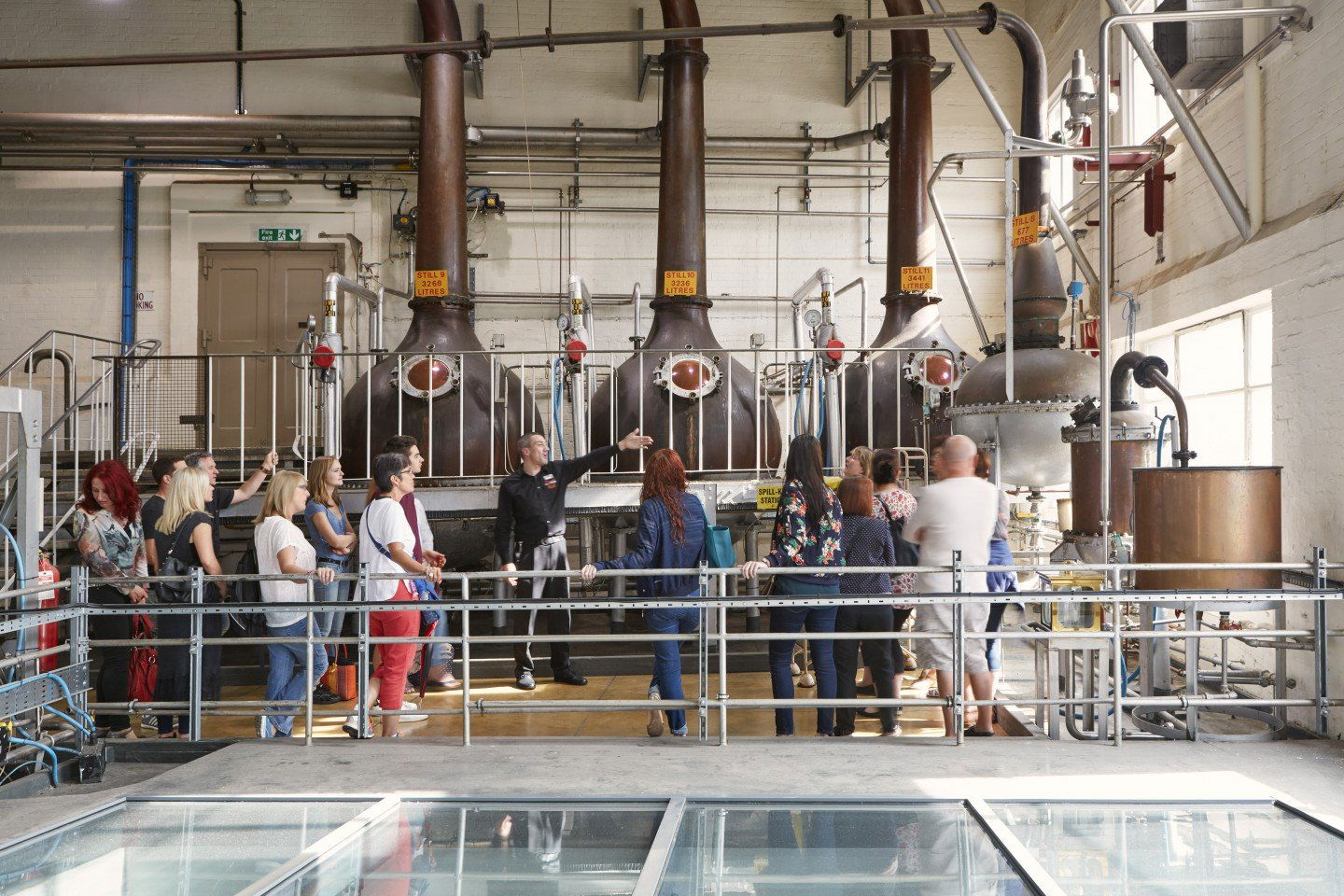
A Working Distillery Inside the City
Most major spirit producers long ago relocated production to industrial estates outside their founding cities. Beefeater has not. The distillery at 20 Montford Place, Kennington, sits in SE11, a few minutes from the Thames and surrounded by the residential density of south London. Walking toward the building, the botanical character of the place announces itself before you reach the entrance — juniper and citrus cutting through the ambient noise of a working city neighbourhood. This is not a heritage reconstruction or a brand experience grafted onto a storage facility. Production happens here, at scale, in a part of London that has seen significant regeneration over the past two decades but retains a grounded, non-tourist character that distinguishes it from more polished distillery visitor centres elsewhere in the United Kingdom.
That urban rootedness matters when thinking about what Beefeater represents in the British gin story. London Dry gin as a category is defined in part by its association with the capital, yet the number of producers actually distilling within Greater London has historically been small. Beefeater remains among the most significant, and its Kennington address is not incidental to its identity. The city's water, the logistical density that shaped its original production decisions, and the botanical trade connections that London's port history enabled all feed into how the spirit developed and why it continues to be made here rather than at a purpose-built facility elsewhere.
Where Beefeater Sits in the British Gin Tier
British gin has fractured into a complex set of categories over the past fifteen years. At one end, small-batch craft producers — many of them single-still operations , have multiplied to a point where differentiation requires either a genuinely distinctive botanical programme or strong regional identity. At the other end, global spirits conglomerates produce at volumes that make them category-defining but remove them from any meaningful conversation about place or character. Beefeater occupies neither extreme. It produces at significant volume while maintaining a London base, and its 2025 Pearl 3 Star Prestige award signals that institutional recognition continues to track its output as qualifying for the upper tier of spirit quality assessment.
For context, the Pearl 3 Star Prestige designation is not a marketing-tier award. It reflects evaluated spirit quality against a structured framework, placing Beefeater in a peer set that includes spirits assessed on production rigour and consistency rather than brand story alone. Within the London gin category specifically, this positions the distillery alongside a smaller group than the sheer number of London Dry producers might suggest. Comparison with Hayman's Gin Distillery in London is instructive: both houses carry documented London production heritage and both have accumulated formal recognition, but they operate at different scales and with different visitor formats, giving drinkers two distinct entry points into the same tradition.
For those building a broader picture of British spirit production, the distillery sits in a wider conversation that includes Scotch producers such as Dornoch Distillery in Dornoch and Dunphail Distillery in Dunphail, as well as established houses like Aberlour in Aberlour and Cardhu in Knockando. The shared thread is the relationship between place of production and spirit character, a question as live in gin as it is in single malt. Plymouth Gin in Plymouth offers perhaps the most direct regional comparison: a geographically defined British gin with Protected Geographical Indication status, against which Beefeater's London identity can be usefully measured.
Botanicals as Terroir: How Place Shapes the Spirit
The editorial angle of terroir expression, usually applied to wine, has meaningful relevance to gin when production remains genuinely located. The London Dry style demands no post-distillation flavouring, meaning what goes into the still and the water used to cut the spirit are the primary variables. Beefeater's botanical recipe is on public record: juniper, angelica root, angelica seeds, coriander seeds, liquorice root, orris root, Seville orange peel, lemon peel, and grapefruit peel. What that list describes is a botanical profile built around citrus brightness against a juniper spine, with earthy root components providing structural depth.
The citrus-forward character can be read as a deliberate expression of London's historical role as a trading port for Mediterranean and Spanish produce , Seville orange peel, specifically, connecting the spirit to centuries of citrus trade through the Thames. This is not a romantic reinterpretation added after the fact; the original botanical selections reflect the practical availability of raw materials in a major port city, which is the same logic that shapes how terroir operates in agricultural production. The spirit's character is in part the character of where and when it was developed.
This framework has implications for how to taste the gin. A spirit that prioritises juniper with citrus support and root-derived structure will behave differently in a classic gin and tonic than one built around floral or maritime notes. Understanding that the profile was shaped by London's commercial geography rather than by a single-maker's contemporary aesthetic helps locate it within the broader British gin tradition rather than evaluating it against the craft-gin wave that followed.
Visiting: What the Experience Offers
The Beefeater visitor experience operates from the Kennington site. Distillery tours and tastings are the core format. Logistics for planning a visit to this part of London are direct from central areas: Kennington Underground station on the Northern line places the address within easy reach of the city centre, and the neighbourhood has no significant tourist congestion, which means the experience is not embedded in the kind of high-footfall environment that shapes visits to Tower of London-adjacent attractions.
Given the 2025 Prestige award and the distillery's position in the London gin conversation, demand for guided experiences tends to track upward during summer months and around key London events. Booking ahead rather than walking in is advisable for any structured tour format, particularly if visiting as part of a broader London spirits itinerary. For those building such an itinerary, our full London wineries guide covers the wider range of production visits available in and around the capital.
Visitors whose interest extends beyond gin and into the full range of London's drinking and dining culture will find additional context in our full London bars guide, our full London restaurants guide, our full London hotels guide, and our full London experiences guide. For those curious about how premium spirit production intersects with wine and other artisanal producers internationally, the work of houses like The Glenturret in Crieff, Balfour Winery in Staplehurst, Abadía Retuerta in Sardón de Duero, and Accendo Cellars in St. Helena each illustrate how place-based production creates a distinct tier of quality , the same argument Beefeater makes from Kennington.
Frequently Asked Questions
- What should I taste at Beefeater Gin?
- The core London Dry expression is the reference point for understanding what the distillery produces and why it holds Pearl 3 Star Prestige recognition. The botanical architecture , juniper-forward, with layered citrus from Seville orange, lemon, and grapefruit peel, and structural depth from angelica and orris root , is leading assessed in a simple mixed serve that does not obscure the spirit's character. A classic gin and tonic or a martini serves this purpose more clearly than heavily flavoured cocktail formats. Tasting within the distillery context, where guides can explain the botanical selection in relation to the London Dry category, adds evaluative depth that is harder to replicate at a bar.
- What's the defining thing about Beefeater Gin?
- Among London gin producers, the combination of active production within Greater London, long-standing category recognition, and formal quality assessment , including the 2025 Pearl 3 Star Prestige award , places Beefeater in a narrower peer group than the sheer volume of London Dry brands might suggest. The distillery at Kennington produces at a scale that most London-based gin operations do not match, and it does so while maintaining institutional recognition for spirit quality. That balance between scale and assessed quality is the defining characteristic: it is neither a craft micro-producer nor a brand that has lost its production connection to the city it names.
- How far ahead should I plan for Beefeater Gin?
- For structured distillery tours, booking a minimum of one to two weeks ahead is sensible outside peak season; during summer (June to August) or around major London event periods, two to four weeks is more practical. The Kennington location is accessible but not embedded in a tourist cluster, so the booking constraint is less about neighbourhood capacity and more about tour availability at the distillery itself. The 2025 Prestige award has raised the profile of the visitor experience, and demand for formal tasting sessions has correspondingly increased. Confirm current booking arrangements directly with the distillery before planning travel around a specific date.
- Why does Beefeater continue to distil inside London rather than relocating production?
- The decision to maintain distilling at the Kennington site reflects both brand positioning and the practical argument that London Dry gin's identity is inseparable from its place of production. For a spirit category defined by name association with a city, physical presence in that city carries credential weight that a relocated facility would undermine. The Pearl 3 Star Prestige award in 2025 suggests that production quality has not been compromised by the urban setting, which in turn reinforces the case that London's water profile and the operational discipline required by a city-centre site contribute to, rather than constrain, the spirit's character.
Access the Cellar?
Our members enjoy exclusive access to private tastings and priority allocations from the world's most sought-after producers.
Access the Concierge