Balfour Winery


Set on a 160-hectare Tudor estate in the Kent Weald, Balfour Winery has been producing English sparkling and still wines since 2004. Two Decanter-awarded wines in 2025, including a Silver medal, signal where the estate sits within the county's increasingly competitive winemaking tier. The grounds, vineyards, and meadows make it as much a destination as a producer.
Weald Clay, Tudor Land, and the Making of a Kent Wine Estate
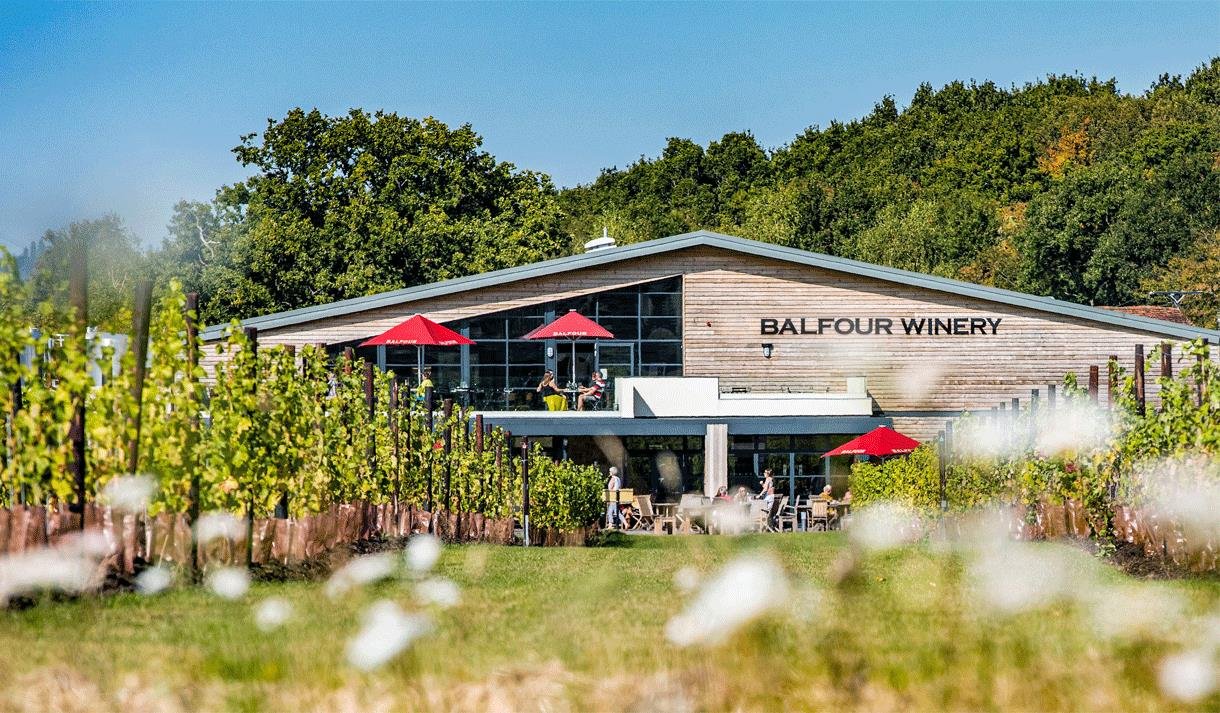
The road into the Weald of Kent has a particular quality in late summer: the hop gardens give way to hedgerows, the land flattens and then rises, and the sky opens in a way that feels nothing like the commuter belt forty miles north. Arriving at Balfour Winery along Five Oak Lane in Staplehurst, the scale registers before anything else. One hundred and sixty hectares of estate land, anchored by a Tudor farmhouse, with vineyard rows running out toward meadows that would have looked broadly familiar five centuries ago. This is not a purpose-built wine campus; it is farmland that became a winery, and that distinction shapes everything the estate produces.
Balfour was founded in 2004, placing it among the first generation of serious commercial wine producers in the modern English wine revival. That timing matters. The estates that planted in the early 2000s had the advantage of selecting their parcels before land prices in Kent reflected winemaking ambition, and they had two decades to understand their soils before the category attracted its current level of attention. English sparkling wine is now a recognised export and a fixture on fine dining lists across London; Balfour was part of the cohort that built that credibility.
What the Land Actually Does
The Weald sits on a geological formation quite different from the chalk North Downs that dominate the popular narrative of Kent wine. Here the soils run to Wealden clay and sandstone, heavier and more moisture-retentive than the free-draining chalk further north. That distinction is not merely academic. In a cool-climate region where ripening is always conditional on the season, heavier soils warm more slowly in spring and hold water through summer dry spells differently than chalk does. The wines that come from this part of Kent carry that signature: they tend toward a rounder, more textured profile in still whites, and in sparkling wines the mousse can carry a slightly broader, creamier quality compared to the more angular effervescence associated with pure chalk terroirs.
Balfour's 160 hectares give the winemaking team meaningful flexibility. An estate of this scale can manage multiple parcels with different aspect and drainage characteristics, blending across the property to balance vintages that arrive unevenly, as most English vintages do. The 2025 Decanter results — two awarded wines, with a Silver and a Bronze — suggest the team is getting that blending arithmetic right. A Silver at Decanter, the most watched international wine competition for English producers, carries genuine comparative weight. It places those specific wines above the bronze and commended tier that accounts for the majority of English sparkling entries and puts them in a bracket where the competition includes producers from across the global sparkling wine category, not just domestic peers.
The Estate as a Place to Spend Time
What makes Balfour an experience rather than simply a place to purchase wine is the relationship between the winery operation and the land around it. The vineyards are open to visitors, and the surrounding meadows give the estate a quality that distinguishes it from the small, intensively managed production sites that characterise many English wine operations. A Tudor estate carries a different spatial logic: the buildings, paths, and field boundaries reflect centuries of use rather than a contemporary leisure concept, and that gives the visit a texture that purpose-built wine tourism facilities rarely replicate.
The estate's Pearl 2 Star Prestige recognition in 2025 confirms that this visitor dimension is taken seriously as part of the overall offer. Prestige-level recognition at a hospitality and experience level sits alongside the Decanter wine awards and suggests Balfour is operating across both axes simultaneously, which is a harder balance to maintain than it appears. Wineries that invest heavily in visitor experience sometimes do so at the cost of production focus; the award record implies that has not been the trade-off here.
For those planning a visit, Staplehurst is accessible by rail from London Bridge and Charing Cross, with trains running regularly on the Southeastern Maidstone East line; the estate sits a short drive from the station. The Weald in general merits a full day rather than a quick stop: the wider area around Staplehurst includes some of the most characteristic agricultural land in the county, and combining a winery visit with time in the broader landscape makes the trip more coherent. If you are exploring other producers and experiences in the area, our full Staplehurst wineries guide covers the local field in detail, and our Staplehurst restaurants guide covers where to eat before or after.
Balfour in the Context of English Wine
The English wine category has expanded rapidly since Balfour's founding vintage, and the competitive picture looks quite different now than it did in 2004. New plantings across Kent, Sussex, and Hampshire have added volume and variety to the market, and the benchmark for what constitutes a serious English sparkling wine has moved upward as the category has matured. Within that context, an estate that has been farming its specific parcels for over two decades has an advantage that cannot be purchased: accumulated knowledge of how those soils and that microclimate behave across the full range of English growing seasons, from the warm, generous years to the ones that test every decision made in the vineyard.
For comparative reference, Balfour occupies a different tier and tradition to the distillery-led UK drinks producers such as Beefeater Gin in London, Plymouth Gin in Plymouth, or Bombay Sapphire Distillery in Whitchurch. The estate winery model, rooted in a specific parcel of land and a single growing region, operates on a fundamentally different logic to production distilleries, where blending and botanical sourcing can be adjusted across supply chains. Internationally, the closest conceptual parallel is the single-estate Champagne and Spanish estate wine tradition; producers such as Abadía Retuerta in Sardón de Duero and Accendo Cellars in St. Helena work from the same premise: that the specificity of a single estate, farmed with long-term consistency, produces wines that carry a legible sense of place that blended regional production cannot replicate.
Closer to home, the Scotch whisky single-estate tradition represented by producers including Aberlour, Cardhu in Knockando, The Glenturret in Crieff, Dornoch Distillery, and Dunphail Distillery in Dunphail shares the same territorial logic, even if the production category is different. In each case, the identity of the product derives from the specificity of its origin, and that origin specificity is what gives the category its defensible premium position.
Those planning a broader Kent itinerary should also consult our Staplehurst hotels guide, our bars guide, and our experiences guide for the surrounding area.
Frequently Asked Questions
- What's the vibe at Balfour Winery?
- The atmosphere is defined by the scale and age of the estate rather than by any designed hospitality concept. One hundred and sixty hectares of Tudor farmland in the Kentish Weald, with working vineyards and open meadows, creates a setting that feels genuinely agricultural rather than staged. The 2025 Pearl 2 Star Prestige recognition suggests the visitor experience is organised and considered, but the prevailing character is that of an active wine estate rather than a leisure venue. Arriving without the pressure of a specific reservation window, and allowing time to walk the vineyard and meadow land, is how the site repays a visit.
- What do visitors recommend trying at Balfour Winery?
- The Decanter 2025 results provide the clearest steer available: the estate's two awarded wines, one Silver and one Bronze, represent the range where production quality has been externally validated. English sparkling wine from the Wealden clay soils of this part of Kent tends toward a rounder, more textured character than chalk-grown alternatives from further north in the county, and that profile distinction is worth understanding before choosing across the range. For context on how Kent producers sit relative to the broader English wine field, our Staplehurst wineries guide maps the local competitive set in detail.
Access the Cellar?
Our members enjoy exclusive access to private tastings and priority allocations from the world's most sought-after producers.
Access the Concierge