Wilsons





1 Michelin Star · National Restaurant Awards Top 100 #32 · SquareMeal UK Top 100 Restaurants #1
Our verdict
Among Bristol's neighbourhood tasting-menu restaurants, Wilsons in Redland occupies a distinctive position: a smallholding-backed operation where the distance from soil to plate is measured in miles rather than supply chains. Operating since 2016 at £££ price point, it pairs a rigorous sourcing model with a tasting menu that draws on seasonal produce the kitchen grows itself, earning sustained critical recognition for its understated precision.

Pearl is the En Primeur Club membership app, where members save venues, book tables and use the concierge.
The menu
What to order
- Smoked_cod_roe
- Fallow_deer
- Bread_and_butter
A Chandos Road Fixture That Earns Its Reputation Slowly
Approach Wilsons on Chandos Road in the early evening and the first thing you register is the stained glass sign: stylised cauliflowers, leeks, onions and peppers rendered in coloured glass, glowing whenever the Redland light catches them. The sign is a family heirloom, inherited from a west London restaurant of the same name that operated decades earlier. Its vegetable motifs were incidental then. Here, they function as a precise manifesto. Wilsons has operated at this address since 2016, long enough to have accumulated a reputation that travels well beyond the postcode.
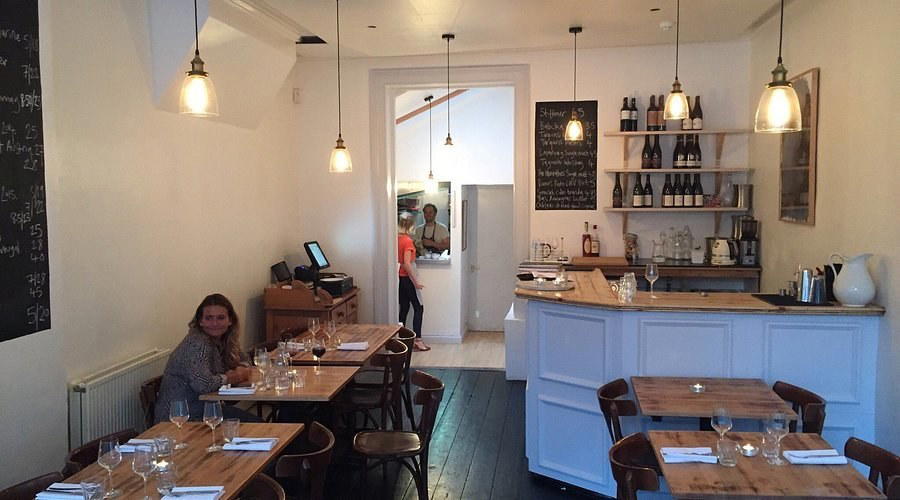
The room itself offers little in the way of distraction. Whitewashed walls, spare decoration, a blackboard carrying the chalked tasting menu, and a pair of antlers mounted above the kitchen pass. Bristol has a developed neighbourhood-restaurant culture, with operations like Bulrush and BOX-E working similar territory, but Wilsons has carved out a specific position: a tasting-menu format underpinned by a working smallholding, with the vegetable supply coming from land the restaurant controls rather than a supplier relationship it can terminate. That structural commitment shows in the food.
How the Menu Is Built, and What That Architecture Reveals
The tasting menu at Wilsons does not rotate on a whim. It is shaped by what the smallholding, which sits under the flight path to Bristol Airport, is actually producing at any given moment. The kitchen grows all its own vegetables and herbs, which means the sequence of dishes across an evening maps the season more accurately than any menu written in advance could. This is not an uncommon claim in Modern British dining in 2024, many restaurants in this tier invoke provenance as a selling point, but fewer have the operational infrastructure to back it. The smallholding here is not a marketing detail; it is the menu's primary constraint and, by extension, its primary creative engine.
Structure of that menu follows a logic familiar from higher-end British tasting-menu restaurants like L'Enclume in Cartmel or Moor Hall in Aughton: small, precise opening courses that calibrate the palate, a mid-section where the kitchen places its most technically demanding work, and a dessert course designed to land with enough clarity to finish the meal. At Wilsons, the sequencing has a characteristic restraint. Dishes tend to be built around one or two dominant flavours rather than layered complexity, and the portion architecture means that by the middle of the menu, the diner is paying close attention rather than working through volume.
Documented dishes from critical visits illustrate the approach. A small serving of red mullet and clementine soup opened one sitting, sharp, tangy, calibrating. Bread from Wilsons' own bakery next door followed, accompanied by buttermilk pheasant and taramasalata. A mid-menu course of sea bass with parsley, labneh and wild garlic capers carried what one reviewer described as a faint foretaste of spring, the kind of seasonal signal that only works when the produce is genuinely current. Monkfish with grilled celeriac, onion and fig leaf represented midwinter comfort in a different register: restrained heat, clean bitterness from the celeriac, an aromatic undertow from the fig leaf. A serving of mallard, beetroot and rhubarb, partially concealed beneath a January King cabbage leaf, brought the gamey, punchy mid-section to a close.
This is not the kind of menu architecture practised at, say, The Fat Duck in Bray, where conceptual drama and multi-sensory technique drive the sequence. Nor does it attempt the polished metropolitan register of CORE by Clare Smyth or The Ledbury in London. Wilsons operates with lower production theatrics and higher dependence on raw ingredient quality. The trade-off is intentional: when the produce is as close and as carefully tended as this, theatrical technique can obscure rather than enhance.
The Smallholding as a Structural Argument
Most Modern British restaurants at the £££ price point position themselves around sourcing credentials: named farms, seasonal supplier relationships, hyper-local foraging claims. The difference at Wilsons is one of control. Growing its own vegetables and herbs removes the restaurant from the supply-chain negotiation that defines how most kitchens actually work, and it produces a menu that shifts incrementally with the agricultural calendar rather than in discrete seasonal jumps. Dry-aged trout with pickled mushrooms and sweet onion broth, a dish cited consistently in critical coverage, illustrates this: the aging and the pickling are techniques that slow time, preserving and deepening ingredients rather than treating them as instant material. The result, according to multiple accounts, is a dish of understated originality, the kind of balance that is harder to achieve than the description makes it sound.
Bristol's food scene has developed a specific strand of this ethos. COR and Chef's Table operate in overlapping territory, and the city's reputation for sustainability-conscious dining predates the national mainstream adoption of the language. Wilsons has been part of that development since 2016, long enough that its commitment reads as foundational rather than fashionable.
The Signature Dessert and What It Signals About the Kitchen's Priorities
The tarte tatin with bay-leaf ice cream has become Wilsons' most documented dessert. In a kitchen that otherwise emphasises savoury restraint and ingredient-led composition, the tarte tatin is a deliberate pivot: technically classical, unapologetically satisfying, and built around a single flavouring addition, bay leaf in the ice cream, that shifts the familiar into something more considered. The bay leaf is not a garnish; it is a reframing. This approach to dessert, where classical form carries a single unexpected element, is characteristic of how the kitchen manages expectation across the whole menu: the architecture is readable, but the execution keeps the diner slightly off-balance.
Service, Wine, and the Neighbourhood Offer
Critical accounts of Wilsons consistently note that the service team operates with the same ethos as the kitchen: low formality, high attentiveness, no detachment between the two halves of the operation. In a city where neighbourhood restaurants compete partly on the warmth of the room rather than the prestige of the address, this integration matters. The wine list is described as thoughtfully assembled, which in context suggests a selection that reinforces rather than complicates the food's sourcing logic, European-leaning, probably biodynamic-friendly, probably shorter than a destination-dining list would offer.
Wilsons sits at the £££ price point, positioning it above Bristol's casual neighbourhood restaurants but below the £££££ tier occupied by the most ambitious destination tables in the UK, such as Gidleigh Park in Chagford or Hand and Flowers in Marlow. At that price, the value argument rests on quality of produce and precision of execution rather than spectacle or scale. By most critical accounts, the kitchen delivers on both.
Wilsons is located at 24 Chandos Road, Redland, Bristol BS6 6PF, with a bakery operating next door that supplies bread for the tasting menu. The restaurant has been in operation since 2016. Booking is advisable, given the small size of the dining room. For a broader view of where Wilsons sits within the city's food scene, see our full Bristol restaurants guide. Those planning a wider trip can also consult our full Bristol hotels guide, our full Bristol bars guide, our full Bristol wineries guide, and our full Bristol experiences guide.
Among the comparable Modern British tasting-menu tables in this city, Wilsons occupies a specific niche: smaller in ambition than 1 York Place, more rooted in agricultural infrastructure than most, and operating with a consistency across eight years that is the most reliable indicator of a kitchen that knows exactly what it is trying to do.
What's the Signature Dish at Wilsons?
The tarte tatin with bay-leaf ice cream is the dish most frequently cited in critical coverage of Wilsons, and it functions as a signature in the precise sense: it encapsulates the kitchen's approach in a single course. The classical form of the tarte tatin, caramelised, structurally confident, is paired with an ice cream that uses bay leaf to reframe the expected. It arrives at the end of a savoury menu built on restraint and seasonal precision, and its directness makes it the course most likely to be remembered. Beyond the dessert, dry-aged trout with pickled mushrooms and sweet onion broth represents the kitchen's savoury philosophy in concentrated form, and appears consistently across documented visits as evidence of what the smallholding model makes possible. Both dishes sit within the broader framework of Modern British cooking as practised at its most ingredient-focused end, where technique serves the produce rather than the reverse.
A Tight Comparison
| Venue | Cuisine | Price | Awards | Notes |
|---|---|---|---|---|
| WilsonsThis venue (the venue you are viewing) | Modern British Fine Dining | $100–150 | 1 Michelin Star · National Restaurant Awards Top 100 #32 | Not listed |
| Bulrush | Modern British Fine Dining | $50–100 | 1 Michelin Star · The Good Food Guide GFG Very Good | Modern British |
| Blaise Inn | Modern British Gastropub | $30–50 | Michelin Bib Gourmand | Traditional Cuisine |
| Little Hollows Pasta | Modern Italian Pasta Bistro | $20–30 | Michelin Bib Gourmand | Italian |
| Root | Modern Vegetable-Led Small Plates | $30–50 | Michelin Bib Gourmand · The Good Food Guide GFG Good | Modern Cuisine |
| Chef's Table | Modern British Fine Dining | $100–150 | Michelin Plate | Modern British |
Recognition history
Dated appearances from independent guides and award organizations, with the underlying list record or original source where available.
Michelin 1 Star
Michelin
National Restaurant Awards Top 100 #32 · No. 32
National Restaurant Awards · 2026 National Restaurant Awards Top 100
Opinionated About Dining Newly Added European Restaurants
Opinionated About Dining
SquareMeal UK Top 100 Restaurants #1
SquareMeal
The Good Food Guide GFG Very Good
The Good Food Guide
Full recognition history (9 entries)
Opinionated About Dining Casual in Europe Recommended
Opinionated About Dining
Michelin 1 Star
Michelin
National Restaurant Awards Top 100 #65
National Restaurant Awards
Michelin 1 Star
Michelin
Continue exploring
More in Bristol
Restaurants in Bristol
All restaurants in Bristol →
Bars in Bristol
All bars in Bristol →
Details
- Intimate
- Cozy
- Modern
- Elegant
- Date Night
- Special Occasion
- Solo
- Open Kitchen
- Extensive Wine List
- Farm To Table
- Local Sourcing
- Tasting Menu
- Set Menu
- Wine Pairing
- Vegetarian Friendly
- Allergy Accommodating
Current opening hours
- Monday
- Closed
- Tuesday
- 7–8:30 PM
- Wednesday
- 12–2:30 PM, 6–9:30 PM
- Thursday
- 12–2:30 PM, 6–9:30 PM
- Friday
- 12–2:30 PM, 6–9:30 PM
- Saturday
- 12–2:30 PM, 6–9:30 PM
- Sunday
- Closed
Hours can change for holidays and private events. Hours as of .
Relaxed, welcoming, and homey atmosphere with a neighborhood feel, featuring light-dappled spaces and a casual yet sophisticated vibe.