
Tabelog 100 #42
Our verdict
Seafood Shokudo Sabaya belongs to Niigata’s practical seafood-diner tradition, where access to the Sea of Japan matters more than ceremony. Its 2026 Tabelog 100 Diner selection gives the room a clear quality signal, while the format remains grounded in shokudo habits: direct, casual, and built around everyday appetite rather than tasting-menu theatre.

Pearl is the En Primeur Club membership app, where members save venues, book tables and use the concierge.
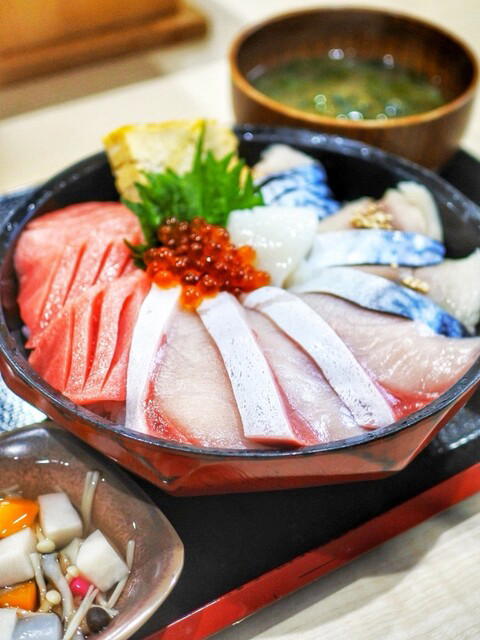
The menu
What to order
- Shime saba don
- Salmon don
- Ikashigure don
- Kaisen don
- Braised mackerel teishoku
- Grilled mackerel teishoku
Kitayama’s restaurant rhythm is quiet: local traffic, everyday routines, and the assumption that a good meal need not announce itself before the first tray lands. In kitayama, seafood is not framed only as special-occasion dining. It can sit inside daily routines, shaped by regional appetite and the shokudo tradition of feeding people efficiently without losing local character.
Seafood Shokudo Sabaya sits inside that tradition. Its Tabelog Hyakumeiten 2026 recognition matters because the category points travellers toward consistency, local pull, and food culture regulars understand before critics arrive. A diner listing does not ask a room to behave like a formal destination restaurant; it asks whether an everyday format has enough identity to travel beyond its neighbourhood. Here, the answer is seafood, not spectacle.
Kitayama seafood, read through the shokudo format
Kitayama’s food identity is best approached through everyday habits, and seafood is part of that conversation. The mood is direct rather than ceremonious. Where seafood is framed as status, the room slows down and explains itself. In the shokudo lane, the stronger signal is repetition: a menu locals return to, a practical dining format, and pricing that keeps the category everyday.
The cafeteria-and-seafood classification says more than a personality-led kitchen story would. The shokudo is a democratic Japanese form, part canteen, part neighbourhood dining room, judged by clarity rather than performance. When seafood enters that setting, the point is not elaborate theatre, but whether the meal feels connected to place. Kitayama gives that grammar a grounded context, from local dining habits to an appetite trained on set meals and direct preparations.
Compared with comparable venue references such as Chiyo Zushi, Seafood Shokudo Sabaya occupies a functional everyday lane. It is not competing for the evening-occasion role of a more formal meal, or chasing the broader casual range represented by World Burger Niigata ekimae ten. Its competitive set is narrower: diners where seafood, speed, and local credibility align. That balance is harder than it sounds, because accessible prices quickly expose weak execution, with little theatre to hide an average meal.
The 2026 Tabelog recognition gives visitors a useful filter without changing expectations. This is not the place for long-form ceremony, rare glassware, or chef-counter narration. It belongs to Japanese dining where value sits in directness. For travellers using our full kitayama restaurants guide, the appeal is seeing how seafood is eaten when treated as an everyday meal, not luxury.
Why everyday format matters more than dining-room polish
Seafood restaurants in Japan often fall into two narratives: urban precision or local abundance. Kitayama offers a quieter reading, where a cafeteria format can make seafood feel natural rather than decorative. A seafood shokudo works because the format joins those strengths. The meal is not built around display; it is built around the practical logic that makes everyday dining complete.
That relationship makes this venue different from a destination tasting room. The editorial reason to come is not a named dish or personality-led kitchen story, but a local food format expressed with low ceremony: seafood in a cafeteria setting, in kitayama, with public recognition attached to a category travellers often overlook while chasing reservations. The absence of luxury cues is part of the argument. A shokudo earns attention through usefulness.
There is also a Japan-wide comparison. Many travellers build itineraries around famous specialist restaurants, then leave the cafeteria tradition underexplored. Yet shokudo dining often gives a sharper read on local habits than a formal restaurant does. It shows what a place repeats. In kitayama, Seafood Shokudo Sabaya offers that read through seafood, while the broader EP Club Japan map can be used to think across other regional dining styles without mistaking casual formats for lesser ones.
Judge the experience by category discipline. A seafood diner should feel casual, direct, and clear in purpose, not ask for the patience of a dégustation or the spending logic of a formal counter meal. Sabaya’s value lies in alignment: the category supports the meal, the format supports the price point, and the recognition supports the detour for travellers already in the kitayama orbit.
How to place it inside a Kitayama itinerary
Kitayama is not shorthand for a city break like Tokyo, Kyoto, or Osaka, so planning works better when food sits inside a wider local circuit. A seafood diner here pairs naturally with a day built around neighbourhood movement rather than one destination meal. Travellers comparing categories can use our full kitayama hotels guide, our full kitayama bars guide, our full kitayama wineries guide, and our full kitayama experiences guide to avoid treating the meal as an isolated errand.
For comparison across casual Japanese formats, useful references are not only seafood rooms. Other everyday dining in Japan shows how simple categories can carry serious local identity when the format is clear and the audience understands what it is returning for. Around kitayama, comparisons are best kept practical: Seafood Shokudo Sabaya for cafeteria-and-seafood directness, with other unnamed local dining rooms filling out a broader casual itinerary.
Seen from outside Japan, that matters. Global appetite for Japanese food often privileges precision and rarity, while everyday formats explain how people actually eat. The daily-use grammar of a shokudo has its own force: quick, accessible, recognisable, and tied to local appetite. Sabaya’s place in kitayama is small and local, but the lesson is the same: the casual form is not lesser when ingredients and regional habits line up.
Travellers heading elsewhere can read it against other simple dining formats, where setting changes the meaning of simplicity. In kitayama, the seafood shokudo argument is plain: come for a local meal with credible recognition, not ceremony. That distinction is exactly what makes it useful.
Frequently asked questions
Does Seafood Shokudo Sabaya work for a family meal?
Yes, it can suit a family meal if the group wants a casual seafood meal rather than a long, formal sit-down. The listed budget is Dinner: JPY 1,000 - JPY 1,999; Lunch: JPY 1,000 - JPY 1,999.
What should I expect atmosphere-wise at Seafood Shokudo Sabaya?
Expect a straightforward shokudo setting rather than a polished dining room. It is listed in the cafeteria and seafood categories in kitayama.
What's the pricing like at Seafood Shokudo Sabaya?
Pricing at Seafood Shokudo Sabaya is listed as JPY 1,000 - JPY 1,999 JPY 1,000 - JPY 1,999 View spending breakdown.
What recognition does Seafood Shokudo Sabaya have?
Seafood Shokudo Sabaya is listed with Tabelog Hyakumeiten recognition for 2026 and a score of 3.59.
What's the address for Seafood Shokudo Sabaya?
kitayama.
At-a-Glance Comparison
Comparable venues by cuisine and price in the same metro.
| Venue | Cuisine | Price | Awards | Notes |
|---|---|---|---|---|
| Seafood Shokudo SabayaThis venue (the venue you are viewing) | Casual Japanese seafood shokudo | $10–20 | Tabelog 100 #42 | Not listed |
| Yoshinoya (吉野家 178号線豊岡店) | Japanese Beef Bowl (Gyudon) | Not listed | Not listed | 下陰 |
| 京都 鶏白湯そば 純 | Kyoto Creamy Chicken Broth Soba | $10–20 | Not listed | Nakagyo-ku |
| Urashima Ramen | Traditional Wakayama Ramen Shop | $1–10 | Tabelog 100 #75 | Uchita |
| Umaiya Takoyaki | Traditional Osaka Takoyaki | $1–10 | Not listed | Tenma |
| Jiyoken | Traditional Hakodate shio ramen | $1–10 | Tabelog 100 #32 | Matsukaze-cho |
Recognition history
Dated appearances from independent guides and award organizations, with the underlying list record or original source where available.
Tabelog 100 #42 · No. 42
Tabelog · Tabelog 100 - Diner - 2026
Continue exploring
More in kitayama
Restaurants in kitayama
All restaurants in kitayama →
Hotels in kitayama
Browse all →
Details
- Cozy
- Quiet
- Solo
- Family
- Casual Hangout
- After Work
- Group Dining
- Standalone
- Local Sourcing
- Sustainable Seafood
- Set Menu
- A La Carte
- Counter Dining
- Pescatarian Friendly
Current opening hours
- Monday
- Closed
- Tuesday
- 10 AM–2 PM
- Wednesday
- 10 AM–2 PM
- Thursday
- 10 AM–2 PM
- Friday
- 10 AM–2 PM
- Saturday
- 10 AM–2:30 PM
- Sunday
- Closed
Hours can change for holidays and private events. Hours as of .
Simple, canteen-like local shokudo with bright, functional interiors focused on efficient lunchtime service rather than decor, attracting solo diners, workers, and families.