
Michelin Plate
Our verdict
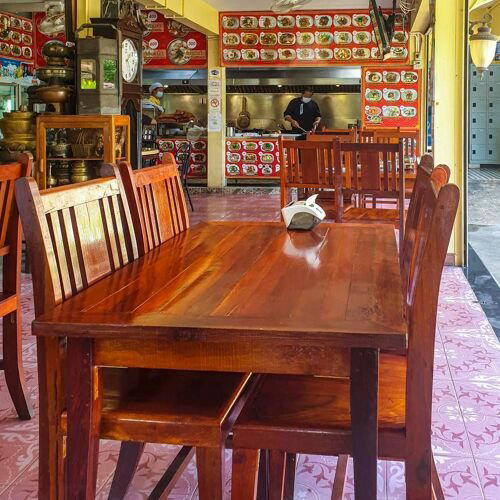
Among Ayutthaya's mid-range Thai restaurants, Rimsaun occupies a distinct position: a Nakhon Si Thammarat-rooted kitchen that has been producing southern Thai cuisine in the ancient capital for over 25 years, earning consecutive Michelin Plates in 2024 and 2025. The open-air setting, with high vaulted ceilings and a shaded garden, frames food that prioritises family recipes over tourist-facing adaptation.

Pearl is the En Primeur Club membership app, where members save venues, book tables and use the concierge.

The menu
What to order
- Southern Thai sour curry with fish
- Fried prawns with tamarind glaze
Southern Thai Cooking in an Ancient Capital
Ayutthaya's food scene is defined largely by the central plains tradition: mild curries, river fish preparations, and the kind of rice-centred cooking that has fed this former royal capital for centuries. Against that backdrop, a kitchen rooted in Nakhon Si Thammarat, a province on the Gulf coast roughly 700 kilometres south, reads as a deliberate outlier. Southern Thai cooking operates on a different register: sharper sourness, more pronounced heat, and a use of fresh turmeric and dried spice that reflects the region's historical trade routes. Rimsaun has been making that case in Pratuchai for more than 25 years, and two consecutive Michelin Plates (2024 and 2025) confirm that the kitchen's approach has found an audience well beyond the local neighbourhood.
The setting is worth describing before the food, because the two are connected. There are no walls. High vaulted ceilings rise over an open garden, and shade does the work that air conditioning would elsewhere. This is not a design choice arrived at recently; it is the kind of structure that reflects a practical, pre-air-conditioning logic common to older provincial Thai restaurants, where cross-ventilation was the only engineering that mattered. The effect, particularly during the cooler months between November and February, is a room that feels embedded in the town rather than sealed off from it.
What the Open-Air Format Signals About the Kitchen
The absence of walls is also an indirect statement about sourcing philosophy. Kitchens that invest heavily in interior infrastructure tend to price for it. Rimsaun's ฿฿ price point, mid-range within Ayutthaya's dining market, comparable to Baan Ta Ko Rai and others in the same tier, reflects a model where the kitchen's budget goes toward ingredients rather than décor. Southern Thai cooking, when done at a serious level, demands quality fish and fresh aromatics; that prioritisation shows in the plate before it shows anywhere else in the room.
Editorial angle worth pressing here concerns what sustainability looks like in practice for a long-running provincial Thai kitchen. It rarely involves certified programmes or published sourcing documents. More often, it is expressed through longevity: a kitchen that has cooked the same family recipes for 25 years, in the same location, at accessible prices, is by definition embedded in local supply chains. Ingredients travel shorter distances, relationships with suppliers run deep, and menus respond to what is seasonal and available rather than what a fixed concept demands. This is the quieter, less visible form of environmental consciousness that characterises much of Southeast Asia's most durable provincial cooking.
Within Thailand's broader southern cuisine recognition story, context matters. Sorn in Bangkok has become the reference point for southern Thai cooking at the highest price bracket, holding two Michelin stars and operating at a price level that places it outside everyday reach. AKKEE in Pak Kret occupies a different register entirely. Rimsaun sits in the middle of a different argument: that southern Thai family cooking, practiced with consistency over decades in a non-Bangkok context, deserves formal recognition on its own terms. The Michelin Plate designation, which signals a kitchen worth knowing rather than a destination in itself, is the appropriate recognition for exactly this kind of place.
The Dishes That Define the Kitchen
The southern sour curry with fish is the kitchen's longest-running reference point. Sour curries in the southern tradition differ structurally from the coconut-based curries of central Thailand: they use tamarind or raw fruit for acidity, produce a thinner, more liquid broth, and carry heat that builds rather than hits immediately. The version here is a family recipe, which means it has not been adjusted for a broader audience or softened for tourist traffic. For context on how rare that consistency is, consider that most Thai restaurants serving heritage tourism sites tend to moderate their heat and sourness over time; this kitchen has not.
The fried prawns glazed in tamarind sauce sit at the other end of the flavour register: sticky, sweet-sharp, and built around the same tamarind that anchors the sour curry. The kitchen's daily specials board is the practical guide to what arrived that morning, and in a town on the Chao Phraya river system, that list will shift with the season and the catch. It is worth arriving early enough to have a full read of the board before ordering.
Baan Pomphet, Baan Mai Rim Nahm, and Baan Pu Karn all work within the central plains tradition. Rimsaun's southern register gives it a distinct identity: diners specifically seeking Nakhon Si Thammarat-style cooking in this city have, effectively, one place to go. For a broader map of what Ayutthaya's dining scene offers across price points and styles, our full Phra Nakhon Si Ayutthaya restaurants guide covers the range in detail.
For those building a longer stay around the ancient city, our Phra Nakhon Si Ayutthaya hotels guide and bars guide map the accommodation and evening drinking options. The experiences guide covers the heritage site itineraries that most visitors structure their days around. If the pull of regional Thai cooking extends beyond Ayutthaya, Aeeen in Chiang Mai and Nahm in Bangkok represent different dimensions of serious regional Thai cuisine, as does Samrub Samrub Thai for those interested in archival Thai cooking traditions. PRU in Phuket is the reference point for southern Thailand cooking framed through a fine dining lens, a useful contrast to Rimsaun's provincial register.
Planning a Visit
Rimsaun is located at Pratuchai, off Phu Khao Thong Soi 5, in the northern part of the Phra Nakhon Si Ayutthaya district. The ฿฿ pricing means a full meal for two with multiple dishes sits comfortably within a budget that most travellers to Ayutthaya will have allocated for a main restaurant meal. The open-air format makes the November to February window the most comfortable period to visit; the shoulder months of October and March are workable. The daily specials board changes with supply, which makes repeat visits genuinely different experiences rather than iterations of the same menu. Ayutthayarom is a nearby alternative for those seeking central-plains Thai cooking in a similar price range. For the wider range of the city's food options at different budgets, the wineries guide and Agave in Ubon Ratchathani round out the regional picture for travellers covering the broader Isan and central plains circuit. The Spa in Lamai Beach provides a further data point for open-air dining in the Thai tradition, for those comparing formats across regions.
Frequently asked questions
Is Rimsaun good for families?
At ฿฿ pricing, Rimsaun is accessible for most family budgets in Ayutthaya, and the open-air, no-walls layout gives children room to breathe. That said, the southern Thai spice profile here is rooted in Nakhon Si Thammarat tradition, heat levels are genuine rather than tempered for tourist palates, so younger diners or those sensitive to chilli should order accordingly.
What is the atmosphere like at Rimsaun?
The structure has no walls, high vaulted ceilings, and a shaded garden, which makes it feel closer to an outdoor pavilion than a conventional dining room. Décor is simple and functional. Michelin Plate recognition two consecutive years confirms the kitchen's standing, but the setting itself signals a kitchen focused on the food rather than the fit-out.
Is Rimsaun Michelin-listed?
Rimsaun has received recognition including: The owner hails from Nakhon Sri Thammarat and has been serving quality southern Thai cuisine in the ancient capital for over 25 years. Despite its simple décor, the restaurant with its high vaulted ceilings, shady garden and lack of walls i….
What's the signature dish at Rimsaun?
The southern Thai sour curry with fish is the dish most directly tied to the owner's Nakhon Si Thammarat background, it's a family recipe that has been on the menu for over 25 years. Southern sour curries differ from central Thai versions in their sharper acidity and absence of coconut milk. The fried prawns glazed in tamarind sauce are also a consistent point of reference, worth ordering alongside the curry.
What does dinner at Rimsaun typically cost?
Pricing at Rimsaun is listed as ฿฿.
A Tight Comparison
| Venue | Cuisine | Price | Awards | Notes |
|---|---|---|---|---|
| RimsaunThis venue (the venue you are viewing) | Southern Thai Heirloom Cuisine | $10–20 | Michelin Plate | Not listed |
| Baan Ta Ko Rai | Authentic Central Thai | $10–20 | Michelin Bib Gourmand | Thai, ฿฿ |
| Pa Lek Boat Noodles | Authentic Thai Boat Noodles | $1–10 | Michelin Bib Gourmand | Noodles, ฿ |
| Angeum | Authentic Vietnamese | $10–20 | Michelin Plate | Vietnamese, ฿฿ |
| Gu Cherng | Authentic Chinese Dim Sum & Peking Duck | Not listed | Michelin Plate | Chinese, ฿฿฿ |
| Here Klae Pork Satay | Thai Pork Satay | $1–10 | Michelin Bib Gourmand | Street Food, ฿ |
Recognition history
Dated appearances from independent guides and award organizations, with the underlying list record or original source where available.
Michelin Plate
Michelin
Full recognition history (3 entries)
Michelin Plate
Michelin
Michelin Plate
Michelin
Continue exploring
More in Ayutthaya

Details
- Quiet
- Cozy
- Scenic
- Rustic
- Special Occasion
- Garden
- Local Sourcing
- Garden
- A La Carte
Current opening hours
- Monday
- 9 AM–9 PM
- Tuesday
- 9 AM–9 PM
- Wednesday
- 9 AM–9 PM
- Thursday
- 9 AM–9 PM
- Friday
- 9 AM–9 PM
- Saturday
- 9 AM–9 PM
- Sunday
- 9 AM–9 PM
Hours can change for holidays and private events. Hours as of .
Tranquil open-air refuge with high vaulted ceilings, leafy garden, diffused light, and breezy wall-less design creating serene, transportive atmosphere.