

Set inside the converted stables of a château village outside Beroun, Papilio earned 77 points in the 2026 La Liste rankings through a tasting menu programme rooted in regional Czech ingredients and the chef's childhood food memory. The format runs from six to ten courses, with a Chef's Table option and a well-considered wine list that extends to a tea pairing for non-drinkers.
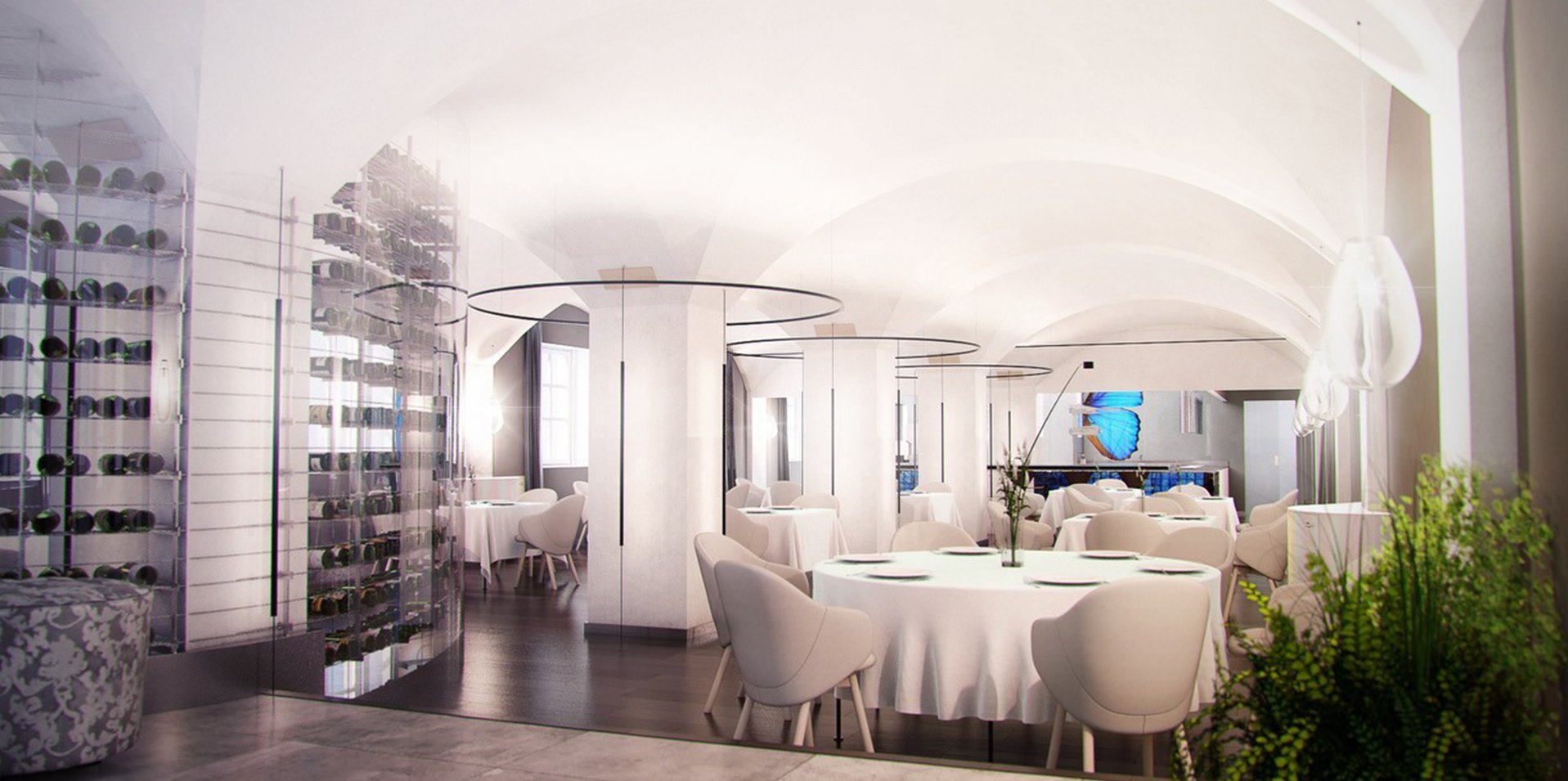
A Vaulted Ceiling Where Horses Once Stood
The shift from agricultural outbuilding to serious dining room is one Central Europe does with particular confidence, and Papilio in Vysoký Újezd u Berouna is among the more compelling examples. The space occupies what was once the stables of the local château, and the architecture makes the history legible: a high groin-vaulted ceiling, whitewashed throughout, creates a room that reads as both austere and considered. There is no decorative noise here. The proportions do the work. For anyone accustomed to the cellar-restaurant idiom common across Bohemia, the vertical drama of the vault offers a different register entirely, closer to a chapel than a wine bar.
Vysoký Újezd sits in the Beroun district west of Prague, a short drive from the city but far enough removed to feel like a deliberate choice rather than an overflow option. The village setting frames the restaurant's sourcing philosophy directly: this is not a city kitchen reaching outward toward regional identity as a trend signal, but a kitchen operating inside the region it draws from. That positioning shapes everything about how the food arrives and what it asks of the diner.
Tasting Menu Architecture and What It Signals
The contemporary Czech fine-dining scene has largely converged on the tasting menu as its dominant format, and within that consensus a meaningful split has emerged between kitchens that use the format as a vehicle for technique-led abstraction and those that anchor it in ingredient provenance and personal food memory. Papilio sits clearly in the second category. The menu at dinner runs to six, eight, or ten courses, with a six-course option available at lunch. That range is itself a signal: the kitchen is not insisting on a single canonical experience but calibrating to occasion and appetite.
Chef Jan Knedla's menu draws on childhood reference points and regional Czech ingredients, a pairing that places it in a tradition of Central European cooking that values the familiar made precise rather than the novel made theatrical. Dishes are presented in a modern and creative style, but the underlying logic is one of recognition: flavours that carry regional memory, rendered with the clarity that only careful sourcing and technique can achieve. This is a different ambition from, say, La Degustation Bohême Bourgeoise in Prague, which works through a historical reconstruction of Bohemian bourgeois cuisine. Papilio's reference is biographical and geographic rather than archival.
Where the Ingredients Come From and Why That Frame Matters
The sourcing angle at a restaurant like Papilio is not incidental decoration. Regional ingredient cooking in Bohemia has a specific geography: the forests and river valleys of the Beroun district, game and freshwater fish from Central Bohemia, dairy and grain from the surrounding agricultural land. A kitchen positioned physically inside this supply zone has a practical advantage over city restaurants claiming regional identity from thirty or fifty kilometres away. Proximity shortens the chain, and a shorter chain means ingredients that arrive at the counter with more of their character intact.
This is the same argument that makes village-restaurant formats compelling across Central Europe, from Moravia to rural Saxony. When the kitchen and the source landscape occupy the same postcode, the menu's seasonal honesty becomes verifiable rather than aspirational. What grows or is raised in the Beroun district in a given season is what appears on the plate, and the ten-course format at dinner gives the kitchen enough space to demonstrate that logic across multiple ingredient categories rather than flattening it into a few headline dishes.
For readers exploring similar approaches elsewhere in the Czech Republic, kitchens such as Babiččina zahrada in Průhonice, Chapelle in Písek, and Entrée in Olomouc each represent different regional anchors within the same national movement toward ingredient-led, place-specific fine dining. Bohém in Litomyšl and Goldie in Tábor extend the conversation into smaller Bohemian towns where the format has taken root outside the Prague orbit.
Service, Wine, and the Non-Alcoholic Option
The service model at Papilio follows a format now common in ambitious European tasting-menu kitchens: the chefs themselves bring the dishes to the table and explain the thinking behind each course. This removes the interpretive layer of a separate front-of-house team and creates a more direct line between the kitchen's intentions and the diner's understanding. It also keeps the room's register intimate rather than ceremonial, which suits both the converted-stable space and the biographical register of the food.
The wine list is well-stocked and presented with evident knowledge. The offer extends to wine by the glass, both domestic and international, and the tea experience as a non-alcoholic pairing is a considered alternative rather than a token concession. In a category where wine pairings often represent the path of least resistance, the tea option signals a kitchen thinking carefully about the full range of its guests. For diners interested in how other Czech restaurants in smaller cities handle the beverage pairing question, ATELIER bar & bistro in Brno and ARRIGŌ in Děčín offer points of comparison across different regional settings.
Chef's Table seats provide direct sightlines into the open kitchen, adding a layer of observation to the meal that appeals to those interested in watching the mise en place behind the courses as they arrive. In summer, a terrace extends the operation outdoors, offering a materially different atmosphere while the menu format remains consistent.
Recognition and Where It Sits
Papilio received 77 points in the 2026 La Liste rankings, placing it among the recognised addresses in the Czech Republic outside Prague. La Liste aggregates critical and guide sources into a single score, and 77 points positions Papilio in a tier that signals consistent quality without the saturation of a city flagship. For a restaurant operating in a village setting in Bohemia, that recognition matters as a practical orientation tool for travellers considering the journey from Prague or Beroun. Other Czech addresses with La Liste recognition at comparable or higher levels include Cattaleya in Čeladná and ESSENS in Hlohovec, both of which operate in non-urban settings and share the village-fine-dining format logic.
For international reference points on what kitchen-served tasting menus in intimate, heritage spaces can achieve at the highest level, Atomix in New York City and Le Bernardin in New York City represent the format's outer range, though the register and ambition are different from Papilio's regional anchoring. Dvůr Perlová voda in Budyně nad Ohří offers a closer Czech parallel in the château-adjacent dining category.
Planning a Visit
Papilio is located at Tyršova náves 1 in Vysoký Újezd u Berouna, roughly thirty kilometres southwest of central Prague by road. The village is accessible by car; the address is the kind of destination that rewards planning rather than impulse, and booking in advance is the practical approach given the limited-seat format implied by the Chef's Table offering and intimate room. Lunch offers the six-course format and typically runs at a shorter duration than dinner, making it a viable option for those combining the meal with broader Beroun district travel. The summer terrace changes the atmosphere considerably; winter dining in the vaulted interior is the defining spatial experience. For further context on the area's dining, hotels, bars, and other options, see our full Vysoký Újezd u Berouna restaurants guide, our full Vysoký Újezd u Berouna hotels guide, our full Vysoký Újezd u Berouna bars guide, our full Vysoký Újezd u Berouna wineries guide, and our full Vysoký Újezd u Berouna experiences guide.
Frequently Asked Questions
Is Papilio okay with children?
The tasting menu format, intimate room, and the price tier associated with a La Liste-recognised restaurant in the Czech Republic make Papilio a poor fit for young children; it is a better choice for older teenagers comfortable with a multi-course, extended-sitting format.
What should I expect atmosphere-wise at Papilio?
The room is a converted château stable in a Beroun district village, dressed entirely in white with a high groin-vaulted ceiling. The tone is calm and considered rather than theatrical. Among Czech fine-dining addresses recognised by La Liste, the setting is more architecturally distinctive than most city-centre competitors, and the absence of urban background noise gives the room a stillness that defines the meal's pace.
What dish is Papilio famous for?
No single signature dish is documented in the public record, which is consistent with a tasting-menu kitchen where the menu changes with the season and the regional ingredient supply. The La Liste citation and chef Jan Knedla's approach point toward dishes rooted in Bohemian regional produce and childhood food memory, presented in a modern style; the format is the vehicle, not any fixed plate.
Need a table?
Our members enjoy priority alerts and concierge-led booking support for the world's most difficult tables.
Access the Concierge