
Hiroshima okonomiyaki is a ritual of layering, timing, and griddle discipline, and Okonomiyaki Hasshou sits firmly inside that tradition. The Noboricho counter-and-table room has Tabelog 100 Okonomiyaki selections across multiple years, including 2025, making it a serious stop for readers tracing the city’s defining everyday dish rather than a formal dining occasion.
Pearl is the En Primeur Club membership app — saves, bookings, and concierge access live there. Same editors, same standards.
- Address
- 14-17 Noboricho, Naka Ward, Hiroshima, 730-0016, Japan
- Phone
- +81 82-224-4577
- Website
- tabelog.com
 Saves & bookings on Pearl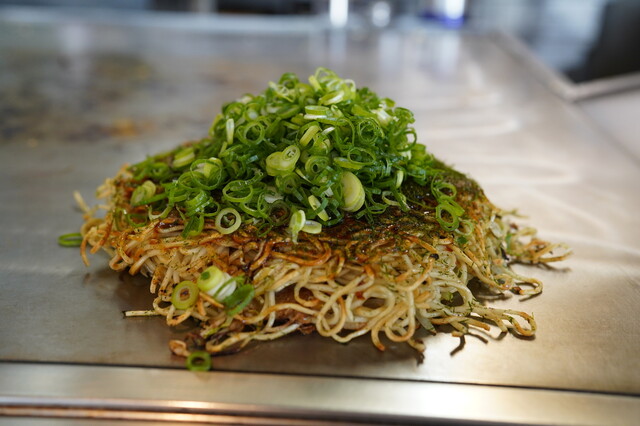
The room announces its priorities quickly: iron griddle, counter seats, tables, and the compact choreography of Hiroshima-style okonomiyaki being built in front of diners. This is not the theatrical quiet of a tasting-menu counter. It belongs to a more democratic dining tradition, where batter, cabbage, noodles, egg, and sauce become a city grammar, and the pace is set by the hotplate rather than by courses.
Hiroshima’s version of okonomiyaki is not just a regional variation on Osaka’s mixed-batter pancake. It is a layered construction, usually assembled in sequence rather than folded into a single batter from the start. That distinction matters because the meal’s pleasure is partly procedural: watching ingredients move from separate components into a compressed, griddled whole. Okonomiyaki Hasshou works within that local vocabulary, and its repeated Tabelog 100 Okonomiyaki selections, including 2025, place it among the city’s recognized addresses for the form.
Hiroshima okonomiyaki as a griddle ritual, not a casual snack
The point of eating okonomiyaki in Hiroshima is not only fullness, though the dish is built for it. The point is the rhythm: order, wait, watch, receive, eat while the surface heat is doing its last work. Counter seating sharpens that rhythm because the griddle is part of the dining room, not hidden behind a kitchen wall. Tables soften the experience for groups, but the format remains rooted in proximity to the plate and the cook’s timing.
Okonomiyaki Hasshou has 32 seats, split between 12 counter seats and 20 table seats, which puts it in the small urban restaurant category rather than the large tourist-hall format that visitors often encounter around station-adjacent dining floors. That scale suits the dish. Hiroshima okonomiyaki loses some of its logic when treated as mass throughput; it is better understood as a short, focused meal with a narrow purpose.
The price tier also says something about the tradition. In a city where serious dinner can run far higher, especially at yakitori and izakaya counters such as Tori Yamamoto in the JPY 10,000 to JPY 14,999 range, okonomiyaki remains one of Hiroshima’s great equalizers. It is local, filling, technically specific, and still accessible. Kushi Dokoro Dochu occupies a different mid-evening bracket, while okonomiyaki answers another question entirely: where does the city’s everyday cooking become worth seeking out with the same intent usually reserved for higher-priced rooms?
Why recognition matters in a city full of okonomiyaki
Hiroshima has enough okonomiyaki shops that choice can become noise. Awards and guide selections are useful here because the category is crowded, informal, and easy for visitors to flatten into novelty. A Tabelog 100 Okonomiyaki listing does not turn the meal into luxury dining; it signals consistency and local category strength inside a field where many addresses look similar from the outside.
That distinction is important for travelers building a Hiroshima food itinerary. A meal here should not replace the city’s broader dining range; it should anchor it. The contrast is the point. Creative cooking at Akai, European-rooted bakery culture at ANDERSEN, sake-led dining at Bishu Bikou Hamai, and old-school sweets at Butter Cake no Nagasaki Do all map different parts of the city’s appetite. CHILAN adds another register. Okonomiyaki sits apart because it is simultaneously regional identity, lunch, dinner, and performance of technique.
For readers comparing Hiroshima with other Japanese food cities, the lesson is useful: not every essential meal is expensive, rarefied, or reservation-led. Some meals matter because they reveal how a city eats when it is not trying to impress anyone. That is why this category belongs beside broader planning resources such as our full Hiroshima restaurants guide, rather than being treated as a side note between temple visits and hotel check-ins.
How to fit it into a Hiroshima itinerary
The Noboricho address places the restaurant in central Hiroshima, close enough to fold into a day built around the city core rather than a separate excursion. The nearest tram access is Kanayama Cho, which makes the meal easier to schedule around sightseeing, shopping, or an afternoon reset. The restaurant has no private rooms, so the experience is public and functional in the Japanese casual-dining sense: arrive ready for a focused meal, not a long private occasion.
The planning logic is simple. Use this as a compact meal in the middle of the day or before an early evening, then let the rest of the itinerary carry a different tone. Hiroshima rewards that kind of sequencing. Readers pairing food with lodging can cross-check our full Hiroshima hotels guide; those continuing into drinking routes can use our full Hiroshima bars guide. For broader regional planning, our full Hiroshima wineries guide and our full Hiroshima experiences guide help frame the city beyond a single meal.
Travelers building a Japan-wide food map may find the comparison useful. The appeal here is different from the beef-centered set meal format at -Grilled beef Sukiyaki- KAMAKURA TANUKIAN 鎌倉 たぬき庵 in Kamakura, the charcoal-and-tuna register of. 鮪と炭火焼き うお炭 秋葉原店 in Tokyo, or the café rhythm of.cafe in Osaka. It also differs from the casual specificity of.know in Kumamoto, (Shoku) Vietnam in Kawasaki, [Curry Senmon Ten] Maruyama Kyoju. in Sapporo, Jōdo Saké Bar in Los Angeles, and Onigiri Time in Pasadena. Hiroshima okonomiyaki is narrower, more codified, and more tied to place.
The editorial case for Okonomiyaki Hasshou is therefore not that it offers formality or spectacle. It offers a clear reading of a Hiroshima dining ritual at a recognized address, with a room scaled for direct contact with the griddle and a category that remains central to the city’s food identity. For a traveler trying to understand Hiroshima through eating, that is a more useful proposition than another generic upscale dinner.
Style and Standing
Side-by-side context: comparable cuisine and price.
| Venue | Cuisine | Price | Notes |
|---|---|---|---|
| Okonomiyaki Hasshou | Hiroshima-style Okonomiyaki | $ | Naka |
| Itsukaichi Hassho | Hiroshima-style Okonomiyaki | $ | Saeki |
| Yagenbori Hassho | Hiroshima-style okonomiyaki | $ | Naka |
| Ganso Hassho | Hiroshima-style okonomiyaki counter | $ | Naka |
| Denko Sekka (電光石火) | Hiroshima-style Okonomiyaki | $$ | Hiroshima Station area |
| Soraya | Japanese Standing Bar | $$ | Naka |
Recognition history
Dated appearances from independent guides and award organizations, with the underlying list record or original source where available.
Tabelog 100 #85 · No. 85
Tabelog · Tabelog 100 - Okonomiyaki - 2025
At a Glance
- Lively
- Cozy
- Well Known
- Energetic
- Casual Hangout
- Group Dining
- Solo
- After Work
- Open Kitchen
- Chefs Counter
- Standalone
- Beer Program
Current opening hours
- Monday
- Closed
- Tuesday
- Closed
- Wednesday
- 10 AM–5 PM
- Thursday
- 10 AM–5 PM
- Friday
- 10 AM–5 PM
- Saturday
- 10 AM–5 PM
- Sunday
- 10 AM–5 PM
Hours can change for holidays and private events. Last verified .
Busy, no-frills Hiroshima okonomiyaki joint with counter seats facing the hot teppan and a few simple tables, bright and compact, busy with conversation and the sound and smell of okonomiyaki being cooked in front of guests.