
At the foot of Grignan's château, Le Clair de la Plume holds a Michelin star (2024) and frames the produce of Provence and the Drôme through three tasting menus, including one built entirely on plants. Chef Benjamin Reilhes anchors the cooking in Nyons olive oil, Drôme guinea fowl, and seasonal vegetables, while Rhône Valley wines carry the pairing logic from first course to the pastry team's季節-driven desserts.
 Discover on Pearl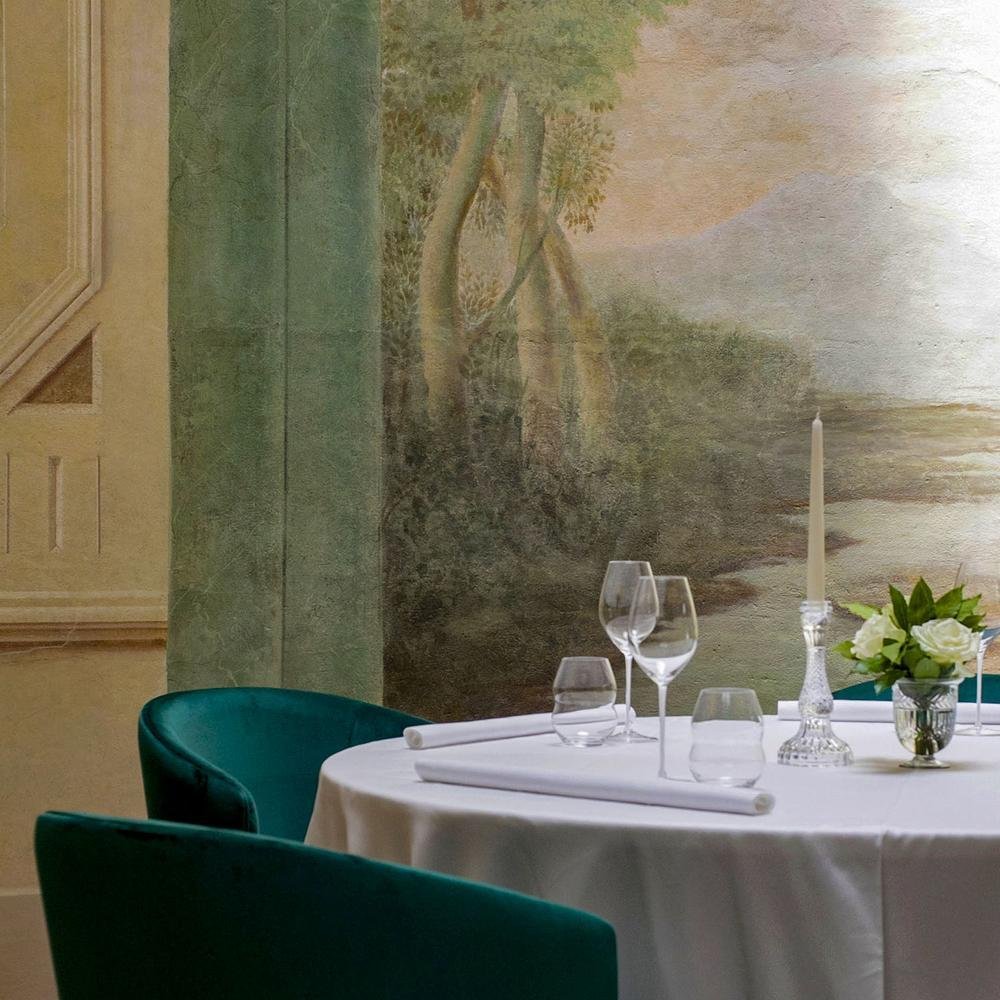
The Setting Before the First Course
Grignan is a village that announces itself from the plain below: the château rises above terracotta rooftops on a limestone bluff, visible for kilometres before the road begins to climb. Le Clair de la Plume occupies a position at the château's foot, on the Place du Mail, where the town exhales into a shaded square. The physical context matters here because it shapes the entire logic of the meal. Guests arriving from Montélimar to the north, or from the lavender plateau of the Drôme Provençale, step directly from one of the more atmospheric market towns in the southern Rhône corridor into a dining room where that landscape's ingredients are the main event. This is not a restaurant that happens to be in the countryside; it is a restaurant whose cooking only makes full sense because of where it sits.
The château above has its own literary weight. Madame de Sévigné, the seventeenth-century letter-writer whose correspondence remains a primary document of French aristocratic life, was a frequent guest there. That cultural inheritance gives the dining ritual at Le Clair de la Plume a particular kind of gravitas, the sense that hospitality in this corner of Provence has been practised seriously for several centuries. The restaurant wears that association lightly, but it informs the register of the service: unhurried, precise, rooted in the assumption that a meal here is worth the time it takes.
The shortlist, unlocked.
Hard-to-book tables, cellar releases, and concierge-planned trips.
Get Exclusive Access →The Architecture of the Meal
The tasting menu format is now the dominant language of Michelin-starred dining across France, from Alléno Paris au Pavillon Ledoyen in Paris at the leading of the points table to regional one-star houses in the Drôme. What differentiates kitchens at this tier is not the format itself but what the format is used to argue. At Le Clair de la Plume, the argument is geographical: three tasting menus, each structured around several courses, with the produce of the immediate region as the organising principle. Olive oil from Nyons, roughly fifteen kilometres to the west, guinea fowl and vegetables from the Drôme, Rhône Valley wines drawn from a corridor that runs from Crozes-Hermitage in the north down through Vinsobres and Grignan-les-Adhémar to the south.
One of the three menus is built entirely on plant sources. That is not a new concept in French fine dining — Michel Bras in Laguiole built a reputation around the gargouillou of wild herbs decades before plant-forward menus became category-wide — but in the southern Drôme, where the summer growing season is long and the market gardens of the Rhône plain are exceptionally productive, it represents a genuine commitment to the territory rather than a menu design exercise. The Bras in Laguiole lineage is worth holding in mind when thinking about what it means for a regional French kitchen to construct an entire experience around plant matter at this level of technique.
The pacing of a multi-course tasting menu carries its own etiquette, particularly in a setting like this. Grignan is not a city where guests are turning tables for a second service. The meal is the evening. That changes the internal rhythm: courses arrive at intervals that allow conversation to develop, the wine programme to be properly considered, and the progression of the menu to register as a sequence rather than a succession of plates. Chef Benjamin Reilhes works within that logic, with Nyons olive oil and Drôme produce structuring the savoury arc, and pastry chef Cédric Perret closing the sequence with desserts calibrated to the season and distinguished, according to the Michelin citation, by an original and striking visual flourish.
Provençal Tasting Menus in Regional Context
The Michelin star awarded in 2024 places Le Clair de la Plume in a specific and relatively small peer set: single-star houses in the southern Rhône and Provence corridor operating the full tasting menu format in small-town or village settings. The comparison points are not the large city kitchens , not AM par Alexandre Mazzia in Marseille, not Mirazur in Menton, whose Mediterranean edge and international reputation place it in a different competitive category entirely , but rather the smaller regional houses that have built a case for dining in the countryside as a destination in itself.
Within Grignan specifically, the dining options spread across a clear price and ambition spectrum. Le Bistro Chapouton and Le Poème de Grignan both operate modern cuisine at the €€ tier, offering accessible entry points to the town's food culture. La Table des Délices covers Provençal cooking at a similar price point. Le Clair de la Plume occupies the €€€€ bracket, which in a village of this scale positions it as a deliberate destination meal rather than a casual dinner , the kind of booking that anchors an overnight stay or a longer visit to the Drôme Provençale.
The Rhône Valley wine framing is worth attention. The Grignan-les-Adhémar appellation, which covers the hills and plateau immediately surrounding the village, produces Grenache-dominant reds and some whites that have historically sat in the shadow of Gigondas and Châteauneuf-du-Pape to the south. A kitchen that draws its wine programme from this corridor, pairing regional produce with regional bottles, is making a coherent geographical argument that runs from the olive press to the glass. Guests familiar with northern Rhône references , Crozes-Hermitage Syrah, Saint-Joseph, the occasional Condrieu , will find the valley's range well represented if the programme follows the regional sourcing logic applied to the food. For a broader overview of what the appellation produces, see our full Grignan wineries guide.
How to Plan the Visit
Le Clair de la Plume is at 2 Place du Mail, at the base of the château hill, which means it is walkable from any accommodation in the village centre. For guests arriving by car, Grignan sits roughly equidistant between Montélimar (TGV connections to Paris and Lyon) and Pierrelatte to the southeast. The A7 motorway provides the main access from the north; from the south, the D133 through the Tricastin plateau is the more direct approach. Booking at this price tier in a village with limited table count warrants planning ahead, particularly across the summer lavender season when the Drôme Provençale draws visitors from across Europe. The €€€€ price range and tasting menu format suggest an evening commitment of two to three hours minimum; this is not a meal to schedule before another engagement.
Guests building a longer programme around the meal will find the rest of Grignan's dining, drinking, and hotel offer mapped in our full Grignan restaurants guide, our full Grignan hotels guide, and our full Grignan bars guide. For context on what else the region offers beyond the table, our full Grignan experiences guide covers the wider options. For travellers building a broader circuit of French regional fine dining, the range runs from Flocons de Sel in Megève and Troisgros - Le Bois sans Feuilles in Ouches in the east and centre, to Auberge de l'Ill in Illhaeusern in Alsace, and internationally to Frantzén in Stockholm and FZN by Björn Frantzén in Dubai for those mapping tasting menu formats across geographies. The Paul Bocuse - L'Auberge du Pont de Collonges in Collonges-au-Mont-d'Or remains the canonical reference for understanding what French regional fine dining has meant historically; Le Clair de la Plume operates in a different register, but it belongs to the same tradition of kitchen and territory as a single argument.
Frequently Asked Questions
- What is Le Clair de la Plume known for?
- Le Clair de la Plume holds a Michelin star (2024) and is known for tasting menus built around the produce of the Drôme and Provence: Nyons olive oil, Drôme guinea fowl, seasonal vegetables, and Rhône Valley wines. The restaurant sits at the foot of Grignan's château and is the most formally ambitious dining option in the village. Chef Benjamin Reilhes leads the kitchen; pastry chef Cédric Perret handles desserts, which the Michelin guide notes for their seasonal calibration and visual originality.
- What should I order at Le Clair de la Plume?
- The kitchen operates on tasting menus rather than à la carte, so the ordering decision is which of the three menus to take. One menu is built entirely on plant sources, making it the reference choice for guests focused on vegetables and Drôme produce. The other menus incorporate guinea fowl and broader protein sources from the region. Given pastry chef Cédric Perret's noted work, staying through the full dessert sequence is part of the meal's logic rather than an optional extra. Rhône Valley wines are the natural pairing anchor throughout.
Cuisine Lens
A fast peer set for context, pulled from similar venues in our database.
| Venue | Cuisine | Awards | Notes |
|---|---|---|---|
| Le Clair de la Plume | Modern Cuisine | Michelin 1 Star | This venue |
| La Table des Délices | Provençal | Provençal, €€ | |
| Le Bistro Chapouton | Modern Cuisine | Modern Cuisine, €€ | |
| Le Poème de Grignan | Modern Cuisine | Modern Cuisine, €€ |
Need a table?
Our members enjoy priority alerts and concierge-led booking support for the world's most difficult tables.
Get Exclusive AccessThe shortlist, unlocked.
Hard-to-book tables, cellar releases, and concierge-planned trips.
Get Exclusive Access →