
On a quiet Uptown block well removed from the French Quarter's noise, Gautreau's has held its position as one of New Orleans' most trusted neighbourhood dining rooms for decades. Under Chef Baruch Rabasa, the New American kitchen earns consistent recognition from Opinionated About Dining, serving a tightly edited menu Tuesday through Saturday to a room that skews local and returning.
The Uptown Address That Locals Keep to Themselves
Soniat Street in the Uptown neighbourhood has none of the performative energy that defines dining in the French Quarter or the Lower Garden District. The houses are large and set back from the pavement, the traffic is residential, and the restaurants are few. Gautreau's sits in a converted pharmacy on that street, its entrance unmarked enough that first-time visitors occasionally walk past it. That low-profile physical presence is not an accident — it maps directly onto how the restaurant has operated for decades: as a neighbourhood institution that earns its regulars through consistency rather than spectacle.
New Orleans dining has always had a split identity. The city's most celebrated rooms — Emeril's, Commander's Palace, the tourist-facing Creole establishments of the Quarter , operate with a degree of showmanship built into their DNA. The Uptown tier, by contrast, tends toward the quieter end of the register. Bayona on Dauphine, Coquette on Magazine: these are restaurants where the room works without demanding your attention, where the food carries the evening. Gautreau's belongs to that cohort, and has done so for long enough that it has become part of the neighbourhood's sense of itself.
What the Room Does and Doesn't Do
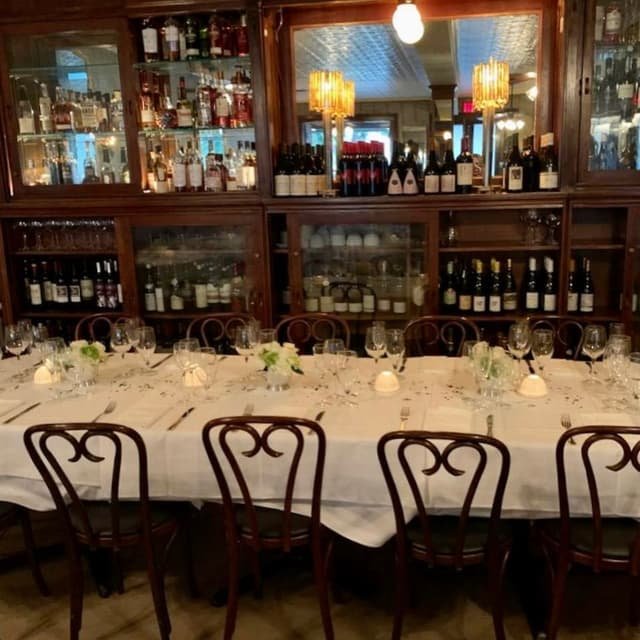
The dining room inside the old pharmacy retains its original tin ceiling, an architectural detail that gives the space genuine age without making it feel staged. The room is not large, and the tables are close enough that the ambient conversation becomes part of the atmosphere. This physical intimacy is a feature of the Uptown dining-room model , it creates a social texture closer to a well-run bistro than a formal destination restaurant. The result, on a busy Thursday night, is a room that reads as full and alive without being loud in the way the Quarter's more tourist-facing operations tend to be.
Service at this level of the New Orleans market tends to be knowledgeable and direct. The regulars here are not tourists working through a city checklist; they are the kind of diners who have a preferred table, who know what they want before they sit down, and who will notice if the kitchen is off its usual pace. That accountability keeps the standard high in ways that recognition from outside the city sometimes cannot.
New American in a Creole City
The New American label carries different freight in New Orleans than it does in cities without a defined local culinary tradition. In New York or San Francisco, New American is simply the working category for ambitious contemporary cooking. In New Orleans, it sits alongside and in dialogue with Creole and Cajun traditions that carry enormous civic weight. A restaurant like Gautreau's, operating within the New American idiom under Chef Baruch Rabasa, is making a particular set of choices about what to cook and for whom.
Those choices tend to read as sophisticated restraint rather than fusion. The kitchen is not trying to out-Creole Commander's Palace or match the high-concept ambition of Saint-Germain at the leading of the contemporary tier. Its peer set is closer to Re Santi e Leoni in its commitment to a coherent seasonal menu executed with care, or to the mid-tier New American rooms that Opinionated About Dining tracks across the country as the working backbone of serious dining outside the starred-restaurant conversation.
That OAD recognition is worth reading carefully. A ranking of #592 on the Casual North America list in 2024, following a Recommended listing in 2023, positions Gautreau's in a competitive bracket that includes well over a thousand tracked restaurants. OAD draws its rankings from the dining records of experienced eaters rather than professional inspector visits, which means consistent, repeat-visit quality tends to register there in ways that one-night performances do not. A Google rating of 4.6 across 297 reviews tells a similar story: this is not a restaurant that peaks for special occasions and coasts the rest of the year.
The Regulars and What They Represent
The Uptown neighbourhood has a residential concentration of the kind of diner who eats out seriously and often. The area's proximity to Tulane and Loyola, its established professional households, and its distance from the Quarter's tourism economy produce a dining public with specific expectations. They want a kitchen that is cooking at a level commensurate with the price, a room that functions as a social space rather than a set piece, and a degree of familiarity with returning faces.
Gautreau's has served that audience long enough to carry a different kind of authority than a newer opening would. The reservation book reflects local loyalty more than it reflects inbound travel, which gives the kitchen a different kind of feedback loop. When the room is predominantly regulars, the standard of the cooking is tested against long-term memory rather than first impressions. Restaurants that survive that scrutiny over years tend to have a clarity of purpose that newer, more trend-conscious openings sometimes lack.
For context on how this model plays out at different price points and formats across the American dining scene, the EP Club guides to Craft in New York City and The Inn at Little Washington track similar dynamics in markets where the New American category has deep local roots. At the higher end of the national conversation, rooms like Le Bernardin, Alinea, The French Laundry, Lazy Bear, Single Thread Farm, and Providence define the upper register of contemporary American cooking. Gautreau's operates well below that altitude , and deliberately so. The Soniat Street model is neighbourhood anchor, not destination landmark, and its longevity suggests that is the harder thing to sustain.
Planning a Visit
Gautreau's opens Tuesday through Saturday, with sittings from 5:30 to 9:30 pm each evening. The restaurant is closed Sunday and Monday, which is standard for a kitchen running a tight operation without the weekend tourism peak that drives extended hours elsewhere. The Soniat Street address is in Uptown, a short drive or ride-share from the Garden District and approximately twenty minutes from the French Quarter depending on traffic. The room's capacity and the ratio of regulars to walk-ins mean advance reservations are advisable, particularly on Fridays and Saturdays. Dress tends to run smart-casual in keeping with the neighbourhood's tone.
For broader trip planning across the city, EP Club maintains full guides to New Orleans restaurants, New Orleans hotels, New Orleans bars, New Orleans wineries, and New Orleans experiences.
Frequently Asked Questions
- What's the leading thing to order at Gautreau's?
- The kitchen operates under Chef Baruch Rabasa within the New American idiom, which in practice means a seasonally adjusted menu rather than a fixed set of signatures. OAD's consistent recognition of the restaurant across 2023 and 2024 points to kitchen-wide reliability rather than individual dishes carrying the room, so the better strategy is to order according to what is freshest on the night. Ask the server what the kitchen is cooking with particular confidence on your visit , in a room this size with this level of regular trade, that question gets a useful answer.
Need a table?
Our members enjoy priority alerts and concierge-led booking support for the world's most difficult tables.
Access the Concierge