Delaware Delicacies Smoke House
Our verdict
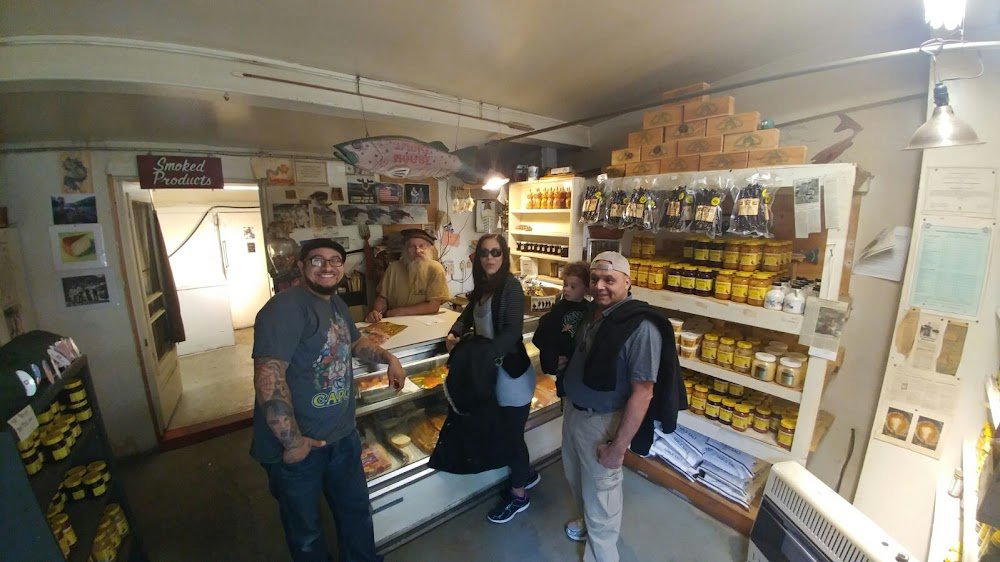
Delaware Delicacies Smoke House on Rhodes Road sits at the edge of the Catskills where serious smoke-house tradition meets the Delaware River valley's agricultural depth. Hancock, NY is far enough from the city to keep sourcing local and crowds thin. For anyone tracing American regional smoke traditions through the rural Northeast, this address is worth the drive.

Pearl is the En Primeur Club membership app — saves, bookings, and concierge access live there. Same editors, same standards.
The menu
What to order
- Smoked eel
- Smoked trout
- Smoked salmon
Where the Catskills Meet Smoke-House Tradition
The rural corridor between Hancock and the Delaware River valley represents one of the quieter arguments for ingredient-driven cooking in the American Northeast. Farmland runs along Route 97, small operations raising heritage livestock and producing dairy at a scale that never reaches the commodity supply chain. Delaware Delicacies Smoke House, at 420 Rhodes Road on the Hancock, NY side of that corridor, sits inside this agricultural context rather than outside looking in. The approach is not a concept or a marketing position — it reflects the geography. In towns this remote, sourcing locally is a condition of operation as much as a philosophy.
The smoke-house format has deep roots in American rural food culture, predating the barbecue-restaurant boom by generations. Traditional smoke houses processed meat for preservation first and flavor second, using whatever hardwood grew nearby. In the Delaware River watershed, that means second-growth forests dense with oak, hickory, and cherry — the same species that now appear in the vocabularies of high-end smoke programs at restaurants drawing national attention. What distinguishes operations like Delaware Delicacies from the urban barbecue wave is proximity: the gap between the animal, the wood, and the plate is measured in miles rather than supply-chain abstractions.
The Sourcing Argument in the Rural Northeast
Ingredient sourcing in American fine dining is frequently discussed at the level of menu copy, a farm name dropped into a tasting-course description at somewhere like Blue Hill at Stone Barns in Tarrytown or Single Thread Farm in Healdsburg. The sourcing conversation at a rural smoke house operates differently. There is no brigade kitchen reinterpreting local produce through a modernist lens; the ingredient is the technique, and the technique is the smoke. What the animal ate, how it was raised, and which wood carried the heat are the variables that determine the result. That directness is harder to fake at this scale.
The Delaware River valley has historically supported dairy, sheep, and small-scale pig operations, all of which translate well to smoke-house processing. Heritage breeds retain fat distribution and muscle density that commodity pork has largely lost, and those qualities show in longer smokes where intramuscular fat renders slowly rather than burning off. The same logic applies to the wood supply: locally sourced hardwood burns at consistent temperatures and carries regionally specific aromatic compounds. Operations in this part of New York and Pennsylvania benefit from a raw-material density that smoke programs in metro areas typically have to import. Restaurants like Smyth in Chicago and Lazy Bear in San Francisco have made sourcing central to their critical identities, in Hancock, it is simply the operating reality.
Reading Hancock on a Culinary Map
Hancock sits at the junction of the east and west branches of the Delaware River, a geography that historically made it a transit point rather than a destination. The population is small and the restaurant scene correspondingly thin. That scarcity changes the calculus for a smoke-house operation: there is no competitive cluster to define the category locally, which means the venue's identity is set more by its production method and sourcing network than by positioning against neighboring restaurants.
For comparison, places like Bacchanalia in Atlanta or Frasca Food and Wine in Boulder draw from dense urban food cultures and compete within well-defined peer sets. A smoke house in Hancock competes primarily with the decision not to drive two hours from the city at all. The draw is product specificity, the kind of smoked goods that require proximity to source material and the patience of low, slow production, neither of which a metropolitan operation can fully replicate. Closer urban analogues that prioritize sourcing integrity, such as Oyster Oyster in Washington, D.C. or The Wolf's Tailor in Denver, are making related arguments about regionality, but from within metro markets where the supply chain still involves logistics. In Hancock, the supply chain is shorter by design and by default.
The Case for Driving Out
American food culture has increasingly accommodated the idea of destination dining at non-metropolitan addresses. The model is well established at the highest price points: The French Laundry in Napa, The Inn at Little Washington, and Addison in San Diego all require travel as part of the proposition. Delaware Delicacies Smoke House operates at a different price register and a different level of formality, but the underlying logic is the same: the thing worth experiencing is not available closer to home, and the drive is part of the context.
From New York City, Hancock is approximately three hours by car. The route along Route 17 and into the Catskill foothills is not incidental, it frames the destination. Arriving at a smoke house on Rhodes Road after that drive places the product in its correct environment. The smoked goods here are not designed for a slick urban setting. They belong to the rural Northeast in the same way that a particular oyster belongs to its estuary. That locatedness is a quality that urban analogs at restaurants like Le Bernardin in New York City or Providence in Los Angeles consciously source toward but cannot fully internalize. Smoke-house production at this remove from urban markets is, by its nature, a regional artifact.
Visitors coming from the New York metro area or from Pennsylvania via Binghamton should plan the visit as a day trip or pair it with time in the Delaware River valley. The surrounding area supports fishing, hiking, and a broader Catskills food trail that includes farmstands and small producers whose output rarely reaches urban retail. Our full Hancock restaurants guide maps the broader eating options in the area for those building a longer itinerary.
Placing Delaware Delicacies in a Wider Tradition
American smoke-house tradition predates the barbecue restaurant category by at least two centuries. Preservation-focused smoking, the curing and cold-smoking of fish, pork, and poultry, was a practical response to the absence of refrigeration, not a culinary statement. The flavor intensity that resulted was a byproduct of the process. Smoke houses in the Catskills and Hudson Valley regions continued this tradition well into the twentieth century, processing locally raised animals for communities that had no access to large commercial meatpacking. Delaware Delicacies operates within that tradition, at an address that connects it to this history more directly than any urban smoke-focused restaurant could claim. Venues like Emeril's in New Orleans or ITAMAE in Miami make equally specific regional arguments, but through formal restaurant formats that curate and interpret their source traditions. A smoke house in Hancock is the tradition, less mediated.
For those tracking where American food sourcing intersects with place-specific production, the same conversation that animates Atomix in New York City and Atelier Moessmer Norbert Niederkofler in Brunico at the other end of the formality scale, Delaware Delicacies Smoke House in Hancock, NY represents the stripped-down American version of that argument. No tasting menu, no sommelier, no press coverage. Just smoke, wood, and proximity to the source.
Practical Details
Frequently asked questions
Is Delaware Delicacies Smoke House a family-friendly restaurant?
The smoke-house format at 420 Rhodes Road, Hancock lends itself to a relaxed, unpretentious setting that typically suits families well. Rural roadside smoke houses in the Delaware River valley corridor tend to operate without formal dress codes or reservation-only policies, which generally makes them more accessible to groups with children.
What's the vibe at Delaware Delicacies Smoke House?
Located on Rhodes Road outside Hancock in Delaware County, this is a working smoke house rather than a polished dining room. Expect a functional, no-frills atmosphere shaped by the production process itself — the kind of place where the smell of wood smoke does more atmospheric work than interior design. It sits in a rural corridor that rewards visitors making a deliberate drive into the Catskills.
Is Delaware Delicacies Smoke House worth a special trip from New York City?
Hancock, NY sits roughly at the southern edge of the Catskills, positioning Delaware Delicacies Smoke House as a plausible anchor stop on a Delaware River valley drive from the metro area. The smoke-house category — preservation-focused, production-driven — is distinct from the broader barbecue restaurant scene and draws a different kind of visitor: one sourcing cured product rather than sitting down to a full service meal. Whether the detour pays off depends on what the current production calendar offers, which is worth confirming before departure.
What should I order at Delaware Delicacies Smoke House?
The smoke-house tradition in this part of the Delaware River valley has historically centred on preservation-focused products — smoked and cured proteins rather than a broad cooked menu. The name Delaware Delicacies signals a focus on finished, packaged, or counter-served smoked goods.
What's the address for Delaware Delicacies Smoke House?
Delaware Delicacies Smoke House is located at 420 Rhodes Rd, Hancock, NY 13783, Hancock.
At-a-Glance Comparison
Comparable venues nearby, for context on price, style, and recognition.
| Venue | Cuisine | Price | Awards | Notes |
|---|---|---|---|---|
| Delaware Delicacies Smoke HouseThis venue — the venue you are viewing | Smoked Eel and Local Fish | Not listed | Not listed | Not listed |
| Charles Pan-Fried Chicken - West Side | Pan-Fried Chicken & Soul Food | $10–20 | Eater 38 #2 | Upper West Side |
| The Cannibal Beer & Butcher | New American Gastropub | Not listed | Not listed | Murray Hill |
| Bar Hugo - Rooftop | Cocktail-focused American rooftop bar with upscale bar bites | $30–50 | Not listed | SoHo |
| District Tap House | American Gastropub | $20–30 | Not listed | Midtown-Times Square |
| Cafeteria | Modern American Comfort | $20–30 | Not listed | Chelsea-Hudson Yards |
Continue exploring
More in Hancock
Restaurants in Hancock
All restaurants in Hancock →
Hotels in Hancock
Browse all →
Wineries in Hancock
Browse all →
Details
- Rustic
- Cozy
- Casual Hangout
- Local Sourcing
- A La Carte
Current opening hours
- Monday
- 9 AM–5 PM
- Tuesday
- 9 AM–5 PM
- Wednesday
- 9 AM–5 PM
- Thursday
- 9 AM–5 PM
- Friday
- 9 AM–5 PM
- Saturday
- 9 AM–5 PM
- Sunday
- 9 AM–5 PM
Hours can change for holidays and private events. Last verified .
Rustic and secluded forest setting with a simple, hand-built wooden shack atmosphere.