



A 17th-century former convent on Fourvière Hill, Villa Florentine occupies the highest point of Vieux Lyon and holds a Michelin 1 Key alongside a Michelin-starred restaurant, Les Terrasses de Lyon. Twenty-nine individually styled rooms blend Italian modernist furniture with Renaissance reproductions across two connected historic buildings. Rates start from US$324 per night, positioning it at the top of Lyon's independent luxury hotel tier.
 Discover on Pearl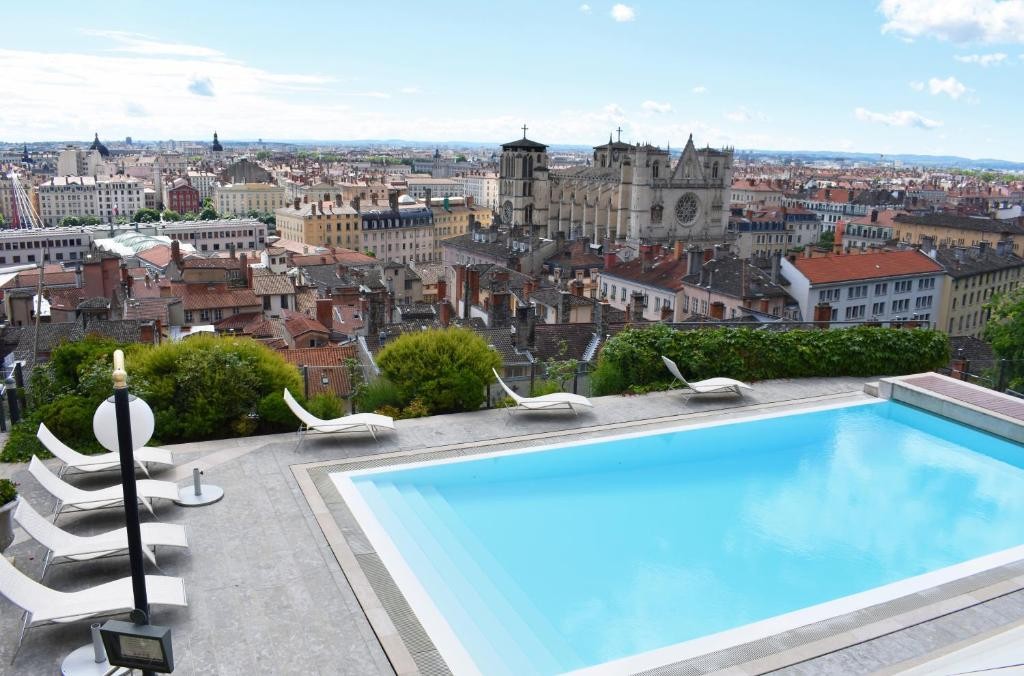
A Convent Above the City
Lyon's premium hotel tier divides, broadly, between grand civic addresses along the Presqu'île peninsula and smaller, character-driven properties anchored to the hillside districts. Villa Florentine belongs firmly to the second category. Positioned at the crest of Fourvière Hill, at the highest point of Vieux Lyon's UNESCO-listed historic quarter, it occupies a 17th-century former convent that looks across the terracotta and grey-slate roofline of one of France's most architecturally intact Renaissance cities. The approach alone, whether by the Fourvière funicular or on foot through the silk-merchant lanes of the old town, establishes a particular relationship between guest and place that flat-city hotels cannot replicate.
The building's Italianate exterior, finished in the warm cream and dusty pink tones associated with Florentine civic architecture, reads as a deliberate act of cultural positioning. Lyon's historic ties to Florence run deep: the city's 16th-century silk trade brought Italian merchants and artisans north, and their influence shaped both the architecture of Vieux Lyon and its approach to domestic refinement. The hotel's name is not incidental — it invokes that genealogy directly. For travellers already familiar with the design-led credentials of properties like Villa Maïa elsewhere in the city, Villa Florentine represents a different axis: where Villa Maïa leans into a contemporary idiom, this property leans into its own history.
The Architecture of a Stay
The property comprises two connected structures: one from the 17th century, one from the 15th, joined through a corridor galleria. That internal passage is more than a convenience — it functions as a compressed architectural timeline, moving the guest between building phases separated by two hundred years. The 29 rooms distributed across both structures are individually configured rather than replicated across a standard template. Some carry mezzanine levels; others open onto private terraces. Hardwood floors appear in some; beamed ceilings in others. The furniture mixes Italian modernist pieces with reproduction Renaissance objects and contemporary artworks, a combination that works better in practice than it might sound on paper because the rooms are large enough to absorb the contrast without feeling cluttered. The main building now includes five luxury apartments for longer stays or those requiring more lateral space.
In the context of French heritage hotels, this approach reflects a wider movement toward interiors that acknowledge their historic container without becoming museum reconstructions. Properties like Domaine Les Crayères in Reims and Baumanière Les Baux-de-Provence operate in comparable territory, where the building itself is part of the guest experience and the interior design serves to activate rather than override that context. At Villa Florentine, the most direct expression of this is the pool terrace, which sits at elevation with an unobstructed southward sightline across the city. It is, by most measurable criteria, the most dramatically positioned pool in Lyon.
Service at Elevation
In small luxury hotels of this scale, 29 rooms creates an inherent advantage: the ratio of staff attention to guests is structurally more generous than at a 150-room city property. What distinguishes Villa Florentine's service register is the absence of the performative formality that older French luxury properties sometimes mistake for sophistication. The model here tilts toward anticipatory attentiveness, the kind that produces a warm wrap at the terrace when the evening drops in temperature without a guest needing to ask. Smaller boutique hotels across Europe have, over the past decade, made this shift away from ceremonial distance toward calibrated presence, and properties that do it well, like La Reserve Ramatuelle or Grand-Hôtel du Cap-Ferrat, tend to generate the kind of guest loyalty that keeps a small-room property fully subscribed. Villa Florentine's 4.7 rating across 1,404 Google reviews suggests it has broadly landed on the right side of that calibration.
The Relais & Châteaux affiliation matters here as a service signal. Membership requires adherence to specific hospitality standards around welcome, personalisation, and physical presentation, which is why that portfolio, which also includes Villa La Coste and Les Sources de Caudalie, holds consistent weight as a trust indicator for guests booking a first visit without local knowledge. At Villa Florentine, Relais & Châteaux membership works in combination with the 2024 Michelin 1 Key designation and the 2025 Gault & Millau Exceptional Hotel award (5 points) to establish a multi-source credential stack that is relatively rare at this room count.
Les Terrasses de Lyon: Cuisine in Context
Lyon occupies a specific position in French culinary geography. As a city historically situated at the confluence of routes connecting Burgundy, the Rhône Valley, the Alps, and Provence, it accumulated both ingredient access and a cooking culture anchored to the bouchon tradition, the no-ceremony bistro format that turns seasonal produce and careful technique into something more than its components. The city's Michelin density per capita remains among the highest in France, and it maintains a reputation for ingredient primacy over conceptual elaboration.
Les Terrasses de Lyon, the hotel's Michelin-starred restaurant, sits within that tradition while operating at a price and setting point that places it above it. The dining room occupies the convent's original hall and extends onto the terrace, where the city spreads below. The kitchen's orientation is described as ingredient-focused, which in a Lyon context means alignment with the regional supply chains that have made the city's dining culture what it is: Bresse poultry, Rhône Valley produce, Saône river fish. For guests combining a Lyon stay with broader French regional travel, the restaurant provides a credible entry point into what Lyon's cooking tradition actually prioritises. Those extending the trip might also consider the dining credentials at Hôtel & Spa du Castellet or La Bastide de Gordes as part of a Provence extension.
For a complete picture of Lyon's dining options beyond the hotel, our full Lyon restaurants guide maps the city's Michelin-starred counters, bouchon institutions, and emerging addresses across all price tiers.
Lyon, Vieux Lyon, and Where This Hotel Sits in the City
Lyon's central geography matters to how visitors use a hotel here. The Presqu'île, the narrow peninsula between the Saône and Rhône rivers, contains the city's primary commercial and dining arteries. The 1st and 2nd arrondissements hold a concentration of wine bars, contemporary restaurants, and covered markets, including the Halles Paul Bocuse. Vieux Lyon, on the west bank of the Saône, is the UNESCO-listed Renaissance quarter, with the traboules (the covered passageways connecting courtyards through silk-weaver buildings) as its most distinctive physical feature. Fourvière Hill rises above Vieux Lyon, site of the Roman amphitheatres and the Basilica of Notre-Dame de Fourvière, whose ivory towers are visible from most of the city.
Villa Florentine's address at the leading of that hill places it at a slight remove from the Presqu'île's walking density, but the funicular connection makes the transit direct. Guests at Hôtel Le Royal or InterContinental Lyon - Hotel Dieu are closer to the Presqu'île on foot, but gain nothing in terms of the view or the architectural experience that the hilltop position at Villa Florentine provides. The trade-off between accessibility and setting is real, and depends on how a guest weights the evening terrace experience against walking distance to the morning market.
For a broader context on the city's hospitality options, see our full Lyon hotels guide, and for bars and wine-focused venues, our full Lyon bars guide and our full Lyon wineries guide cover the Rhône Valley connections in more detail. Our full Lyon experiences guide covers the Roman amphitheatres, silk museums, and cultural programming that sit closest to the hotel geographically.
Planning a Stay
Rates at Villa Florentine begin from US$324 per night (Gault & Millau 2025 pricing reference: US$423), positioning it at the upper end of Lyon's boutique hotel market. Bookings and enquiries go through the hotel directly at florentine@relaischateaux.com or by telephone at +33 (0)4 72 56 56 56, with full information at villaflorentine.com. The 29-room count means availability tightens during Lyon's trade fair calendar, the city hosts major international events in gastronomy, textiles, and industrial sectors, so lead times of six to eight weeks are advisable for peak periods. Guests who have stayed at comparable French properties such as Royal Champagne Hotel & Spa or Cheval Blanc Courchevel will find the service register familiar; those arriving from larger city-centre hotels may notice the difference in pace and attentiveness that the smaller format enables.
Frequently Asked Questions
Cuisine Context
These are the closest comparables we have in our database for quick context.
| Venue | Cuisine | Awards | Notes |
|---|---|---|---|
| Villa Florentine | Michelin 1 Key | This venue | |
| InterContinental Lyon - Hotel Dieu | |||
| Villa Maïa | Michelin 1 Key | Michelin 1 Key | |
| Hôtel Le Royal |
Preferential Rates?
Our members enjoy concierge-led booking support and priority upgrades at the world's finest hotels.
Get Exclusive Access