


Set behind a Georgian facade on a quiet Kent Street block in Millers Point, The Langham, Sydney occupies a different register from the harbour-front hotels that define most luxury comparisons in this city. With 96 rooms, a multicultural open-kitchen restaurant, a Chuan Day Spa drawing on traditional Chinese medicine, and what is reportedly Sydney's only hotel tennis court, it positions itself as a more contained, culturally layered alternative to the city's larger five-star properties.
 Discover on Pearl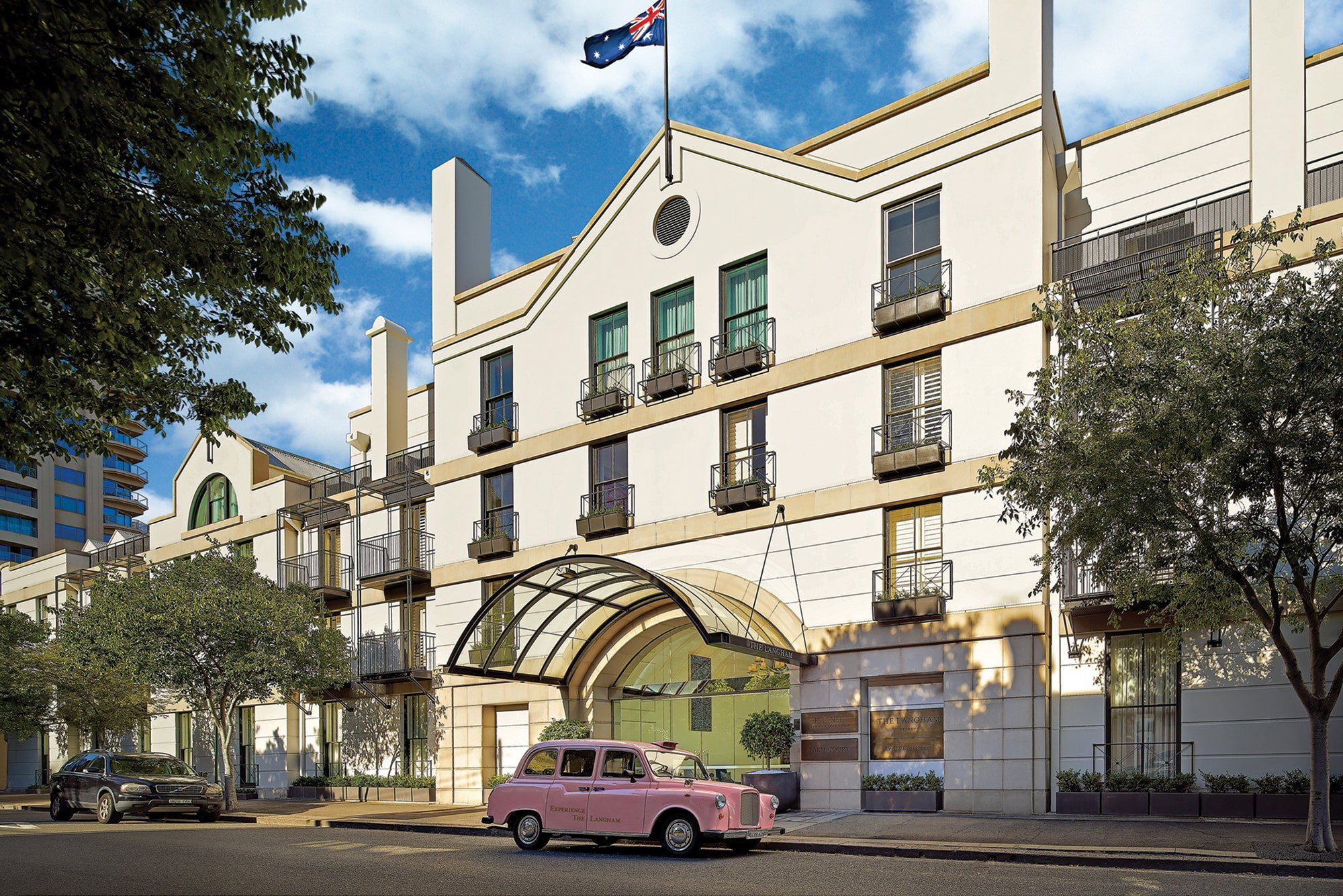
Where the Rocks District Places The Langham in Sydney's Hotel Hierarchy
Sydney's premium hotel tier splits, broadly, into two camps: the harbour-front properties that trade on water views and landmark adjacency, and a smaller cohort of historically grounded addresses that use neighbourhood density and architectural restraint as their value proposition. The Langham, Sydney belongs to the second group. On a quiet block at 89–113 Kent St in Millers Point, the hotel sits within the Rocks district, Sydney's oldest urban precinct, where nineteenth-century sandstone warehouses and Georgian streetscapes survive largely intact. That address removes the property from the constant churn of the Wharf redevelopment zone while keeping it within a ten-minute walk of Circular Quay, the Opera House, and the Museum of Contemporary Art Australia. The positioning is deliberate: proximity to the landmarks without being absorbed by them.
Compared to the scale and spectacle of neighbours like Crown Sydney or the harbour-view dominance of the Park Hyatt Sydney, The Langham operates on a more contained footprint. With just 96 rooms, it sits in a tier that prioritises space-per-guest over total room count, and that calculation shows in the accommodation itself. The entry-level guest rooms measure approximately 530 square feet, which the database notes as the largest basic-level rooms available in Sydney at that category. The signature Observatory Suite extends to around 1,310 square feet. These numbers matter in a city where even premium hotels frequently offer entry rooms under 400 square feet.
A Georgian Shell, a Multicultural Kitchen, and What That Combination Signals
The cultural context embedded in The Langham, Sydney is more layered than a typical heritage-conversion hotel. The stately Georgian exterior houses a food-and-beverage concept that reads as a deliberate inversion of that restraint: Kitchens on Kent operates with eight open kitchen stations, each serving a different multicultural cuisine. In Australian cities, the multicultural dining model reflects a broader demographic reality: Sydney draws substantial immigration from East and Southeast Asia, South Asia, and the Pacific, and its restaurant culture has absorbed those influences across every price tier. A hotel anchoring its main dining concept in that plurality is making a cultural statement as much as a commercial one.
The Globe Bar takes a different approach: cedar-paneled, furnished with velvet sofas and leather armchairs, it serves contemporary Australian fare in a setting that references the nineteenth-century club rooms that would have occupied buildings like this one. Together, Kitchens on Kent and the Globe Bar create an internal dialogue between Sydney's colonial architectural inheritance and its multicultural present, which is, arguably, the more honest way to represent this city than choosing one register and ignoring the other.
Afternoon Tea with Wedgwood continues the Langham group's signature practice across its global properties. The format includes signature scones, lamington (a specifically Australian reference in a programme that could have defaulted entirely to generic European pastry traditions), finger sandwiches, terrines, and caviar, served over Wedgwood premium teas or champagne. The inclusion of lamington is a small but deliberate act of localisation within a format that originated in Victorian England — the kind of detail that separates a considered programme from a template rolled out across a brand portfolio without adjustment.
The Chuan Spa and the Case for Traditional Chinese Medicine in a Sydney Context
Spa programming in premium Sydney hotels has largely defaulted to Balinese-inflected treatments or generic European skincare brands, which makes The Langham's choice of format notable by contrast. The Day Spa by Chuan draws its treatment philosophy from traditional Chinese medicine, specifically the concept of balancing the five elements. Products come from Babor (German), Aromatherapy Associates (British), and Ikou (Australian-based), a sourcing mix that reflects both the Chuan brand's Chinese heritage and the property's Pacific-facing context. In a city with a large Chinese-Australian community and significant inbound travel from Greater China, anchoring the spa in TCM principles carries more cultural coherence here than it might in, say, a Langham property in a European capital.
The fitness offering adds a detail that is genuinely rare at this address tier: a tennis court. The database identifies it as the only hotel tennis court in Sydney proper, which, given the density of the CBD and the premium placed on any outdoor space in Millers Point, makes it a meaningful differentiator. The 20-metre heated indoor pool carries a different kind of distinction: the ceiling above it is fitted with an LED installation mapping the Southern Hemisphere night sky, a design choice that transforms an otherwise standard amenity into something specific to this latitude.
Room Configuration, Art Collection, and the Logic of the Corner Terrace
Rooms at The Langham, Sydney are configured with Parisian shutters that open either east toward the Sydney skyline or west toward the Anzac Bridge, and the orientation choice affects the visual register considerably. The corner rooms with terraces offer wrap-around balcony views of the Rocks district and the western harbour, which places them in a different visual category from the east-facing skyline rooms: less postcard-familiar, more architecturally specific to the precinct. For guests who have seen the Opera House from hotel rooms before, the western harbour angle can offer more genuinely new perspective.
The hotel's art collection draws on the Australian modernist tradition, with works from Brett Whiteley, Sidney Nolan, and Albert Tucker displayed in the public spaces. These are not decorative placeholders: all three artists occupy significant positions in twentieth-century Australian art history, and their presence signals a collection assembled with some curatorial intent rather than acquired for ambient effect. The Museum of Contemporary Art Australia sits approximately ten minutes away on foot, and the Art Gallery of NSW is reachable within thirty minutes, which gives the art-focused visitor a coherent itinerary that extends from the hotel's own walls outward.
Placing The Langham in the Wider Sydney Luxury Context
Sydney's premium hotel market offers genuine variation across style, scale, and location logic. Capella Sydney occupies a heritage-conversion building in the CBD with a design-led programme that targets a broadly similar guest profile. Four Seasons Hotel Sydney and InterContinental Sydney both operate at higher room counts and a more corporate-facing pitch. Crown Towers Sydney pushes into gaming-resort territory. Ace Hotel Sydney and Crystalbrook Albion address a younger, design-literate market. The Langham's 96-room count, Georgian address, and culturally specific programming (Chuan spa, TCM framework, Wedgwood afternoon tea with Australian adaptation) carve out a position that does not map neatly onto any of those alternatives. Its Google rating of 4.6 across 1,429 reviews suggests that the positioning lands with the guest profile it is targeting.
Rates from approximately $462 per night place the property in the upper-mid premium tier for Sydney — above the midmarket international chains but below the ultra-luxury waterfront outliers. Rooms with terraces carry a premium over the standard configuration, and advance planning is advisable for the afternoon tea programme, which is a known draw for both hotel guests and non-resident visitors. The Pampered Pets programme, with a dedicated pet room service menu and custom Langham beds, extends the hotel's offer to travelling guests with animals, a niche that few properties in this tier address with equivalent specificity.
For context across Australian properties, the format and cultural weight of The Langham, Sydney differs substantially from destination retreats like Southern Ocean Lodge in Kingscote or The Tasman in Hobart, and from the design-forward urban posture of The Calile in Brisbane or 1 Hotel Melbourne. Within its own category of historically anchored, mid-scale luxury in a major Australian capital, it operates with a degree of programme coherence that rewards the guest who engages with what it specifically offers rather than treating it as a generic five-star address.
Explore more about where The Langham sits in Sydney's hospitality offer through our full Sydney hotels guide, and map your stay against the city's dining and drinking scene via our full Sydney restaurants guide, our full Sydney bars guide, our full Sydney wineries guide, and our full Sydney experiences guide.
Frequently Asked Questions
The Minimal Set
A quick peer reference to anchor this venue in its category.
Preferential Rates?
Our members enjoy concierge-led booking support and priority upgrades at the world's finest hotels.
Get Exclusive Access