Secolario - Masseria del Viverbene

A Michelin Selected masseria in the Salento interior, Secolario occupies a restored trulli-and-farmhouse complex outside Palmariggi in Puglia's Grecìa Salentina. The property sits within the slower, land-facing tradition of agrarian hospitality that defines this corner of southern Italy, positioned as an alternative to the coast-facing resort circuit around Fasano and Otranto.
Pearl is the En Primeur Club membership app — saves, bookings, and concierge access live there. Same editors, same standards.
- Address
- località Alti Pareti, Palmariggi, Italy
- Phone
- +393758750934
 Saves & bookings on Pearl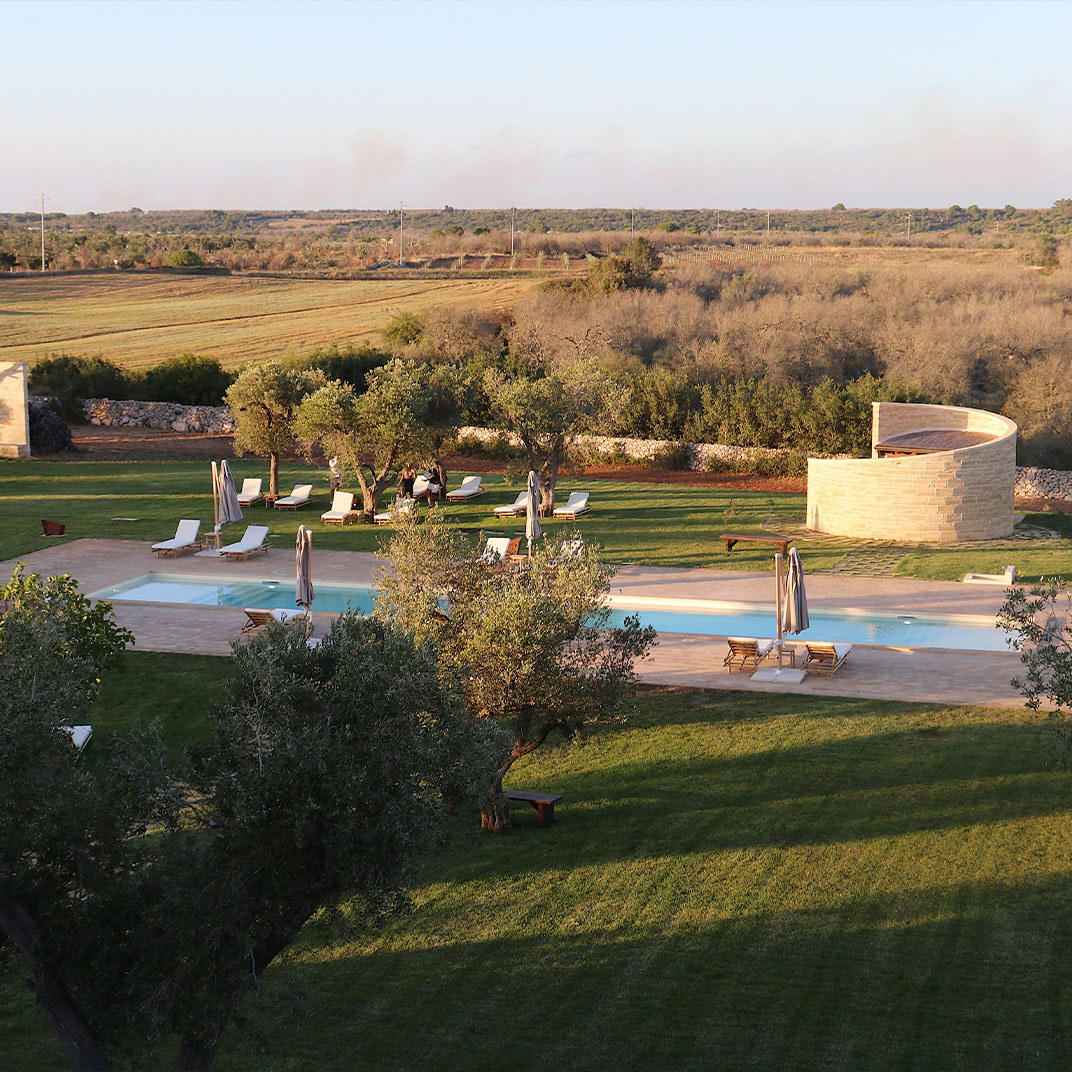
Stone, Silence, and the Architecture of the Salento Interior
The approach to Palmariggi from the Lecce–Otranto corridor passes through a sequence of low dry-stone walls, olive groves running in close parallel rows, and occasional outcroppings of pale limestone that give the Salento its particular quality of light. This is the Grecìa Salentina, a belt of villages in Puglia's deep south where Greek was still spoken in living memory and where the built environment has changed slowly enough that the distinction between agricultural structure and habitation remains deliberately blurred. Secolario – Masseria del Viverbene sits within that tradition, at località Alti Pareti on the edge of Palmariggi, as a restored masseria: the Puglian farm complex that historically combined olive press, livestock quarters, and family residence under a single fortified perimeter.
The masseria form is worth understanding before arriving. Unlike the agriturismo conversions common across Tuscany or Umbria, which tend to adapt farmhouses into rooms while preserving the original volume and plan, the Puglian masseria typically involves a more substantial reworking of heterogeneous structures: trulli, lamie (barrel-vaulted store rooms), and open cortile spaces that were never designed with guest comfort in mind. The design challenge is always the same: how much to intervene, how much to leave. Properties that overcorrect toward comfort produce something indistinguishable from a boutique hotel; those that under-intervene make the historical fabric the burden of every night's stay. Secolario's MICHELIN Selected status in the 2025 Hotels guide signals that the balance here lands credibly on the side of considered hospitality rather than either extreme.
Where Secolo Meets Salento: The Physical Language of the Property
Salento's vernacular architecture is built for thermal management, not aesthetics, though the two often coincide. Walls of pale carparo limestone, sometimes a metre thick, maintain interior temperatures well below the ambient heat of a Puglian August. Conic trulli roofs, corbelled in dry stone, create internal volumes that breathe differently from flat-roofed structures. Cortile spaces function as outdoor rooms rather than purely transitional zones. At a property like Secolario, each of these elements carries functional logic that a purely decorative renovation would undermine. The Michelin Hotels selection process, which evaluates properties across dimensions including character, quality of setting, and architectural integrity, implies that the physical language here has been respected rather than overwritten.
Grecìa Salentina context adds another layer. Palmariggi is a small comune with a population measured in hundreds, not the tourist-infrastructure density of the Adriatic coast around Otranto or the Ionian coast around Gallipoli. Reaching it requires intent: this is not a property you pass on the way to somewhere else. That geographic positioning shapes the experience before the gate opens. The comparative set includes Puglia's larger resort-scale properties such as Borgo Egnazia in Savelletri di Fasano, which operates at a completely different scale and coastal orientation, as well as smaller, design-led conversions that have proliferated across the region over the past decade. Secolario sits in the smaller-footprint, interior-facing cohort: properties where the surrounding agricultural landscape is genuinely part of the offer rather than a backdrop for pool photography.
The Puglia Interior vs. the Coastal Resort Circuit
Southern Italian hospitality has split along a fairly legible axis. On one side: the coast-facing, amenity-dense resort model, which runs from Amalfi (see Borgo Santandrea on the Amalfi Coast and Il San Pietro di Positano) through Capri (JK Place Capri) and down into Puglia's Adriatic strip. On the other: the agricultural estate model, which turns land productivity into atmosphere and trades beach access for olive groves, dry-stone walls, and a slower temporal rhythm. Secolario belongs to the second category in one of Italy's most intact rural interiors.
The Grecìa Salentina villages, including Palmariggi, Martano, Corigliano d'Otranto, and Sternatia, have attracted a specific type of traveller over the past decade: one more interested in the texture of Puglian daily life than in the poolside infrastructure of the coast. This pattern mirrors broader shifts visible across Italian rural hospitality, from Umbrian borghi like Corte della Maestà in Civita di Bagnoregio to Sienese wine-country estates such as Borgo San Felice in Castelnuovo Berardenga and Rosewood Castiglion Del Bosco near Montalcino. The common thread is an architectural identity rooted in productive landscape rather than scenic coastline, and a hospitality model where restoration credibility carries as much weight as thread-count.
Practical Orientation: Getting There and Timing a Stay
Palmariggi sits within the Lecce province, placing Brindisi and Lecce airports as the two most logical entry points. Brindisi handles the broader range of low-cost European carriers, while Lecce's smaller airport (Galatina, also known as Lecce–Galatina) offers shorter transfer times into the Grecìa Salentina. Either way, a car is not optional: the Salento interior has no meaningful public transport connecting its smaller comuni, and the masseria's address at località Alti Pareti, outside the village centre, makes self-drive the only realistic approach. This is consistent with the property type across this region.
Seasonally, the Salento interior operates on a different logic from the coast. August brings peak coastal crowding and high heat, but the masseria's thick-walled architecture handles temperature in a way that glass-and-concrete beach hotels cannot. Spring, from late April through June, and autumn, from September through October, offer one temperate conditions and the period when the olive groves are at their most active. For those comparing properties across Italy's north-south axis, the contrast with Passalacqua on Lake Como or Grand Hotel Tremezzo is sharp: where northern lake properties run their seasons around spring and early summer, southern Puglian estates extend meaningfully into October without significant weather risk.
Rates start at $254 per night.
At-a-Glance Comparison
Comparable venues nearby, for context on price, style, and recognition.
| Venue | Cuisine | Price | Notes |
|---|---|---|---|
| Secolario - Masseria del ViverbeneThis venue — the venue you are viewing | Restored historic Apulian masseria with contemporary updates preserving territorial memory and craftsmanship. | $$$$ | Not listed |
| Vigne di Fagnano 1709 Eco Relais | Restored 18th-century noble rural residence blending luxury comfort with historical authenticity. | $$$$ | Santo Stefano Belbo |
| Villa Bardini | Historic 17th-century villa with monumental gardens on a hillside overlooking Florence. | $$$$ | San Niccolo |
| AEON Hotel | Contemporary renovation of historic rustic manor with modern architectural volumes integrated into the landscape. | $$$$ | Soprabolzano |
| Felder Alpin Lodge | Restored 11th-century Alpine farmhouse with modern luxury | $$$$ | Villanders |
| Piazza di Spagna 9 | Boutique art gallery hotel in historic palazzo | $$$$ | Tridente |
Recognition history
Dated appearances from independent guides and award organizations, with the underlying list record or original source where available.
Michelin Selected
Michelin
At a Glance
- Romantic
- Rustic
- Quiet
- Elegant
- Scenic
- Intimate
- Cozy
- Romantic Getaway
- Honeymoon
- Wellness Retreat
- Weekend Escape
- Historic Building
- Panoramic View
- Garden
- Terrace
- Wi Fi
- Pool
- Spa
- Hot Tub
- Restaurant
- Massage
- Concierge
- Elevator
- Garden
- Wi Fi
- Pool
- Spa
- Hot Tub
- Restaurant
- Massage
- Concierge
- Elevator
Quiet sobriety with thick limestone walls, natural light, Puglia-inspired craftsmanship, and serene olive grove surroundings.