
A moated Renaissance castle in the Ruhr Valley village of Kettwig, Schlosshotel Hugenpoet holds MICHELIN Selected status in the 2025 guide. The property places it within a small cohort of German castle hotels where historic architecture and considered hospitality intersect. For travellers arriving from Düsseldorf or Essen, it offers a counterpoint to urban grand hotels without requiring a long detour.
Pearl is the En Primeur Club membership app — saves, bookings, and concierge access live there. Same editors, same standards.
- Address
- August-Thyssen-Strasse 51, Kettwig, Germany
- Phone
- +49 2054 12040
- Website
- hugenpoet.de
 Saves & bookings on Pearl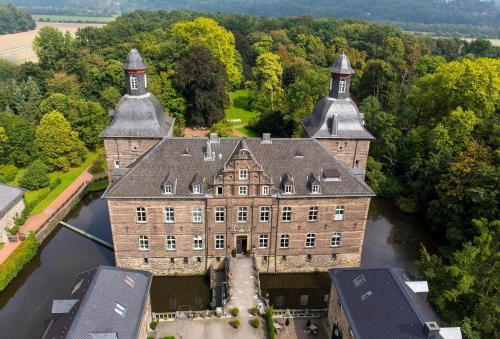
Stone, Water, and the Weight of Five Centuries
Approaching Schlosshotel Hugenpoet along August-Thyssen-Strasse 51 in Kettwig, the first thing that registers is the moat. Water surrounds the property on multiple sides, and the Renaissance stonework rises from it with the kind of unhurried permanence that no amount of interior renovation can replicate. Castle hotels occupy a specific tier in German hospitality, one where the architecture itself sets the frame for everything that follows, and Hugenpoet sits firmly in that category. The building's physical presence does the work that lobbies in urban luxury hotels assign to art installations and bespoke furniture.
Kettwig, now a district of Essen in the Ruhr Valley, has a particular relationship with water and industry. The Ruhr River runs close by, and the area carries the residual texture of a region that once powered German industrial output and has since reinvented itself as a place of cultural heritage and quieter tourism. A castle hotel in this context is less anomaly than anchor: it grounds the area's identity in an era that predates the furnaces and rolling mills that defined the region for most of the twentieth century.
Where Hugenpoet Sits in the German Castle Hotel Tier
Germany's Michelin-selected hotel list for 2025 covers a wide range of property types, from urban design hotels to rural wellness retreats. Schlosshotel Hugenpoet's inclusion in that list places it alongside properties that the guide's inspectors consider worthy of a specific recommendation. Within the castle-hotel subset, the competition set in Germany includes properties in regions with stronger tourist infrastructure, such as Bavaria and Baden-Württemberg, which means a Ruhr Valley entry like Hugenpoet occupies a slightly different position: it draws on regional heritage rather than postcard scenery.
For comparison, the Althoff Seehotel Überfahrt in Rottach-Egern positions itself around lakeside setting and a strong food-and-beverage program, while the Schloss Elmau Luxury Spa Retreat and Cultural Hideaway in Elmau leans into Alpine scenery and cultural programming. Hugenpoet's draw is more architectural and more specific: a working moated castle in a post-industrial valley, held to Michelin standards. That is a narrow brief, and it suits a particular kind of traveller well.
Within the North Rhine-Westphalia region, the nearest comparable urban luxury anchor is the Breidenbacher Hof in Düsseldorf. The contrast between that property's grand-city-hotel format and Hugenpoet's moated-castle remove illustrates how the region segments its premium accommodation: urban sophistication on one end, historic withdrawal on the other.
The Architecture as the Program
Renaissance castle architecture in the German Rhineland follows a recognisable logic: symmetrical facades, round or rectangular towers at the corners, and a deliberate relationship with water as both defence and ornament. Hugenpoet's moat is not a decorative afterthought; it is structural, both physically and experientially. Guests crossing the entrance effectively cross a threshold from the surrounding landscape into an enclosed world, a transition that the leading historic properties use to shift the guest's sense of pace and expectation.
Inside, the tension that castle-hotel operators across Europe manage is the same everywhere: how much of the historic fabric to preserve, how much to update for modern comfort, and where to let contemporary design intervene without producing a collision between centuries. The properties that resolve this leading tend to treat the original architecture as the dominant voice and allow contemporary additions to function as a quiet counterpoint rather than a competing statement. Whether Hugenpoet achieves this balance across its interiors is a question that, but the Michelin selection signals that the overall calibration meets a recognised threshold.
What the stone walls, vaulted ceilings, and moat setting do provide is a physical specificity that no amount of interior design can manufacture in a purpose-built hotel. This is architecture as experience, and it explains why travellers who have stayed at properties like Hotel Traube Tonbach in Baiersbronn or Weissenhaus Private Nature Luxury Resort still find Hugenpoet worth a separate trip. Each property offers a different kind of physical encounter with German hospitality heritage.
Getting to Kettwig and Timing a Stay
Kettwig is accessible by S-Bahn from both Düsseldorf and Essen, with the S6 line serving the area directly, making it a realistic option for guests arriving by rail. By car from Düsseldorf's city centre the drive takes about 25 to 30 minutes. This proximity to two major urban centres is part of what makes Hugenpoet work logistically: it is sufficiently removed to feel like a departure from city pace, but not so remote that it demands a full destination commitment.
Travellers combining a stay here with time in the broader region might also look at the Excelsior Hotel Ernst in Cologne, roughly an hour to the south, for a city-anchor before or after a castle interlude. The Ruhr area's cultural infrastructure, including the density of museums in Essen, Bochum, and Dortmund, means that a Hugenpoet stay can be built into a serious cultural itinerary rather than treated as a pure escape. Spring and early autumn tend to offer particularly photogenic conditions for the exterior stonework and surrounding grounds, avoiding both the grey of winter and the compressed heat of a German July.
Properties like Villa Contessa in Bad Saarow, Söl'ring Hof in Sylt, Seezeitlodge Hotel and Spa in Gonnesweiler, and Luisenhöhe in Horben each represent a different strand of German hospitality, and Hugenpoet's castle-specific offer reads most clearly when placed against that range. For international context, comparable castle-adjacent luxury can be found at Badrutt's Palace Hotel in St. Moritz and Hôtel de Paris Monte-Carlo, both of which share the quality of architecture-as-identity that defines Hugenpoet's appeal.
Each handles the intersection of historic structure and contemporary guest expectation differently, and comparing them sharpens the case for what Hugenpoet specifically offers.
At-a-Glance Comparison
Comparable venues nearby, for context on price, style, and recognition.
| Venue | Cuisine | Price | Awards | Notes |
|---|---|---|---|---|
| Schlosshotel HugenpoetThis venue — the venue you are viewing | Historic moated castle with neo-Renaissance elements and modern renovations | $$$$ | 5-Star | Not listed |
| Wald & Schlosshotel Friedrichsruhe | Luxury country-house resort in historic castle grounds | $$$$ | 5-Star | Zweiflingen |
| Hyatt Regency Köln | Contemporary luxury with modern elegance; established 1988, renovated 2011-2012 with Hirsch Bedner Associates design. | $$$$ | 5-Star | Deutz |
| Steigenberger Grandhotel und Spa | Classical grand hotel resort with historical villas and modern spa facilities | $$$$ | 5-Star | Heringsdorf |
| Hotel Franks | Classic mountain lodge updated for the 21st century | $$$$ | 5-Star | Oberstdorf |
| KPM Hotel & Residences | contemporary design-forward retreat | $$$$ | 5-Star | Charlottenburg |
Recognition history
Dated appearances from independent guides and award organizations, with the underlying list record or original source where available.
Michelin Selected
Michelin
At a Glance
- Romantic
- Elegant
- Quiet
- Sophisticated
- Cozy
- Scenic
- Romantic Getaway
- Anniversary
- Weekend Escape
- Honeymoon
- Historic Building
- Garden
- Terrace
- Wi Fi
- Spa
- Fitness Center
- Room Service
- Concierge
- Business Center
- Valet Parking
- Garden
- Wi Fi
- Spa
- Fitness Center
- Room Service
- Concierge
- Business Center
- Valet Parking
Elegant yet cozy atmosphere with historic architecture, stucco ceilings, marble gates, and stylish accents connecting history and contemporary style.