Sal Salis Ningaloo Reef Safari Camp

La Liste Top Hotels
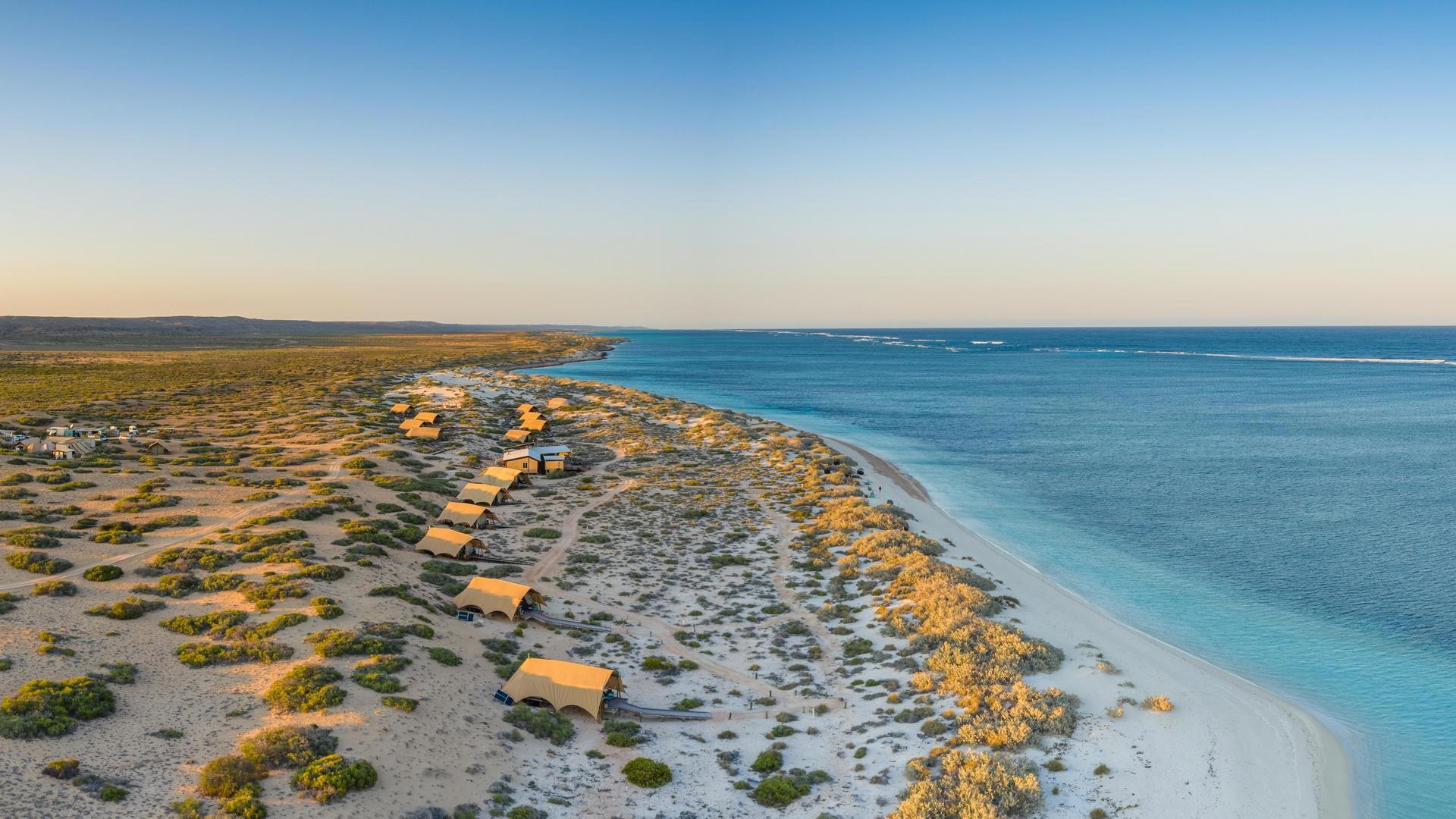
Sal Salis Ningaloo Reef Safari Camp occupies a stretch of Cape Range National Park where the desert meets one of the world's largest fringing reefs. Recognised in La Liste's Top Hotels 2026 with 93.5 points, the camp positions itself at the intersection of genuine wilderness access and considered design. This is not a resort in any conventional sense, the reef is the amenity, and the tented structures exist to keep you close to it.

Pearl is the En Primeur Club membership app, where members save venues, book tables and use the concierge.
Where the Outback Stops and the Reef Begins
There is a particular geographic coincidence at Ningaloo that most reef destinations cannot replicate: the point where an arid, red-earthed national park meets a living coral system at the waterline, with almost no buffer between them. Cape Range National Park compresses that contrast into a narrow coastal strip, and Sal Salis sits directly inside it, on Yardie Creek Road within the park boundary. You do not drive through a town or resort precinct to get here. You drive through limestone gorges and spinifex flats, and then the Indian Ocean appears. That sequence matters architecturally and experientially in ways that shape everything about how the camp is designed and how it functions.
Australia's premium wilderness lodge tier has expanded in recent years, with properties across the Northern Territory, the Kimberley, and South Australia competing for the traveller who wants ecological immersion without forfeiting considered design. Sal Salis sits within that cohort. Where Wildman Wilderness Lodge in Marrakai positions itself around wetland and floodplain access in the Leading End, Sal Salis is defined entirely by reef proximity and the structural challenge of placing accommodation on a coastal dune system inside a protected park.
The Architecture of Non-Permanence
Designing for a national park sets constraints that urban luxury properties never encounter. Structures must be removable, footprints must be minimal, and the design cannot compromise the landscape it is meant to foreground. The tented safari format, borrowed loosely from East African camp tradition and adapted for Western Australian conditions, is the logical answer to those constraints. Canvas and timber frame on a raised deck platform: impermanent enough to satisfy park conditions, open enough to keep the environment present at all times.
What distinguishes considered execution of this format from a basic glamping product is the degree to which the structure mediates between the human body and the environment without fully enclosing it. A tent that creates genuine shelter from the sun and overnight temperature drop while still transmitting the sound of the reef at low tide, the shift in wind direction before a change, the visibility of stars in a park with negligible light pollution, that is an architecture problem, not merely a hospitality one. The leading examples of this format in Australia do not try to compete with urban luxury hotels on conventional terms. They compete on access and specificity of place.
La Liste recognised Sal Salis in its 2026 Leading Hotels ranking with a score of 93.5 points, placing it inside a peer group that includes properties operating at the intersection of design quality and destination specificity. For context, La Liste's methodology weights both hospitality quality and placement within a broader cultural or natural framework. A score at this level, for a camp with no permanent structures inside a national park, signals that the jury is evaluating something beyond thread count and restaurant credentials. It is a recognition of category, as much as quality within a category.
Ningaloo Reef as the Actual Product
Ningaloo is one of the few places on Earth where a fringing reef runs close enough to shore that you can snorkel it without a boat. That is the reef's distinguishing geography, and it is the reason a camp here can credibly argue that the accommodation is secondary to what lies a short walk from the tent door. The reef extends approximately 260 kilometres along the coast and hosts whale sharks seasonally, roughly March through July, alongside manta rays, turtles, and coral systems that have remained largely intact compared to heavily visited sites in Queensland.
This reef-access logic separates the property from the competitive dynamics that govern most Australian luxury hotels. Properties like Capella Sydney or The Tasman in Hobart compete on service depth, F&B; programming, and urban cultural access. Sal Salis competes on a different axis entirely: the reef at your door, the national park around you, and a design format that makes sense only in this specific location. Southern Ocean Lodge in Kingscote offers the closest structural parallel in Australia, a remote, design-led wilderness property where the natural environment is the primary offering, though its context is the Southern Ocean and Kangaroo Island's temperate ecosystem rather than tropical reef.
Getting There and Planning the Visit
Cape Range National Park sits approximately 1,200 kilometres north of Perth, near Exmouth. The standard access route runs via Exmouth, which has a regional airport served by flights from Perth; the drive from Exmouth into the park then continues along the coast road. The remoteness is not incidental, it is structural to the experience and to the park's ecological condition. The road into the camp passes through park land requiring a national park entry fee, and visitors should confirm vehicle requirements and park access conditions ahead of arrival, as the terrain is not suited to all vehicle types.
Seasonality matters considerably here. The whale shark season from roughly March to July draws the highest demand for reef-based experiences, though the camp operates across a broader window. The summer months (December through February) bring intense heat to the Pilbara and Gascoyne coast, which affects both comfort and reef visibility conditions. The shoulder season between whale shark peak and the onset of summer, late July through October, offers a different reef character with fewer large pelagic encounters but consistent coral quality and more moderate temperatures.
For those building a broader Western Australian itinerary, Cape Lodge in Wilyabrup in the Margaret River wine region provides an obvious counterpoint: a vineyard-and-fine-dining base at the state's southern tip, sitting at the opposite end of the Western Australian coast from Ningaloo. The two properties share almost nothing in format or environment, which makes them logical bookends for a state-wide journey rather than alternatives to one another.
Given the camp's position inside a national park, direct booking through the property's own channels is the standard approach. The camp operates at low capacity relative to demand, particularly during whale shark season, which means forward planning of several months is advisable for peak-period visits. Our full Cape Range National Park restaurants guide covers broader planning context for the region.
How It Fits the Australian Wilderness Lodge Tier
The Australian premium wilderness lodge category has a relatively small number of properties that combine genuine ecological access with a design standard sufficient to earn international recognition. Most urban luxury hotels in Australia, The Calile in Brisbane, Crown Metropol Melbourne in Southbank, InterContinental Sydney Double Bay by IHG, compete on architecture, F&B; reputation, and urban location. Wilderness lodges compete on access, low-impact design, and the quality of the natural system they sit within.
Sal Salis's La Liste score of 93.5 places it within a tier where the jury is, by implication, judging the camp against other wilderness and remote properties rather than against city five-star hotels. That framing is useful for the prospective guest: this is not a property that will offer the same breadth of service as a full-service urban hotel. It will offer something considerably harder to engineer, a position inside one of Australia's most ecologically significant coastal environments, in a format that does not compromise the landscape to deliver it.
Fast Comparison
Comparable venues nearby, for context on price, style, and recognition.
| Venue | Cuisine | Price | Awards | Notes |
|---|---|---|---|---|
| Sal Salis Ningaloo Reef Safari CampThis venue (the venue you are viewing) | experiential eco-luxury glamping | Not listed | La Liste Top Hotels | Not listed |
| The Sundays | Contemporary boutique tropical escape | Not listed | 1 Michelin Key · Travel + Leisure It List Hotels | Catseye Beach |
| Mondrian Gold Coast | Sculptural beachfront towers inspired by sand dunes and headland with open-air living spaces. | Not listed | Michelin Selected · Esquire Best New Hotels | Burleigh Heads |
| Spicers Peak Lodge | Contemporary luxury mountain lodge blending Scottish bluestone and recycled timber with bespoke furnishings and local landscape photography. | Not listed | 2 Michelin Keys · Virtuoso Luxury Hotel Partner | Scenic Rim |
| Crystalbrook Sam Hotel | Luxury, sustainability-led urban hotel bringing Crystalbrook’s forward-thinking five-star hospitality to Adelaide. | Not listed | Not listed | Adelaide CBD |
| Jackalope Hotel | luxury design hotel | $300–500 | Not listed | Merricks North |
Recognition history
Dated appearances from independent guides and award organizations, with the underlying list record or original source where available.
La Liste Top Hotels
La Liste
Details
- Scenic
- Rustic
- Intimate
- Romantic
- Romantic Getaway
- Honeymoon
- Wellness Retreat
- Weekend Escape
- Beachfront
- Panoramic View
- Beach Access
- Waterfront
Relaxed, serene wilderness atmosphere with natural lighting, ocean breezes, and communal dining under starry skies, fostering disconnection and reconnection with nature.