
A Michelin Selected resort on Koh Tao's quieter southern bay, Jamahkiri Dive Resort & Spa positions itself at the intersection of serious dive access and hillside design. The property sits above Ao Thian Og, where the Gulf of Thailand's cleaner visibility and the island's dive-certification reputation draw a more focused traveller than the backpacker hubs further north.
Pearl is the En Primeur Club membership app — saves, bookings, and concierge access live there. Same editors, same standards.
- Address
- 21/2 Moo 3 Koh Tao, Ao Thian Og, Koh Tao, Thailand
 Saves & bookings on Pearl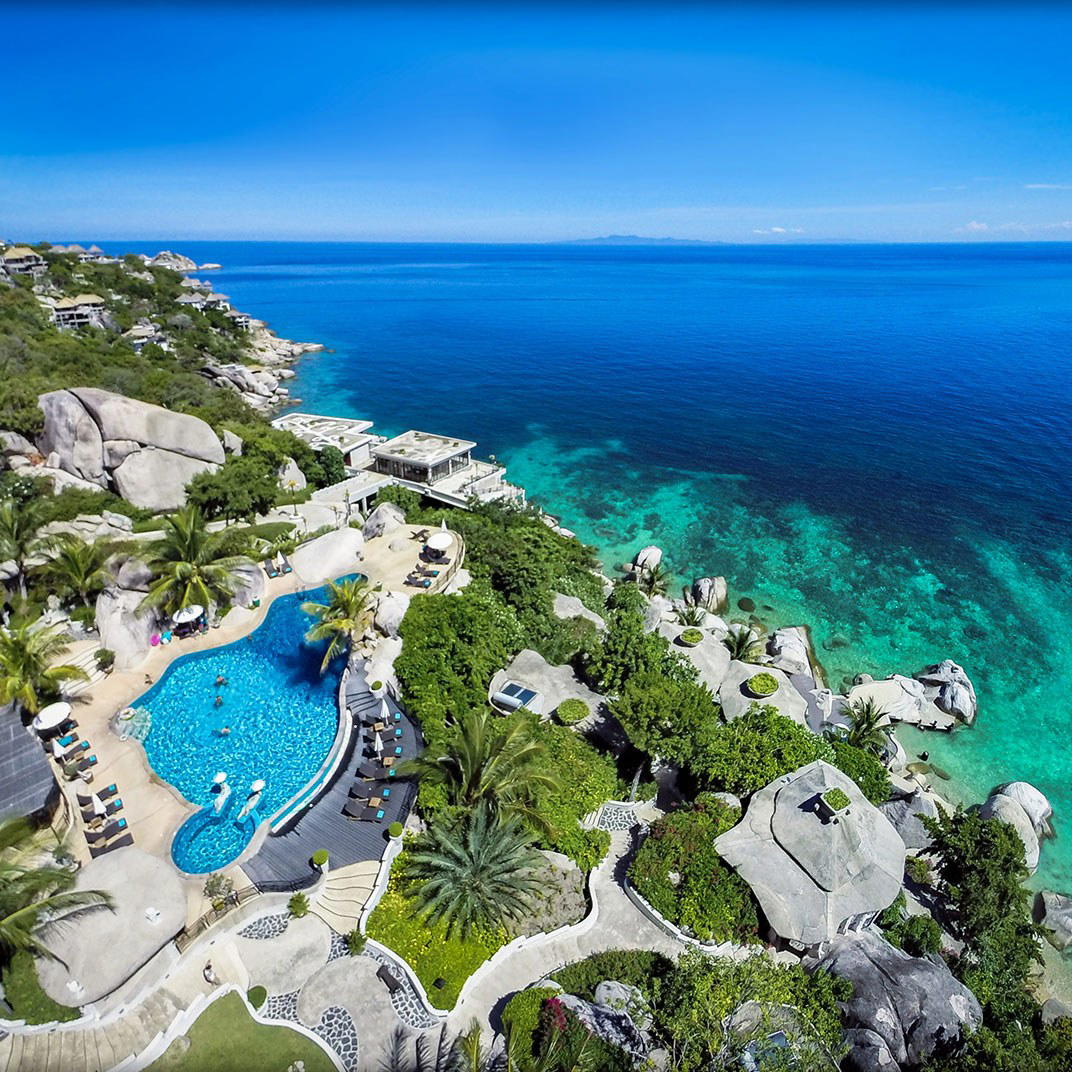
Where Koh Tao's Dive Culture Meets Considered Hillside Design
Koh Tao has long occupied a specific lane in Thailand's island hierarchy: smaller than Koh Samui, less resort-dense than Phuket, and carrying a reputation built almost entirely on the quality and accessibility of its dive sites. The island certifies more scuba divers per year than almost anywhere else in the world, a statistic that shapes not just its economy but its accommodation tier. Most properties on the island serve the certification-course market: dormitories, basic bungalows, dive shop packages. A smaller cohort operates at a higher register, and Jamahkiri Dive Resort & Spa sits in that upper bracket, distinguished by its hillside position above Ao Thian Og on the island's southern flank and by a 2025 Michelin Selected designation.
That Michelin recognition matters here more than it might elsewhere. On an island where the dominant accommodation narrative is budget-first, a property earning selection from the Michelin hotel guide signals a material step-change in finish, service consistency, and design intent. Jamahkiri's inclusion positions it within that latter group rather than the dive-resort commodity market it physically neighbours.
The Physical Logic of Ao Thian Og
The choice of Ao Thian Og as a location carries editorial weight. Koh Tao's western and northern bays, Sairee Beach in particular, concentrate the island's nightlife, dive shops, and budget guesthouses into a dense strip. Ao Thian Og, on the southern coast, operates on a different rhythm. The bay is quieter, the approach steeper, and the physical separation from Sairee's churn is a design decision as much as a geographic one. Properties in this position trade convenience for atmosphere, and the hillside elevation characteristic of the bay's resorts means that the architecture must work with gradient rather than against it.
Hillside resort design in Southeast Asia has produced two distinct tendencies. The first treats gradient as a problem to be solved with flat-cut platforms and maximal pool decks. The second treats it as a structural asset, allowing buildings to step down the slope so that sightlines, cross-ventilation, and the relationship between indoor and outdoor space are all shaped by topography. The better properties in this bay category, and Jamahkiri sits among them, are built around the second logic. Compare this approach to how Keemala in Phuket uses Phuket's hillside terrain, or how Phulay Bay in Krabi handles the interface between refined land and water access: the design challenge is similar even if the scale differs substantially.
Design Reading: Hillside Architecture on a Dive Island
The architectural character of resorts in this part of Koh Tao is shaped by three pressures that do not apply to flat beachfront properties. First, structural logistics: foundations on slope require more engineering than platforms on sand, which tends to limit scale and favour smaller, more considered room counts. Second, material vernacular: hillside properties in the Gulf of Thailand typically draw from local timber, stone, and open-structure traditions, partly from practical necessity and partly because the aesthetic reads as appropriate to the setting. Third, and most significantly, view orientation: on a hillside above a bay, every room has a potential sight angle that beachfront rooms, by definition, cannot replicate in the same way.
That combination of factors places hillside dive resorts in a different design conversation from the large-footprint beach resort model exemplified by properties like Soneva Kiri in Trat or Four Seasons Chiang Mai. Those properties operate at a different scale and price tier, with correspondingly different infrastructure. Jamahkiri competes not on scale but on specificity of experience: the resort's address at 21/2 Moo 3, Ao Thian Og, places it in a bay that rewards guests who have already decided they want Koh Tao's particular combination of dive access and relative quiet, rather than guests seeking the full-service beach resort format available on larger islands.
Koh Tao in the Thailand Island Context
Thailand's island accommodation market has stratified sharply over the past decade. At the premium end, properties like Samujana Villas on Koh Samui and Pimalai Resort & Spa on Koh Lanta compete on villa scale, spa infrastructure, and proximity to major airports. Koh Tao operates outside that competition by nature: there is no commercial airport, access requires either a ferry from Chumphon or Surat Thani or a connection via Koh Samui, and the island's infrastructure has a ceiling that is structural rather than aspirational. That friction is also the filter. The traveller who arrives at Jamahkiri has already self-selected through a more demanding arrival sequence than the traveller checking into a beachfront property on Phuket or at InterContinental Hua Hin.
That self-selection shapes the guest profile and, by extension, the design brief. A resort on Koh Tao serving serious divers and dive-adjacent travellers does not need the same breadth of amenity as a destination resort serving a general leisure market. It needs a specific depth: reliable dive operations, considered outdoor spaces that function well in humidity, and rooms designed around the rhythms of people who are in the water by 7am and back at dusk. The spa component at a dive resort also functions differently than at a land-based property: recovery, rather than indulgence, is the operating logic.
Planning Your Stay
Reaching Koh Tao from Bangkok involves a combination of flight or overnight train to Chumphon or Surat Thani, followed by a ferry crossing; from Koh Samui, a high-speed catamaran runs to Koh Tao's Mae Haad pier. The Lomprayah and Songserm ferry services operate year-round, though frequency and crossing times vary by season. The Gulf of Thailand side of the Koh Samui archipelago, which includes Koh Tao, has its primary dive season running from April through September, with visibility at its clearest in the mid-year months. The October-to-December period brings the Gulf's monsoon, with choppier crossings and occasional resort closures, so timing around this window is material to the experience.
Comparable Venues
Comparable venues nearby, for context on price, style, and recognition.
| Venue | Cuisine | Price | Awards | Notes |
|---|---|---|---|---|
| Jamahkiri Dive Resort & SpaThis venue — the venue you are viewing | Sumptuous living resort harmonizing traditional Thai design with natural surroundings. | $$$$ | 5-Star | Not listed |
| OUTRIGGER Phi Phi Island Resort | Barefoot luxury eco-resort with traditional Thai village-inspired architecture | $$$$ | 5-Star | Laem Tong Bay |
| The Library | Minimalist beachfront resort with conceptual design inspired by literature and zen. | $$$$ | 5-Star | Chaweng Beach |
| Veranda High Resort Chiang Mai - MGallery | Hillside luxury resort blending Thai heritage and contemporary architecture | $$$$ | 5-Star | Hang Dong |
| Layan Residences by Anantara | Exclusive private pool residences blending privacy with resort luxury | $$$$ | 5-Star | Thalang |
| La Miniera Pool Villas Pattaya | Luxury pool villa resort with private heated pools in every unit | $$$$ | 5-Star | Nong Prue |
Recognition history
Dated appearances from independent guides and award organizations, with the underlying list record or original source where available.
Michelin Selected
Michelin
At a Glance
- Quiet
- Scenic
- Romantic
- Intimate
- Elegant
- Honeymoon
- Romantic Getaway
- Wellness Retreat
- Weekend Escape
- Beachfront
- Infinity Pool
- Destination Spa
- Panoramic View
- Wi Fi
- Pool
- Spa
- Fitness Center
- Room Service
- Concierge
- Beach Access
- Waterfront
- Wi Fi
- Pool
- Spa
- Fitness Center
- Room Service
- Concierge
- Beach Access
Lush tropical getaway with open-air design, dark woods, traditional Thai interiors, and tranquil natural surroundings.