
A 15th-century patrician residence on Bruges's Dijver canal, Hotel de Tuilerieën occupies one of the historic centre's most coveted addresses. Among Bruges boutique hotels, it sits in the canal-facing tier where architecture and setting do as much work as the rooms themselves. Guests arrive by water's edge and stay within walking distance of the city's principal monuments.
What the Dijver Address Actually Means
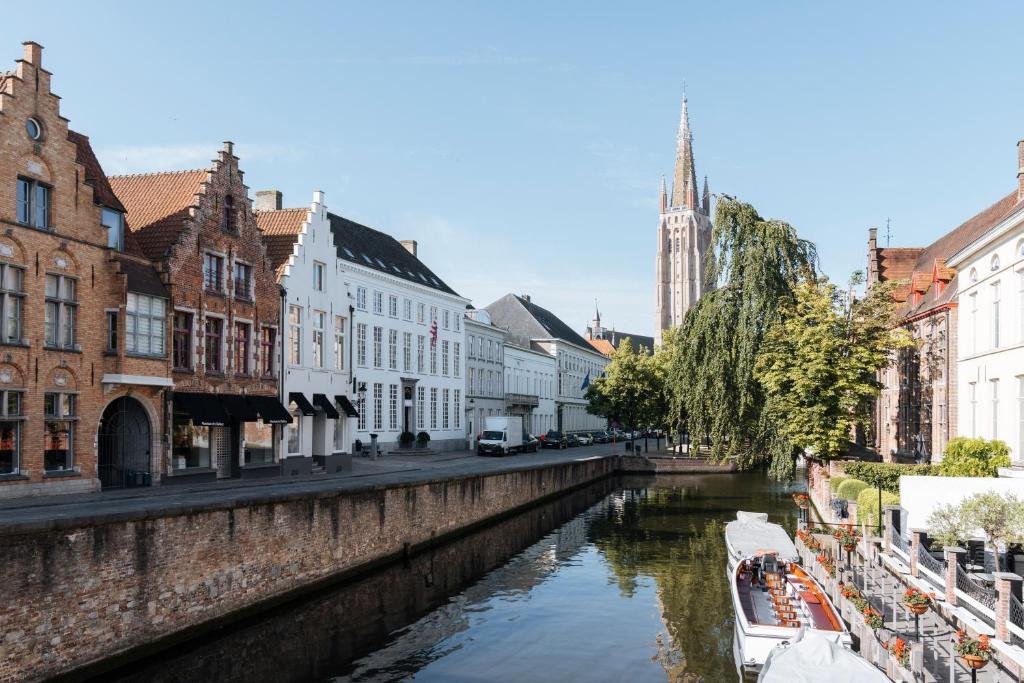
Bruges has two distinct hotel types: those that describe themselves as historic and those that genuinely are. Hotel de Tuilerieën belongs to the second category. The building dates to the 15th century, when it functioned as a noble patrician residence, and its position on the Dijver — the canal the city calls 'Holy Water' — places it on one of the oldest and most photographed stretches of water in northern Europe. This is not a heritage detail that exists only in the lobby copy; it shapes what guests see from their windows, the light that falls through the rooms at dawn, and the particular quiet of a canal-side night in a medieval city.
The Dijver runs through the heart of Bruges's protected historic centre, and the address at number 7 puts guests within easy reach of the Groeningemuseum, the Onze-Lieve-Vrouwekerk, and the Markt, all navigable on foot in minutes. That proximity matters in Bruges more than in most cities because the historic centre is compact and the logic of the place is pedestrian. Hotels positioned on the inner canals function as bases from which visitors can exhaust the city's main circuit in a morning and spend the afternoon deciding what to go deeper on.
Canal-Side Position in the Context of Bruges Boutique Hotels
Bruges's premium boutique tier has organised itself around two kinds of address: canal-facing properties, which carry a visual premium, and those set back in quieter residential streets, which trade views for a different kind of atmosphere. Hotel de Tuilerieën sits firmly in the canal-facing group, alongside [Hotel De Orangerie](/hotels/hotel-de-orangerie-bruges-hotel), which occupies a converted 15th-century convent on the Dijver's neighbouring waterway. Both properties compete on the same combination of historic architecture and water proximity, which narrows their competition considerably relative to properties like [Hotel Heritage](/hotels/hotel-heritage-bruges-hotel) on Niklaas Desparsstraat, where the setting is elegant but interior-facing.
The canal view, in Bruges, is not an aesthetic bonus; it is the primary asset. The Dijver's tree-lined banks, particularly in late spring and autumn when tourist density drops and the light flattens into something almost Flemish Primitive in quality, offer a version of the city that feels continuous with the medieval paintings in the Groeningemuseum a short walk away. A hotel that places guests directly on that edge charges accordingly, and the market for it is specific: travellers who have typically visited Bruges before and know that the canal side is where the city's texture concentrates.
The Building and Its Place in Bruges's Hotel Architecture
Bruges is a city that has survived largely intact since the medieval period, which means its premium accommodation stock tends to occupy genuinely old buildings rather than sympathetic conversions of 19th-century structures. Hotel de Tuilerieën's 15th-century fabric puts it in the older end of that range, comparable in age to properties like [Hotel Van Cleef](/hotels/hotel-van-cleef-bruges-hotel) and older than the majority of boutique properties in the city's hotel stock. The description of the property as a former patrician residence is architecturally legible: the scale of the Dijver-facing façade, the relationship of the building to the canal bank, and the depth of the structure are all consistent with the merchant-class residential typology that defined this stretch of waterfront during Bruges's commercial peak in the 14th and 15th centuries.
For guests who arrive by the canal rather than by road, the approach by water frames the building in a way that a street arrival cannot replicate. Bruges's canal boat routes pass the Dijver, and the experience of seeing a hotel from the water before checking in at its door is a specific pleasure that only canal-side properties can offer. It is a logistical detail that also functions as an orientation: guests who take the canal route before arrival understand the city's geography more intuitively than those who navigate exclusively by street.
Planning a Stay: Practical Orientation
Hotel de Tuilerieën sits at Dijver 7, 8000 Brugge, in the protected historic centre. Bruges is served by direct rail connections from Brussels (approximately 55 minutes from Brussels-Midi), making it viable as a base for travellers exploring multiple Belgian cities. Ghent, where [1898 The Post](/hotels/1898-the-post-ghent-hotel) occupies a converted post office in the Korenmarkt district, is reachable in under 30 minutes by train, and Antwerp's [Botanic Sanctuary](/hotels/botanic-sanctuary-antwerp-antwerp-hotel) sits within an hour. Bruges's historic centre is a low-traffic zone, and the Dijver is most efficiently reached on foot from the Bruges rail station, a walk of roughly 20 minutes through the medieval street grid, or by taxi for guests arriving with luggage.
The canal-side location means early-morning walkers will have the Dijver almost entirely to themselves before the day-trip tourism volume builds after 10am. This is worth factoring into any itinerary: the city's most photographed spots, including the Rozenhoedkaai junction a short distance from the hotel, are materially different experiences at 7am versus midday. For the city's restaurant and bar circuit, [Our full Bruges restaurants guide](/cities/bruges) covers the current options in detail, while [Our full Bruges bars guide](/cities/bruges) maps the drinking scene that has developed around the city's strong local beer culture.
Bruges rewards returning visitors who have moved past the headline circuit, and a canal-side base helps that process by keeping the city's slower rhythms in constant peripheral view. Travellers considering whether to base in Bruges versus Ghent or Antwerp will find the comparison between Hotel de Tuilerieën and properties like [Dukes' Palace Brugge](/hotels/dukes-palace-brugge-bruges-hotel) or [Boutiquehotel 't Fraeyhuis](/hotels/boutiquehotel-t-fraeyhuis-bruges-hotel) a useful lens for understanding how the city's hotel tier has arranged itself: larger converted palaces at one end, smaller canal-side character properties at the other. For a broader view of how [Our full Bruges hotels guide](/cities/bruges) maps the full range, that reference covers the city's current accommodation stock across price points.
Frequently Asked Questions
- What's the leading room type at Hotel de Tuilerieën?
- Canal-facing rooms at Hotel de Tuilerieën carry the obvious advantage of the Dijver view, which is the primary reason to choose this property over others in the Bruges boutique tier. The building's 15th-century structure means room configurations vary, and guests who prioritise both historic character and the canal elevation should request an upper-floor, canal-facing room at the time of booking. Properties in this category typically have a limited number of such rooms, and they are the first to be reserved.
- What's Hotel de Tuilerieën leading at?
- Its address. In a city where location determines the quality of the ambient experience more than almost anywhere else in Belgium, being positioned directly on the Dijver in the historic centre gives Hotel de Tuilerieën an advantage that no amount of interior investment can replicate elsewhere. Among Bruges boutique hotels, it competes in the canal-facing tier, a small group that includes Hotel De Orangerie, and that tier commands a premium precisely because the supply of genuinely historic canal-side buildings is fixed.
- How hard is it to get in to Hotel de Tuilerieën?
- Bruges draws significant visitor volume, particularly between May and September when the canal-side properties fill weeks in advance. If you are travelling in high season and have a specific canal-view preference, booking several months ahead is the practical standard for this tier of property. Should Hotel de Tuilerieën be unavailable, the comparable canal-side alternatives in [Our full Bruges hotels guide](/cities/bruges) include Hotel De Orangerie and, for a different format, The Notary.
- Is Hotel de Tuilerieën a good base for day trips to other Belgian cities?
- Bruges's rail connections make it a functional base for exploring Belgium's main cities. Brussels is approximately 55 minutes from Bruges station, Ghent under 30 minutes, and Antwerp around an hour. For travellers who want to compare how Bruges's boutique hotel stock relates to what's available in other Belgian cities, properties like [1898 The Post in Ghent](/hotels/1898-the-post-ghent-hotel) and [Botanic Sanctuary Antwerp](/hotels/botanic-sanctuary-antwerp-antwerp-hotel) represent the equivalent design-led tier in their respective cities.
Cost Snapshot
A quick context table based on similar venues in our dataset.
| Venue | Hotel Group | Awards | Google Rating | Notes |
|---|---|---|---|---|
| Hotel de Tuilerieën | 1 awards | This venue | ||
| Hotel Heritage | 1 awards | 4.7 (608) | ||
| Dukes' Palace Brugge | Michelin 1 Key | |||
| Boutiquehotel 't Fraeyhuis | Michelin 1 Key | |||
| Hotel Van Cleef | Michelin 1 Key | |||
| The Notary | Michelin 1 Key |
Preferential Rates?
Our members enjoy concierge-led booking support and priority upgrades at the world's finest hotels.
Access the Concierge