
Michelin Selected
Selected by the Michelin Guide Hotels 2025, Entô occupies a remote position on Ama, a small island in Japan's Oki archipelago where the built environment is as deliberate as the isolation. The property represents a strand of Japanese hospitality that treats landscape and architecture as inseparable, a model increasingly recognised beyond its island setting. Reaching it requires intent, which is precisely the point.

Pearl is the En Primeur Club membership app, where members save venues, book tables and use the concierge.
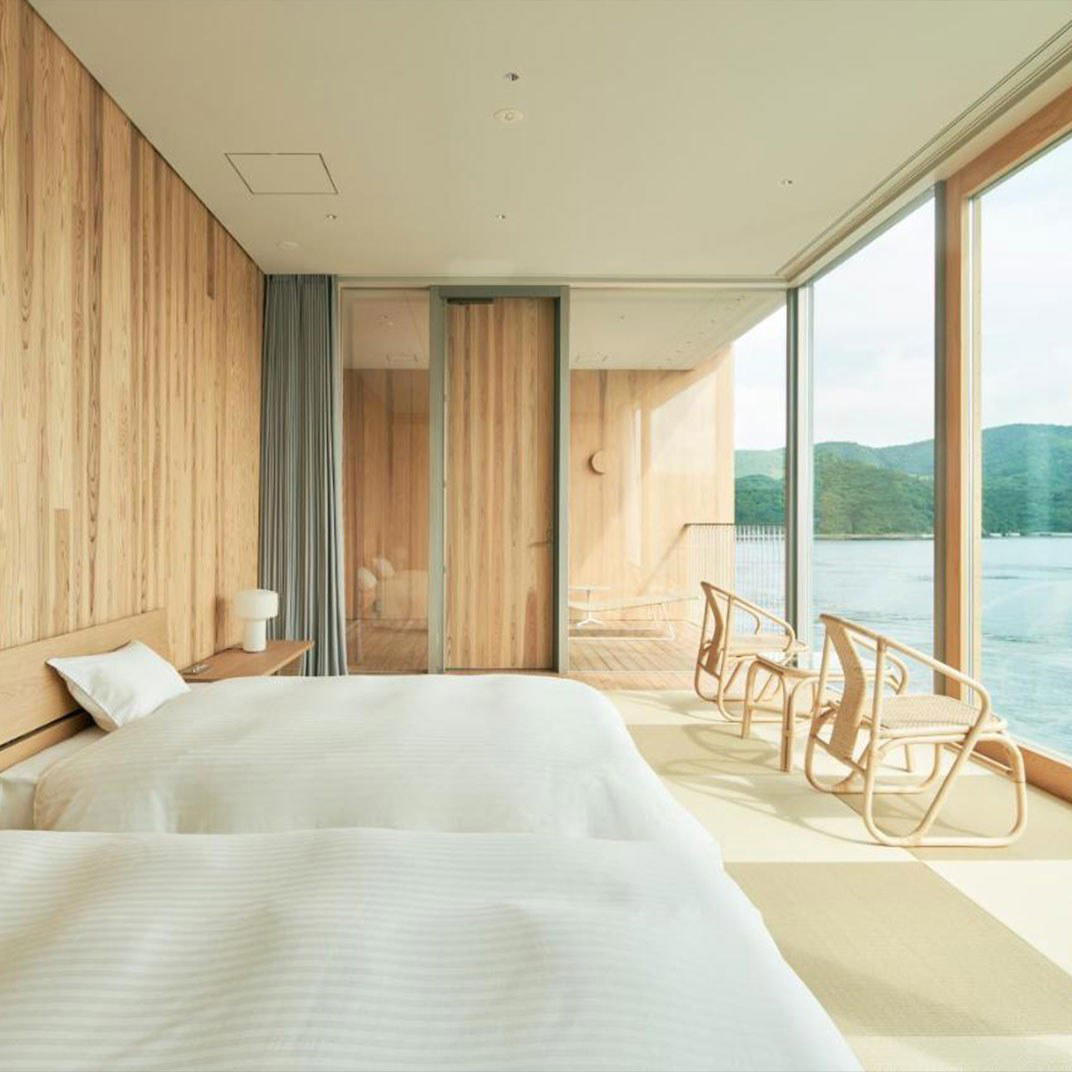
An Island Where the Building Is the Argument
Japan's most considered hospitality properties share a structural logic: the architecture arrives before the amenity list. On Ama, one of the four islands that make up the Oki archipelago in the Sea of Japan, Entô makes that case as plainly as any property in the country. Selected by the Michelin Guide Hotels 2025, it belongs to a small cohort of Japanese stays where the building's relationship to its site is the primary editorial statement, not a feature to be mentioned after the spa and the restaurant, but the organising principle around which everything else is arranged.
That cohort has grown in critical visibility over the past decade. Properties like Benesse House on Naoshima established that remote Japanese islands could support architecture-led hospitality at a serious level, drawing an audience willing to plan travel around a building rather than a city. Entô positions itself in that lineage, on an island that offers its own distinct case: Ama is part of the UNESCO World Geopark covering the Oki Islands, and the geological character of the place, ancient rock formations, coastal drama, a pace defined by fishing rather than tourism infrastructure, gives the property a site unlike the more visited art-island circuit.
The Physical Logic of Entô
In Japanese, the name Entô (円島) relates to the round island form, a reference that signals how deliberately the property has grounded itself in place. The architectural approach at this tier of Japanese hospitality typically pursues one of two paths: either a dialogue between traditional building forms and contemporary materials, or a more radical erasure of the boundary between interior and exterior. Entô follows the second logic. The structure is designed to read as continuous with its coastal setting rather than placed upon it, a choice that aligns it with a broader movement in Japanese hospitality architecture toward buildings that recede rather than assert.
This approach has precedent in properties across the archipelago's premium tier. Zaborin in Hokkaido deploys a similar material restraint against a forest setting; Amanemu in Mie uses low horizontal architecture to echo the rhythm of the Ise-Shima coastline. What distinguishes Entô is that its site is genuinely remote, not remote in the sense of being two hours from a major airport with a private transfer, but remote in the sense that reaching Ama requires a ferry crossing from the Shimane or Tottori coastline, and the island has a population measured in hundreds. That friction is load-bearing. It keeps the guest count low and the atmosphere particular to those who have decided the journey is itself a condition of the stay.
Where Entô Sits in Japan's Premium Property Field
The Michelin Hotels selection is the relevant trust signal here. The 2025 list covers properties across Japan where the overall guest experience meets a threshold the guide's inspectors consider noteworthy, not necessarily the highest price tier, but a consistent level of quality and character that sets the property apart from standard accommodation. Entô's inclusion places it in the same recognition framework as properties with significantly larger operational scales and urban or resort-adjacent locations.
For context, the Japanese premium ryokan and design-hotel market has fragmented into several distinct peer sets. At one end sit urban flagships: Bvlgari Hotel Tokyo and HOTEL THE MITSUI KYOTO operate with international brand infrastructure and city-centre access. At the other end, deeply rural properties like Entô, Satoyama-Jujo in Niigata, or Nasu Mukunone compete on singularity of setting and the quality of the experience that setting enables. Entô belongs firmly to the latter group, with the additional factor that island geography creates a natural cap on visitor numbers that reinforces the atmosphere the architecture is trying to produce.
The mid-register of that rural tier includes well-established names: Gora Kadan in Hakone and Asaba in Izu have decades of critical recognition behind them, set against landscapes that are by now well-mapped by premium travel. Entô's competitive position benefits from the relative unfamiliarity of the Oki Islands as a destination, the archipelago has not yet been absorbed into the standard Japan premium itinerary, which means guests arrive without the comparative weight of expectations formed elsewhere.
The Oki Islands as Context
Understanding Entô means understanding the Oki archipelago, which most Japan itineraries skip entirely. The islands sit roughly 50 to 80 kilometres off the Shimane coast, reachable by high-speed ferry from Shichirui or Sakai-Minato. The crossing itself runs around two to three hours depending on the service and departure point, which filters the guest profile considerably. The Oki Geopark designation reflects a geological history stretching back roughly 2.5 billion years, with the islands serving as a refuge for endemic species and a range of cliffs, cedar forests, and coastline that has changed little under the pressure of mass tourism because mass tourism has not arrived.
Ama specifically is known for its ama divers, the women free-divers whose practice of harvesting shellfish and seaweed from the sea floor is one of the older sustained food traditions in coastal Japan. That cultural specificity matters for a property whose architecture and positioning are grounded in place: the local context is not decorative but substantive, a set of practices and traditions that the building's decision to recede rather than dominate allows to remain visible.
Planning a Stay at Entô
Reaching Ama is not complicated, but it requires sequencing. Flights to Oki Airport on Dōgo Island (the largest in the archipelago) connect from Osaka Itami and Tokyo Haneda on Japan Air Commuter, with the crossing to Ama then requiring a further ferry or inter-island connection. The ferry route from the Shimane coastline is the more scenic approach and avoids the domestic flight transfer. Given the island's scale and the property's positioning, booking well in advance is advisable, properties of this type, recognised by the Michelin Hotels list and operating in genuinely limited-capacity settings, fill at a rate that does not reflect their relative obscurity in international travel planning.
Guests considering Entô as part of a wider Japan itinerary might reference our full Ama guide for additional context on the island, or look at how other remote-island properties in the region handle the logistics question: Jusandi in Ishigaki and Halekulani Okinawa each move through the distance-from-mainland tension differently, and comparing approaches is useful for calibrating expectations.
Comparison Snapshot
| Venue | Price | Awards |
|---|---|---|
| EntôThis venue (the venue you are viewing) | $300–500 | Michelin Selected |
| Bvlgari Hotel Tokyo | Not listed | 3 Michelin Keys · World's 50 Best #24 |
| Aman Kyoto | Not listed | 2 Michelin Keys · World's 50 Best #74 |
| Aman Tokyo | Not listed | 2 Michelin Keys · World's 50 Best #11 |
| Palace Hotel Tokyo | Not listed | 3 Michelin Keys · World's 50 Best #73 |
| Amanemu | Not listed | 3 Michelin Keys · La Liste Top Hotels |
Recognition history
Dated appearances from independent guides and award organizations, with the underlying list record or original source where available.
Michelin Selected
Michelin
Details
- Minimalist
- Scenic
- Quiet
- Modern
- Elegant
- Romantic Getaway
- Wellness Retreat
- Weekend Escape
- Panoramic View
- Waterfront
- Terrace
- Wi Fi
- Spa
- Restaurant
- Concierge
- Parking
- Waterfront
- Elevator
Minimalist modernist design with floor-to-ceiling windows emphasizing natural light, serene seascape views, and a pared-down atmosphere focused on the surrounding environment and landscape.