Château L’Hospitalet Wine Resort, Beach & Spa
Set within a 1,000-hectare biodynamic estate between Narbonne and the Mediterranean coast, Château L'Hospitalet Wine Resort, Beach & Spa occupies a category rarely attempted in southern France: a working wine domaine converted into a resort without shedding its agricultural identity. The estate produces its own appellations, houses two accommodation formats, and sits at the intersection of Languedoc's wine country and the Golfe du Lion shoreline.
Where the Garrigue Meets the Shore
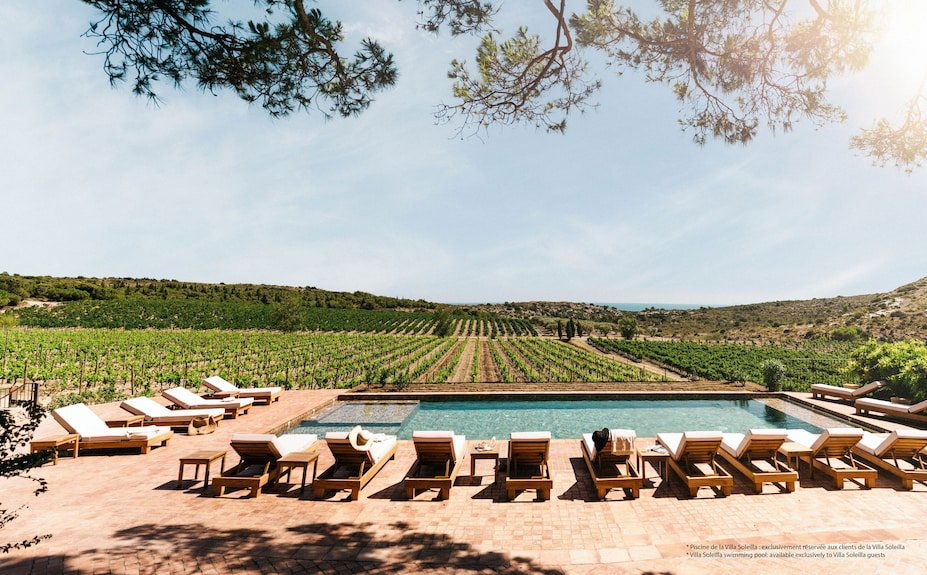
The approach to Château L'Hospitalet along the D168 from Narbonne sets the terms of the place before you arrive. The road cuts through scrubland that carries the dry, herbal scent of garrigue — wild thyme, rosemary, and cistus baking in the southern sun — before the estate's vineyard rows come into view, running in disciplined lines across a landscape that opens, eventually, toward the blue edge of the Mediterranean. This is Languedoc-Roussillon wine country, and the resort makes no effort to disguise that fact. The vines are the architecture here, and the 1,000-hectare estate they occupy is as much the product as any room or restaurant within it.
That position , between working agricultural land and coastal resort , defines a niche in French hospitality that most properties avoid. Wine country retreats in France tend to cluster in appellations long associated with luxury: Bordeaux's Médoc and Saint-Émilion, Burgundy's Côte de Beaune, Champagne's Marne Valley. Properties like Les Sources de Caudalie in Bordeaux and Royal Champagne Hotel & Spa in Champillon occupy that more established tier. L'Hospitalet makes a different argument: that the Languedoc's biodynamic producers and Mediterranean exposure represent their own form of premium, distinct from the prestige appellations to the north.
The Architecture of the Estate
The physical design of L'Hospitalet follows the logic of a working domaine rather than a purpose-built hotel. The main building reads as a fortified Languedocian farmhouse , thick stone walls, terracotta rooflines, proportions that prioritise shade and thermal mass over visual spectacle. This is an aesthetic approach shared by some of the most considered wine-country properties in southern France, where the architecture defers to the land rather than competing with it. The contrast with show-piece resort design , the kind deployed at coastal addresses like Hotel Du Cap-Eden-Roc in Cap d'Antibes or La Reserve Ramatuelle in Saint-Tropez , is deliberate and instructive. Where Riviera luxury signals itself through spectacle and sea-facing drama, L'Hospitalet signals through materiality and rootedness.
The biodynamic vineyard rows serve a structural purpose beyond agriculture: they create a spatial rhythm across the estate, framing views from terraces and guest quarters, and orienting movement through the property. Arriving guests pass through vine corridors before reaching the main reception, a sequence that functions as an architectural statement of intent. The spa and gardens extend this logic, using indigenous planting and local stone to hold the estate within its regional context rather than importing an international resort aesthetic onto the site.
Villa Soleilla operates as a second accommodation layer within the estate, offering a degree of separation from the main hotel while remaining embedded in the same vineyard setting. This two-tier format, a main property alongside a private villa annexe, appears at comparable estate resorts across Provence and the Languedoc, where the demand for private, self-contained stays has grown alongside interest in wine tourism. Properties like Villa La Coste in Le Puy-Sainte-Réparade and La Bastide de Gordes in Gordes occupy a similar structural position in Provence's premium estate category.
Languedoc's Wine Identity at Ground Level
Estate's biodynamic certification carries specific weight in the Languedoc context. The region has historically produced high volumes of inexpensive wine, and its premium producers have spent decades differentiating themselves within a category the market long associated with bulk output. Biodynamic conversion is one of the more visible signals of that differentiation. Growing on 1,000 hectares under biodynamic protocols is not a small operational commitment, and the scale of L'Hospitalet's estate places it well above the boutique single-appellation model that most wine-country hotels operate within.
For guests whose primary interest is the wine program rather than the resort infrastructure, the estate's position near Narbonne gives practical access to the wider La Clape and Corbières appellations, both of which have sharpened their quality credentials in recent vintages. The coast is close enough that the estate benefits from marine influence on its terroir , one of the conditions that distinguishes the Languedoc's Mediterranean-facing hillside plots from inland production.
Planning Your Stay
The estate sits along the D168 between Narbonne and the coast, reachable from Narbonne-Ville station, which connects directly to Paris via TGV. Summer bookings in this part of the Languedoc follow Riviera-adjacent demand patterns: July and August fill fastest, and the shoulder months of May, June, and September offer the leading combination of weather, vine activity, and availability. The harvest period, typically September into early October, is when the estate's agricultural calendar is most visible and the air carries the fermentation notes that define working domaine stays.
Guests looking to contextualise L'Hospitalet within a broader southern France circuit might pair it with Baumanière Les Baux-de-Provence in Les Baux or Hôtel & Spa du Castellet in Le Castellet for a comparison of Provençal and Languedocian wine-country hospitality approaches. Those looking for a change of register entirely can extend toward the Riviera proper , The Maybourne Riviera in Roquebrune-Cap-Martin and Grand-Hôtel du Cap-Ferrat, A Four Seasons Hotel sit in a different category of coastal luxury, where the price point and operating format have more in common with Cheval Blanc Paris than with an agricultural estate.
Explore further using our full Beach & Spa restaurants guide, our full Beach & Spa hotels guide, our full Beach & Spa bars guide, our full Beach & Spa wineries guide, and our full Beach & Spa experiences guide.
Frequently Asked Questions
- Is Château L'Hospitalet Wine Resort, Beach & Spa more formal or casual in atmosphere?
- The estate leans informal by the standards of French luxury hospitality. The architecture, working vineyard setting, and agricultural scale give it a character closer to an active domaine than to the polished formality of properties like Cheval Blanc Courchevel or Domaine Les Crayères in Reims. The Languedoc context reinforces this: the region's wine culture is less ceremony-driven than Bordeaux or Burgundy, and that registers in how the estate presents itself. Guests dress for warm southern evenings rather than for a grand dining room.
- What is the leading accommodation option at Château L'Hospitalet Wine Resort, Beach & Spa?
- The Villa Soleilla represents the estate's premium accommodation tier, operating as a self-contained property within the larger domaine. For guests seeking private estate stays with direct vineyard access, this format sits alongside comparable villa annexe models at properties like Casadelmar in Porto-Vecchio and Castelbrac in Dinard. Specific suite configurations and pricing should be confirmed directly with the estate, as the offering evolves seasonally.
Preferential Rates?
Our members enjoy concierge-led booking support and priority upgrades at the world's finest hotels.
Access the Concierge