Camp Denali
At Mile 89 of Denali Park Road, Camp Denali sits at the end of the only road that penetrates North America's largest national park, placing guests closer to the Alaska Range than any other private accommodation. The camp operates on a wilderness-lodge model where the physical setting, not amenity stacking, is the proposition. For travelers whose threshold is high and whose patience for logistics is real, it occupies a tier of its own in Alaskan wilderness travel.
Pearl is the En Primeur Club membership app — saves, bookings, and concierge access live there. Same editors, same standards.
- Address
- Mile 89 Denali Park Road, Denali National Park, AK 99755
- Phone
- +1 907 683 2290
- Website
- campdenali.com
- Directions
- Get directions
 Saves & bookings on Pearl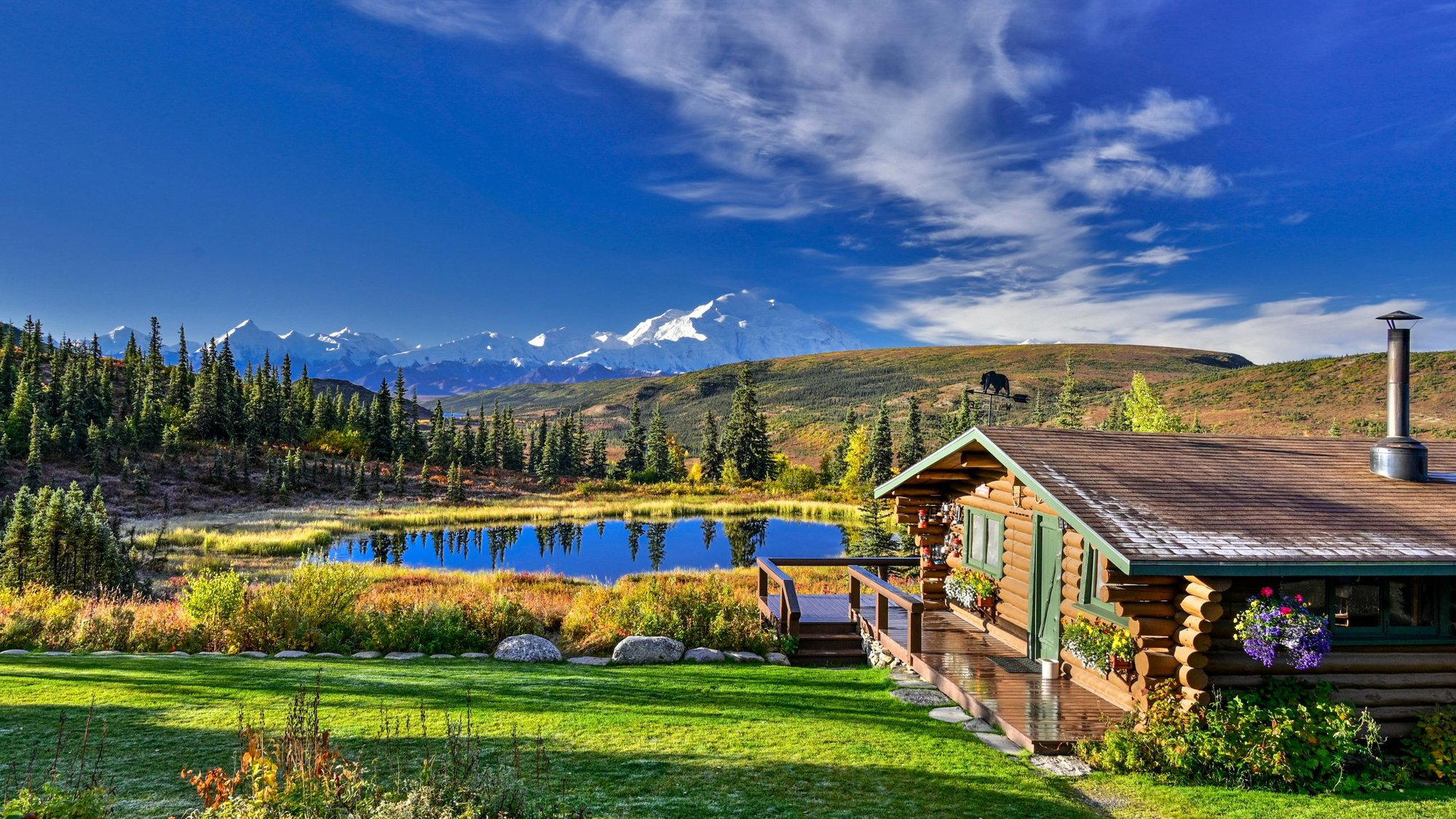
Forty Miles from the Last Paved Road
Camp Denali is a 19-room hotel in Denali National Park, Alaska, with rates from $1,475 per night. The approach to Camp Denali tells you most of what you need to know. Mile 89 of Denali Park Road is not a landmark you reach by accident. Private vehicles are prohibited past the park's Savage River checkpoint, so guests travel the remaining distance by park concessionaire bus, watching the boreal forest thin into open tundra as the Alaska Range fills the windshield. By the time the property's hand-built cabins come into view, with Denali's north face occupying the skyline at roughly 27 miles distance, the architecture already feels deliberate: structures sized and positioned to defer to what surrounds them rather than compete with it.
That relationship between built form and wilderness terrain is the defining design logic at Camp Denali, and it places the property in a specific and relatively rare tier of American wilderness lodging. The broader category splits between large destination resorts that import luxury amenities into remote settings (think Amangiri in Canyon Point or Amangani in Jackson Hole) and smaller outposts where the accommodation serves primarily as a base camp. Camp Denali sits in a third position: modest in scale and deliberate in material restraint, but program-rich in a way that requires significant planning infrastructure. It is closer in spirit to Blackberry Farm in Walland or Sage Lodge in Pray than to a tent-and-cot backcountry operation.
Structures That Read as Landscape
The cabins at the hotel reflect a mid-twentieth-century Alaskan vernacular, and that absence is part of the point. The structures reflect a mid-twentieth-century Alaskan vernacular: log and timber construction, small footprints, south-facing windows sized to frame the mountain rather than panoramize the view into wallpaper. This is an architectural tradition that grew from practical necessity in subarctic conditions rather than from resort design trends, and it remains largely unchanged at the property. The result is that the cabins feel earned rather than installed.
Within the American wilderness lodging category, this approach has become increasingly countercultural. Properties like Post Ranch Inn in Big Sur and Ambiente, A Landscape Hotel in Sedona have made architectural ambition central to their identities, with significant design investment in how structures integrate with topography. The hotel's integration is quieter: the buildings do not announce themselves. Individual cabins are positioned across a hillside, spaced for privacy, each oriented toward the Alaska Range. The main lodge building anchors the communal program, with the dining room functioning as a gathering space where guests share meals family-style, a format that shapes the social architecture of a stay as much as any physical design choice.
The Logic of a Fixed Itinerary
The hotel operates on a stay-based model common to remote wilderness properties: guests book multi-night packages rather than nightly rates, with guided programming included. This format, also used at properties like Alpine Falls Ranch in Superior and Canyon Ranch Tucson in Tucson, exists partly for logistical reasons and partly because meaningful engagement with a remote environment takes time that a one-night stay cannot provide. In Denali's case, the minimum stay structure also reflects the property's position at Mile 89: the travel time to reach it from the park entrance alone makes short visits impractical.
The guiding program centers on natural history interpretation, wildlife observation, and hiking across the surrounding tundra. Denali National Park's wildlife corridor along the park road is one of the few places in North America where grizzly bears, wolves, caribou, and Dall sheep are reliably present in open terrain with good sightlines. Access to this corridor from a property positioned at Mile 89 is a locational credential that properties closer to the park entrance, or properties outside the park entirely, cannot match.
For the domestic wilderness lodging category, this kind of access-as-amenity has become a meaningful differentiator. Properties like Kona Village, A Rosewood Resort in Kailua Kona or Little Palm Island Resort & Spa in Little Torch Key sell geographic exclusivity through island or coastal remoteness. The hotel sells it through park access that is structurally restricted to a handful of permitted concessionaires. The address at Mile 89 is not incidental; it is the product.
Season, Timing, and the Light Question
The hotel operates seasonally, with the property open during the Alaskan summer months when the park road is passable and wildlife is active across the tundra. This is a practical constraint that doubles as a curatorial one: the property's character is inseparable from the extended daylight of an Alaska summer, when usable light for hiking and wildlife observation runs well past midnight. The summer solstice period, when Denali can receive close to 24 hours of usable daylight, represents a different physical experience of wilderness than any winter or shoulder-season alternative would provide.
Guests planning around peak summer access should expect to book well in advance. The combination of limited cabin inventory, multi-night minimums, and a short operating season compresses demand into a narrow window. Properties at this tier of remote American lodging, whether SingleThread Farm Inn in Healdsburg or Auberge du Soleil in Napa in agricultural settings or backcountry alternatives in national park corridors, routinely fill months ahead for peak dates. At the hotel, given the access restrictions distinctive to its Mile 89 position, that lead time is likely longer than at comparably priced alternatives with easier logistics.
For reference, see our full Denali Borough restaurants and venues guide for broader context on what the region offers across accommodation and dining tiers.
comparable set and Positioning
Placed against the broader American luxury wilderness lodging category, the hotel occupies a specific position: smaller and less architecturally ambitious than Aman properties, more program-intensive and remotely situated than design-led hotels like Troutbeck in Amenia or Bowie House, Auberge Resorts Collection in Fort Worth, and more access-defined than resort complexes like Bernardus Lodge & Spa in Carmel Valley or Four Seasons at The Surf Club in Surfside. The closest analogues are properties where geographic position inside a protected area constitutes the primary value proposition, and where the built environment is designed to support rather than compete with that position.
That design restraint is not a limitation but a statement about what the property is for. In an era when wilderness lodges increasingly compete on spa programming, wine lists, and architectural photography, a property that keeps its structure modest and its guiding program primary is making an explicit choice about its comparable set. The choice is consistent with everything Mile 89 implies.
Planning Your Stay
Access to the hotel requires pre-booking multi-night packages; the park road logistics make this non-negotiable for any meaningful stay. Guests typically fly into Fairbanks or Anchorage and connect to the park area by road or small aircraft, then travel the park road by bus to the property. Given the combination of air connection logistics, minimum stay requirements, and peak-season demand, treating the booking process as an expedition planning exercise rather than a hotel reservation is the practical approach. Properties with comparable logistical complexity, such as Raffles Boston in Boston for urban alternatives or Aman New York in New York City for full-service luxury comparisons, offer easier logistics but a fundamentally different proposition.
How It Stacks Up
Comparable venues nearby, for context on price, style, and recognition.
| Venue | Cuisine | Price | Awards | Notes |
|---|---|---|---|---|
| Camp DenaliThis venue — the venue you are viewing | rustic wilderness lodge | $$$$ | Not listed | Not listed |
| Sheldon Chalet | Exclusive alpine luxury chalet on private nunatak | $$$$ | Not listed | Denali National Park |
| The Wildbirch Hotel | Modern design-forward boutique blending Alaskan heritage with upscale comfort | $$$ | Not listed | Mushing District |
| Tutka Bay Lodge | Intimate family-run wilderness lodge blending rustic Alaskan charm with luxury adventure. | $$$$ | Not listed | Kachemak Bay |
| Tsaina Lodge | rustic wilderness lodge | $$$$ | Not listed | Valdez |
| Hotel Captain Cook | Historic luxury with modern updates | $$$ | 4-Star | Downtown Anchorage |
At a Glance
- Rustic
- Scenic
- Quiet
- Intimate
- Romantic Getaway
- Wellness Retreat
- Group Retreat
- Weekend Escape
- Panoramic View
- Wi Fi
- Mountain
- Wi Fi
Rustic elegance in tastefully appointed cabins amidst wilderness, fostering intimate connection with nature.