


Michelin Selected · Tablet Hotels Best New Hotel Designs (Asia) · Small Luxury Hotels of the World Member
A 19th-century hunting lodge in Rajasthan's Pali district, Brij Lakshman Sagar sits in the heritage-property tier that prizes locally sourced materials and architectural continuity over imported luxury vocabularies. The property's revival preserves its original scale and spatial logic, placing it among a small cohort of Indian heritage stays where the building itself carries the curatorial weight.

Pearl is the En Primeur Club membership app, where members save venues, book tables and use the concierge.
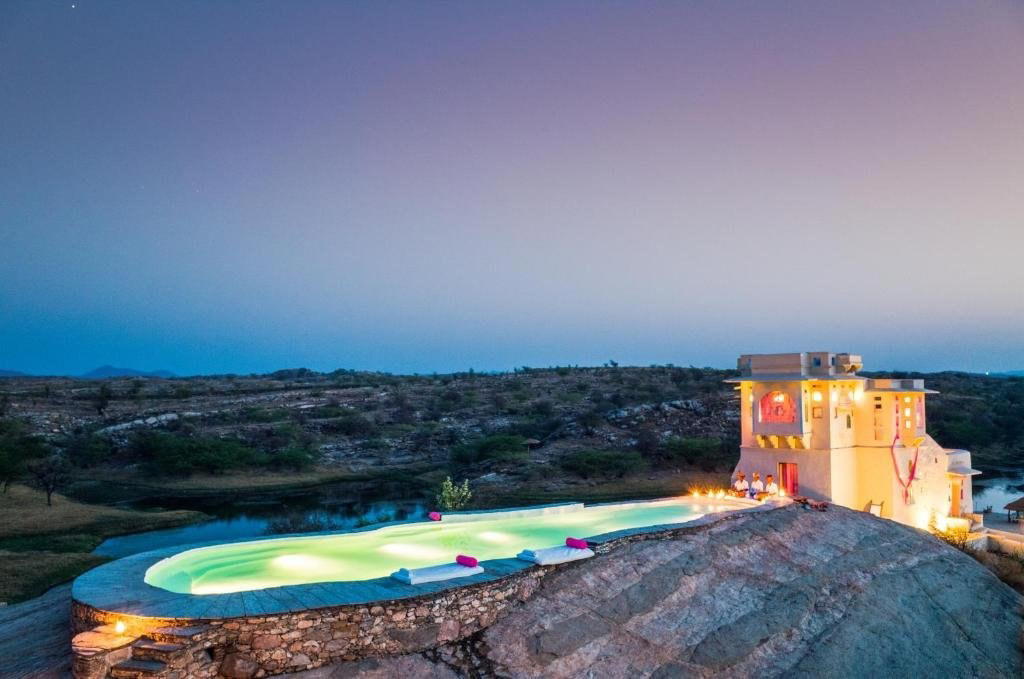
Where the Architecture Does the Talking
Rajasthan's heritage-hotel category has split into two distinct streams over the past two decades. One stream flows toward palatial scale: grand facades, ballroom-sized lobbies, and a heritage aesthetic applied like a coat of paint over modern resort infrastructure. The other stream, considerably smaller, prizes the opposite: properties where the original structure is the primary experience, and where restoration choices are legible in every beam, stone, and courtyard proportion. Brij Lakshman Sagar belongs firmly to the second stream. Set in the uplands of the Pali district along Raipur Road near Haripur Railway Station, this 19th-century hunting lodge has been revived not as a museum piece or a themed resort, but as a working expression of the regional craft and material culture that produced it.
The hunting lodge typology is worth understanding on its own terms before arriving. These were not palaces; they were functional outposts built for aristocratic use in wilderness terrain, which means the architecture prioritises intimate scale, directional views, and integration with landscape over ceremonial grandeur. That structural logic remains the governing principle here. Rooms are not arranged to impress on approach; they are arranged to frame what lies beyond the walls. It is a spatial philosophy that puts the surrounding Rajasthani uplands at the centre of the experience, with the built environment acting as a filter rather than a spectacle.
Local Materials as Design Language
In an era when luxury properties in India often source finishing materials, furniture, and fittings from distant suppliers in the name of consistency, the commitment to local provenance at Brij Lakshman Sagar represents a genuine editorial choice. Architecture and styling sourced from the immediate region means that the stone, the textiles, the carved woodwork, and the decorative vocabulary all carry the fingerprint of Rajasthani craft traditions rather than a global luxury aesthetic imported for the occasion.
Rajasthan's craft traditions are among the most extensively documented in India: sandstone carving from Jodhpur and Nagaur, block-printed and resist-dyed textiles from the Barmer and Jaipur belts, hand-knotted dhurries from Salawas, lacquerwork furniture from Udaipur. When a property commits to sourcing within this tradition, the rooms accumulate a material density that mass-market heritage hotels cannot replicate. Each surface carries provenance. The weight and warmth of the place is not manufactured; it is inherited. For comparison, properties that achieve comparable material authenticity in other Indian heritage contexts include Haveli Dharampura in Delhi and Chapslee in Shimla, both of which treat the original structure as a primary curatorial object rather than a backdrop.
The Pali District as Context
Pali sits in central-western Rajasthan, a district better known to textile traders and pilgrims than to international tourism circuits. That relative obscurity is precisely what makes it interesting from an editorial standpoint. The dominant Rajasthan tourist corridor runs between Jaipur, Jodhpur, and Udaipur, with most properties in the luxury tier oriented toward that axis. Properties in Pali operate outside that gravitational pull, which tends to mean smaller guest volumes, less transactional hospitality rhythms, and a greater chance of engaging with the terrain on its own terms rather than as a backdrop to a curated itinerary.
The upland terrain around the property connects to the broader Aravalli landscape that stretches across western Rajasthan, and the proximity to Suján Jawai in the Jawai region places Brij Lakshman Sagar within a loose cluster of considered heritage and wildlife-adjacent stays that have begun to reframe the western Rajasthan experience beyond the fort-and-palace circuit. For travellers building a considered Rajasthan itinerary, this part of the state rewards those willing to move away from the established corridor. Our full Pali restaurants guide covers the broader food and hospitality picture in the district.
Where Brij Lakshman Sagar Sits in the Indian Heritage Market
India's heritage-stay market operates across a wide range of price points and restoration philosophies. At the upper end of the market, international-standard properties like The Leela Palace Jaipur, The Oberoi Amarvilas in Agra, and The Taj Mahal Palace in Mumbai compete on service infrastructure and brand recognition as much as on architectural character. At the opposite end, authentically restored properties with limited keys and locally grounded design operate on a different logic entirely, one where atmosphere, material honesty, and a sense of genuine place outweigh the amenity checklist.
Brij Lakshman Sagar positions itself in the latter category, alongside a cohort of Indian properties where the restoration brief was clearly to preserve rather than to perform. The Brij brand, of which this lodge is a part, has developed a track record in this approach across Rajasthan, making it a useful reference point for travellers comparing heritage options in the region. Parallel properties in other Indian states that operate under similar philosophies include Aman-i-Khas in Ranthambore, where the design is low-intervention by principle, and Ananda in the Himalayas in Narendra Nagar, where the architectural relationship to landscape takes precedence over conventional resort programming.
Planning Your Stay
Brij Lakshman Sagar is located on Raipur Road near Haripur Railway Station in the Pali district of Rajasthan, a position that makes it accessible from Jodhpur (the nearest major transport hub) while remaining genuinely removed from the urban circuit. The lodge's railway-adjacent location means that rail travel from Jodhpur or Jaipur is a viable approach for those who prefer it. The cooler months between October and March represent the standard window for Rajasthan travel, when daytime temperatures in the Pali uplands are manageable and the landscape is at its most photogenic after the monsoon's retreat. Summer months push temperatures into ranges that significantly alter the outdoor experience, and the monsoon period, while atmospheric, can affect accessibility on rural roads in the district.
Given the property's small scale and the growing interest in off-corridor Rajasthan, booking well in advance is advisable, particularly for the October-to-February peak period when competing demand from wildlife and heritage itineraries is highest across western Rajasthan. For travellers building a wider India itinerary that moves between heritage contexts, useful reference points in other states include Garner Kutch Gujarat in Kutch for a comparable regional-craft immersion in Gujarat, and Anantya By The Lake in Kaliyal for a southern Indian counterpart that similarly prioritises landscape relationship and local material culture over conventional resort infrastructure.
Comparable Venues
Comparable venues nearby, for context on price, style, and recognition.
| Venue | Cuisine | Price | Awards | Notes |
|---|---|---|---|---|
| Brij Lakshman SagarThis venue (the venue you are viewing) | Restored 19th-century hunting lodge with authentic Rajasthani architecture using locally sourced materials | $200–300 | Michelin Selected · Tablet Hotels Best New Hotel Designs (Asia) | Not listed |
| Suján Jawai | Hotel | $1,000–1,500 | 2 Michelin Keys · World's 50 Best #91 | Pali |
| Taj Bekal Resort and Spa, Kerala | Contemporary classic resort with Kettuvallam houseboat-inspired architecture blending local Kerala elements and modern luxury. | Not listed | Michelin Selected | Bekal |
| The Leela Palace Bengaluru | Palatial luxury resort in urban setting | $200–300 | Michelin Selected | Old Airport Road |
| Taj Aravali Resort & Spa, Udaipur | Contemporary Rajasthani retreat blending tradition and modernity | Not listed | Michelin Selected | Bhujra |
| RAAS Jodhpur | Heritage haveli restored with modern additions | Not listed | Michelin Selected · Mr & Mrs Smith Seal of Approval | Walled City |
Recognition history
Dated appearances from independent guides and award organizations, with the underlying list record or original source where available.
Michelin Selected
Michelin
Tablet Hotels Best New Hotel Designs (Asia)
Tablet Hotels · Tablet Hotels Design Awards 2026: Best New Hotel Designs (Asia)
Small Luxury Hotels of the World Member
Small Luxury Hotels of the World
Details
- Romantic
- Quiet
- Rustic
- Scenic
- Elegant
- Intimate
- Honeymoon
- Romantic Getaway
- Wellness Retreat
- Anniversary
- Weekend Escape
- Private Villa
- Infinity Pool
- Historic Building
- Panoramic View
- Private Dining
- Pool
- Spa
- Wi Fi
- Room Service
- Concierge
- Free Parking
- Mountain
- Garden
Tranquil and enchanting with riotous colorful local decor complementing the austere Rajasthan badlands, soft evening lighting for starlit dinners, and a peaceful natural atmosphere filled with birdsong and peacocks.