Bay of Fires Bush Retreat

Bay of Fires Bush Retreat sits on 795 Reids Road in Binalong Bay, Tasmania, selected by the Michelin Hotels guide for 2025. The property occupies a low-impact position within the coastal bush of northeastern Tasmania, where the white-sand beaches and orange-lichen granite of the Bay of Fires conservation area form the immediate backdrop. It represents a strain of Australian wilderness accommodation that treats the surrounding landscape as the primary design material.
Pearl is the En Primeur Club membership app — saves, bookings, and concierge access live there. Same editors, same standards.
- Address
- 795 Reids Rd, Binalong Bay TAS 7216, Australia
- Phone
- +61 3 6376 6000
- Website
- bayoffiresbushretreat.com.au
- Directions
- Get directions
 Saves & bookings on Pearl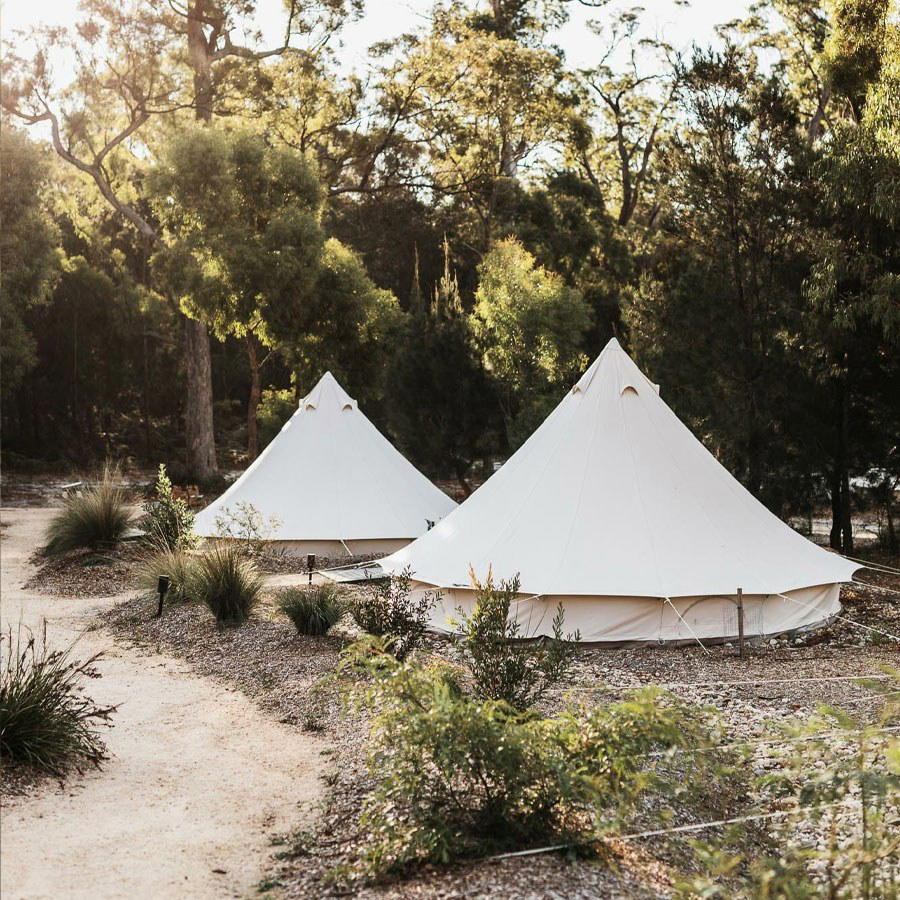
Where the Bush Does the Architectural Work
In northeastern Tasmania, a specific kind of hospitality has taken hold: properties that treat the surrounding landscape not as a view to frame but as the structural logic of the entire stay. The Bay of Fires coastline, with its white-quartz beaches, orange-lichened boulders, and banksia-dense scrub, is among the more visually coherent wilderness stretches in Australia. Bay of Fires Bush Retreat, a 5-star hotel in Binalong Bay with rates from about USD 210 per night, sits at 795 Reids Road and was selected by the Michelin Hotels guide for 2025.
The design approach at properties in this category begins with a question most hotels never ask: what is the minimum intervention required to make this place habitable? The answer shapes everything from structure to material palette to sightlines. Where city hotels like Capella Sydney or The Tasman in Hobart use architecture to assert a metropolitan identity, bush retreats in the Bay of Fires region use architecture to recede. The bush does the work; the built elements provide shelter and orientation.
The Bay of Fires Setting as Context
Binalong Bay sits at the southern end of the Bay of Fires, a roughly 50-kilometre coastal stretch that runs north toward Eddystone Point. The area carries a distinct visual signature: orange and yellow lichens colonise the granite outcrops along the shoreline, and the sea shifts between deep blue and pale aquamarine depending on the angle of the sun. It is not a populated coast in any conventional resort sense. Accommodation options remain sparse, which is part of the point. The region's remoteness is what separates it from more accessible Tasmanian destinations closer to Launceston or Hobart.
For context, Tasmania has developed a recognisable tier of wilderness-focused accommodation in recent decades, most of it positioned in parts of the island where the ecological settings justify the journey. Piermont Retreat in Dolphin Sands occupies a different coastal register on the east coast, while properties further afield like Wildman Wilderness Lodge in Marrakai and Southern Ocean Lodge in Kingscote represent the same broader category across the continent: accommodation that earns its rates through setting and restraint rather than facilities density. Bay of Fires Bush Retreat operates within that peer group.
Design Logic in a Remote Context
The design sensibility common to serious bush retreats in this region prioritises materials that weather gracefully and structures that minimise visual interruption of the treeline or coastal sightlines. Timber, corrugated metal, and stone that references local geology are the standard vocabulary. Glass is used to dissolve the boundary between inside and outside rather than to display the building itself. The result, when executed well, is accommodation that feels genuinely embedded in its site rather than placed on top of it.
This contrasts with a different strain of Australian boutique design, exemplified by properties like The Calile in Brisbane or Mondrian Gold Coast, where design is an active statement about urbanity and cultural positioning. Neither approach is superior; they are responding to entirely different briefs. But it is worth understanding that the Michelin selection for Bay of Fires Bush Retreat signals recognition of a property that has met its own design logic on its own terms, not one that is competing on the axis of amenities, F&B; programming, or service theatre.
Australia's wilderness accommodation sector has split between large-scale eco-resorts that retain significant service infrastructure and smaller, more sparingly provisioned properties where the ratio of guests to landscape is kept deliberately low. Emirates One&Only; Wolgan Valley sits in the former camp: heritage homestead, full spa, wildlife-conservation framing, a complete resort experience in a remote setting. The hotel occupies the latter register, where lower guest density and deeper immersion in a specific place are the distinguishing features.
Planning the Stay
Binalong Bay is accessible from Launceston, the more practical entry point for the northeast of the state, rather than Hobart. The drive from Launceston to Binalong Bay runs roughly two to two-and-a-half hours depending on road conditions, passing through the Tamar Valley before moving east across the island. Guests should plan for self-sufficient arrival: the region has limited commercial infrastructure, and the remoteness that defines the experience also means that provisions, equipment, and logistics need to be handled in advance or in St Helens, the nearest town of any size to Binalong Bay. For those arriving from interstate, Launceston Airport connects to Melbourne and Sydney, giving reasonable access without requiring a Hobart transit. Those who have recently stayed at properties like Osborn House in Bundanoon or Empire Spa Retreat in Yallingup will recognise the operational register: this is accommodation built around immersion in a particular place, not around convenience.
Seasonality matters here more than at most properties. The Bay of Fires is at its most legible in the Tasmanian summer, roughly December through March, when long daylight hours, stable weather, and accessible water temperatures align. Autumn brings different light and fewer people. Winter is cold and often wet, but the coast takes on a starkness that some travellers prefer. The Michelin selection reflects performance year-round, but timing a visit for the shoulder seasons of late November or April often means the full character of the landscape without peak-summer crowding.
For broader orientation across the region, our full Binalong Bay restaurants guide covers the food and drink options in and around the area, useful context for building out the practical side of a stay that may require more advance planning than most. Travellers coming from properties like Melbourne Place or Harbour Rocks Hotel in The Rocks should adjust expectations accordingly: this is a different kind of travel, defined by what is absent as much as what is present.
How It Stacks Up
Comparable venues nearby, for context on price, style, and recognition.
| Venue | Cuisine | Price | Awards | Notes |
|---|---|---|---|---|
| Bay of Fires Bush RetreatThis venue — the venue you are viewing | Modern glamping resort with rustic-but-stylish furnishings emphasizing low environmental impact and immersion in native bushland. | $$ | 5-Star | Not listed |
| COMO Hotels and Resorts Melbourne | Urban boutique hotel in a fashionable shopping and dining precinct, combining apartment-style accommodation with hotel services. | $$$ | 5-Star | South Yarra / Chapel Street |
| Lilianfels Blue Mountains | Historic country house resort with European charm | $$$$ | 5-Star | Katoomba |
| Freycinet Lodge | Luxury eco-lodge reimagining of classic camp cabins with contemporary design elements; timber structures integrated into natural landscape with grounded elegance. | $$$ | 4-Star | Coles Bay |
| Mondrian Gold Coast | Sculptural beachfront towers inspired by sand dunes and headland with open-air living spaces. | $$$$ | 5-Star | Burleigh Heads |
| Eden Health Retreat | Luxurious rainforest lodges with valley views and modern wellness facilities | $$$$ | 5-Star | Currumbin Valley |
Recognition history
Dated appearances from independent guides and award organizations, with the underlying list record or original source where available.
Michelin Selected
Michelin
Continue exploring
More in Binalong Bay
Hotels in Binalong Bay
Browse all →
At a Glance
- Scenic
- Cozy
- Rustic
- Quiet
- Bohemian
- Weekend Escape
- Romantic Getaway
- Wellness Retreat
- Garden
- Terrace
- Design Destination
- Panoramic View
- Parking
- Garden
- Parking
Warm, inviting, and naturally lit spaces that blend rustic charm with modern comfort; guests describe the setting as magical and peaceful, with an emphasis on immersion in nature while maintaining luxury amenities.