Ambua Lodge
Set at roughly 2,100 metres in Papua New Guinea's Southern Highlands, Ambua Lodge places guests inside the montane forest above the Tari Valley, among the more ecologically concentrated regions on the island. The lodge operates as a base for birdwatching, cultural contact with Huli communities, and high-altitude trekking in a part of the world where international-standard accommodation is genuinely scarce.

Pearl is the En Primeur Club membership app — saves, bookings, and concierge access live there. Same editors, same standards.
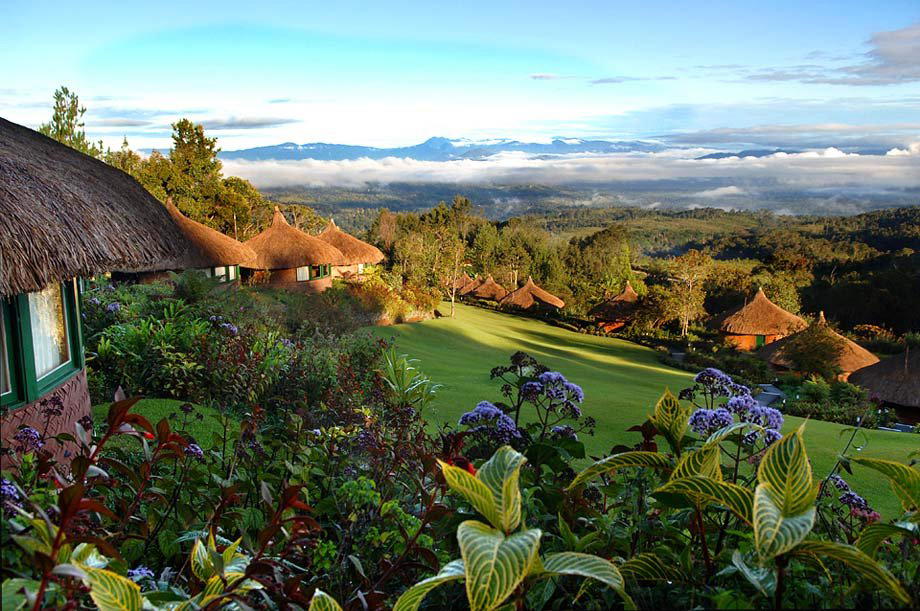
Where the Cloud Forest Sets the Terms
Ambua Lodge is a hotel in the Southern Highlands of Papua New Guinea, with 48 rooms and a casual dress code. Ambua Lodge, sitting at approximately 2,100 metres above the Tari Valley in Papua New Guinea's Southern Highlands, belongs to that category. The altitude here is not incidental. It determines what you hear at dawn, what arrives at the feeding stations outside the rooms, and how cold the air becomes once the afternoon mist rolls in from the forest edge. The architecture at Ambua has always followed that logic: thatched bungalows built to recede into the treeline rather than assert themselves against it.
Papua New Guinea's highlands accommodation has never operated on the same scale or competitive density as, say, East Africa's safari circuit or Southeast Asia's design-led resort tier. Properties like Makara Lodge in Tari and Airways Hotel and Residences in Port Moresby represent the bracketing options for travellers passing through PNG: the gateway city hotel on one end, the remote highlands base on the other. Ambua occupies the latter position more completely than almost any other property in the country, which is precisely what makes it relevant to a narrow but serious segment of the international travel market.
The Architecture of Concealment
The design philosophy at high-altitude wilderness lodges in the Pacific and sub-Pacific region has historically defaulted to one of two approaches: imported materials that signal comfort at the expense of place, or vernacular construction that prioritises belonging over amenity. Ambua has, across its operational history, leaned toward the second. The bungalow format, with pitched thatch roofing and timber framing, reads as an intentional response to the surrounding montane forest rather than an imposition on it. In this sense, Ambua shares a design logic with properties in different geographies, Amangiri in Canyon Point, for instance, uses raw concrete and desert palette to disappear into Utah redrock, while Hotel Esencia in Tulum works through jungle canopy integration. The ambition is the same: let the site win.
What distinguishes Ambua's architectural context from those examples is the relative absence of international design influence. The Southern Highlands is not a destination that attracts architects seeking profile. The lodge's built environment reflects practical necessity and ecological sensitivity in roughly equal measure, which gives it an authenticity that more polished properties often manufacture expensively and still fail to achieve. The absence of resort infrastructure, no spa pavilions, no infinity-edge pools calibrated for Instagram, is not a gap. It is the point.
For travellers accustomed to properties like Castello di Reschio in Lisciano Niccone or Cheval Blanc Paris, where design is itself a primary attraction and every surface carries an intentional authorship, Ambua requires a recalibration of expectations. The physical space here serves the programme, birdwatching, Huli cultural engagement, forest walking, rather than being the programme itself. That is a fundamentally different hospitality proposition, and guests who arrive expecting the former tend to miss what the lodge actually offers.
The Tari Valley as the Real Exhibit
The Southern Highlands of Papua New Guinea sit within one of the highest concentrations of endemic bird species on Earth. The Tari Basin and surrounding forest are primary habitat for Birds of Paradise, including species rarely observable outside this specific altitudinal band. Ambua's position at the forest edge, at an elevation that captures both lower montane and cloud forest zones, places it within range of species lists that draw serious ornithologists from Australia, Europe, and North America specifically to this location. This is not a general wildlife destination where birdwatching is an add-on activity. It is one of the few places in the world where the birds themselves are the primary infrastructure.
That reputation has sustained Ambua's market position in the absence of the conventional luxury signals that drive bookings elsewhere. Where properties like Aman New York or Bvlgari Hotel Tokyo compete on service density, F&B; programming, and address prestige, Ambua competes on ecological access, a category where its comparable set globally is small and its position within Papua New Guinea is effectively without equivalent.
Planning a Stay: Logistics and Timing
Reaching the Southern Highlands requires routing through Port Moresby, where travellers typically spend at least one night before connecting to Mendi or Tari on a domestic carrier. The connection to Airways Hotel and Residences in Port Moresby makes practical sense as a transit base before the highlands leg. Domestic flight schedules in PNG are subject to disruption, and building buffer days into an itinerary is standard practice for anyone who has travelled the circuit before.
The dry season, running broadly from May through October, corresponds with particularly reliable visibility and trail conditions in the highlands, and represents peak season for birdwatching guides and cultural access. The wet season brings heavier cloud cover and muddier tracks but also a different forest character that some naturalists actively prefer. Advance booking, particularly during the dry season window, is advisable given the limited room count at highland properties of this type.
Travellers combining the highlands with coastal or island extensions frequently route back through Port Moresby before connecting onward. The full trip architecture typically runs ten days at minimum to justify the journey.
Positioning Against Global Wilderness Lodges
The global market for high-altitude wilderness lodges is narrower than the broader luxury hotel market, and operates on different selection criteria. Properties like One&Only; Mandarina in Riviera Nayarit or Mandarin Oriental Bangkok attract guests partly through brand recognition and service infrastructure. Ambua operates in a different register entirely: it attracts guests who have already done the research, already accepted the logistics, and are coming specifically for ecological access that no amount of brand equity can replicate in a different location.
That specificity of purpose is both the lodge's strength and its limiting factor. It is not a property that converts casual luxury travellers who discover it on a list. It is a destination that serious naturalists and highland travel specialists have tracked for years. In a market where so many properties chase the same guest with the same design vocabulary and the same F&B; concepts, there is a distinct argument for this kind of irreplaceable positioning. Properties from Badrutt's Palace in St. Moritz to Hotel du Cap-Eden-Roc in Cap d'Antibes hold their market position through long-established address prestige. Ambua holds its position through something harder to manufacture: location that cannot be moved and ecology that cannot be themed.
At a Glance
- Scenic
- Rustic
- Quiet
- Cozy
- Romantic Getaway
- Wellness Retreat
- Weekend Escape
- Panoramic View
- Garden
- Bar
- Laundry Service
- Mountain
- Bar
- Laundry Service
Cozy atmosphere with central fireplace, landscaped gardens, and cool highland evenings warmed by electric blankets.