← Guides
What a Visit to E. Guigal Actually Involves The confirmation arrives by email, or more likely by phone, in French, and it is not a given. E.
What a Visit to E. Guigal Actually Involves The confirmation arrives by email, or more likely by phone, in French, and it is not a given. E.
The confirmation arrives by email, or more likely by phone, in French, and it is not a given. E. Guigal, the Ampuis house that turned the Côte Rôtie into a collector's obsession, does not run a public tasting room at its working winery. There is no walk-in cellar door, no booking widget, no Resy page. Getting inside the winery, located at 5 Route de la Taquière, 69420 Ampuis,1 requires either a trade connection, a well-timed direct inquiry, or the patience to work through a specialist importer or wine-travel operator. For most private visitors, access is possible, but it is not easy, and it is not guaranteed.
What is publicly documented about Guigal visits, from trade accounts and wine-travel operators who have facilitated them, points to a cellar experience centered on the estate's aging program rather than a formal tasting-room format.
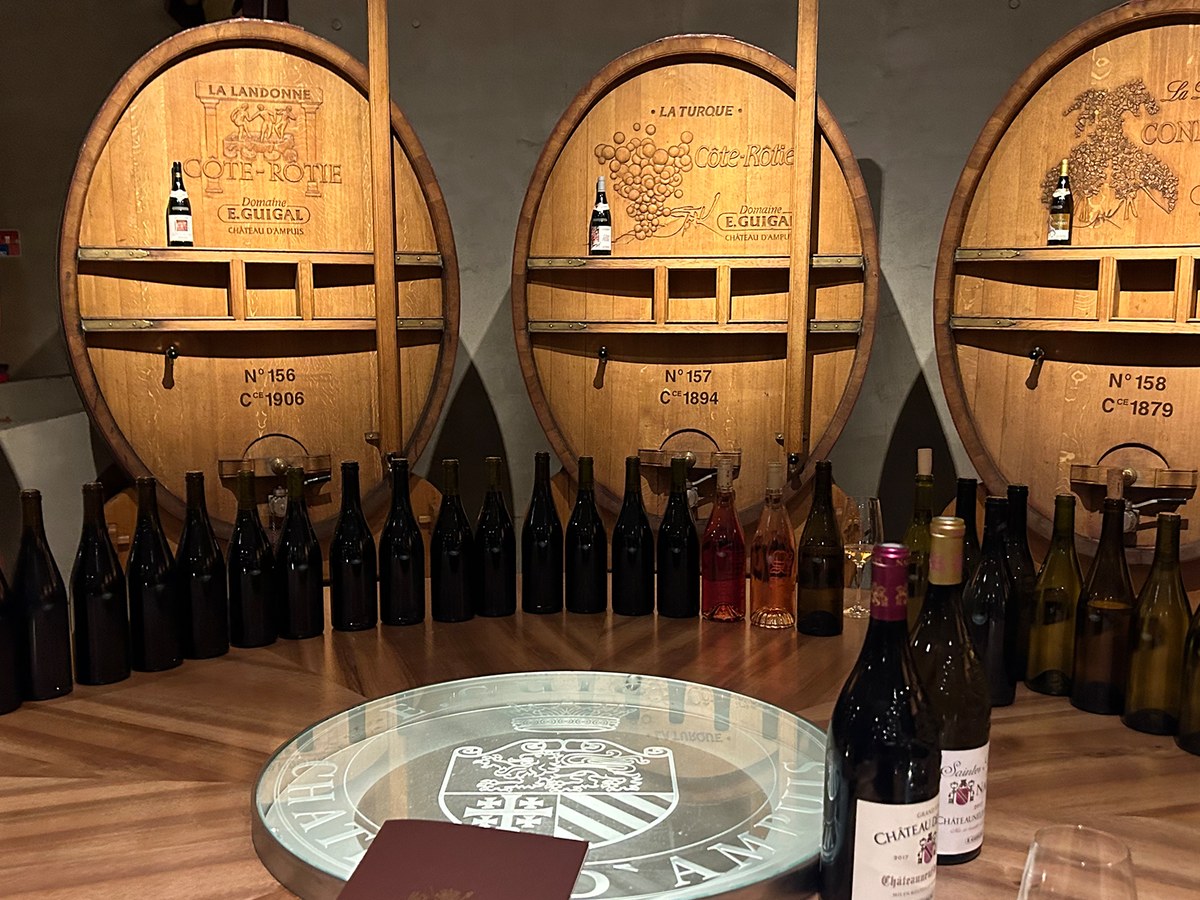
The Guigal cellars in Ampuis hold the La-Las through an extended élevage in new oak, a program that is immediately legible when you stand among the barriques. The cellar holds as many as 4,000 French oak barrels,2 and Guigal is the only winery in the Rhône with its own cooperage, producing 850 barrels annually.3 La Mouline, La Landonne, and La Turque each age in their own rotation; the cellar visit typically includes the barrel halls where this program runs.
The tasting component, when it occurs, focuses on the estate's range rather than a structured flight of the La-Las, these are not wines poured casually. Trade visitors and serious collectors may taste from barrel or from recently released vintages depending on timing and the nature of the relationship. The format is not a fixed menu; it reflects the conversation.
The setting is working Ampuis, the town sits directly on the Rhône, the terraced Syrah vineyards of the Côte Rôtie visible on the slopes above. The Côte Blonde and Côte Brune are not abstract appellations here; they are the hillside you can see from the road. That geographic immediacy, standing in the cellar while the source of La Landonne is visible through the window, is what the visit delivers that no tasting elsewhere replicates.
Confirm the scope of the visit when making your appointment request.
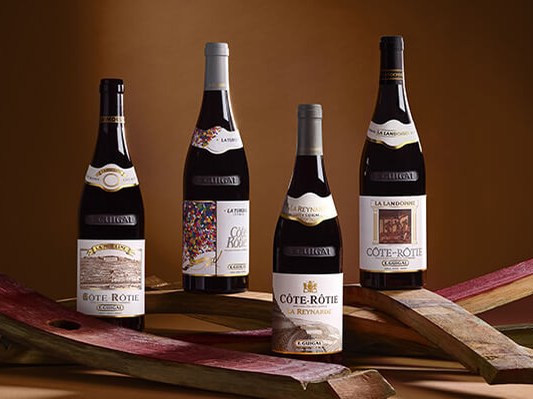
Guigal produces particularly sought-after wines in the northern Rhône, the three single-vineyard Côte Rôtie cuvées known as the La-Las: La Mouline, La Landonne, and La Turque. These are not large-production wines. No more than 400 cases are made of La Mouline and La Turque; La Landonne runs to around 800 cases.3 La Mouline is sourced from a parcel of Viognier-co-planted Syrah on the Côte Blonde. La Turque, the youngest of the three, is produced at no more than 400 cases per year.4 La Landonne was assembled parcel by parcel from 17 growers over a decade, with the vineyard fully replanted.5 Allocations go to a tight network of négociants and importers who have held relationships with the family for decades.
The family dimension matters here too. Marcel Guigal expanded the estate Étienne founded in 1946 into one of the Rhône's most influential houses. His son Philippe now leads winemaking. This is a family operation that has never needed to court casual visitors; demand for the wines has always outrun supply. The estate spans 75 hectares of vineyards, with 40 hectares in Côte-Rôtie alone,6 a scale that keeps the focus firmly on farming and élevage rather than visitor programming.
The routes that do work, in rough order of reliability:
Trade and importer introductions. One reliable path. If your wine merchant has a direct relationship with Guigal's UK, US, or European importer, a visit request routed through that channel carries weight. Négociants and importers who hold allocations occasionally facilitate client visits as part of a broader Rhône itinerary. This is the route that works; it requires building the merchant relationship first. Specialist importers such as House of Grauer7 handle Guigal allocations and can be contacted directly about access.
Direct contact with the domaine. Guigal does accept some private visitor inquiries, particularly from serious collectors. Writing in French, explaining your connection to the wines and your purpose, and requesting a visit several months in advance is the approach most likely to receive a response. Confirm directly with the domaine before planning travel around an assumed appointment.
Specialist wine-travel operators. A small number of Rhône-focused tour operators include Guigal as part of curated itineraries. One such private guided tour, departing from Lyon, is priced at $509.35 per person,8 runs approximately four hours, and is capped at eight guests.8 These operators hold pre-arranged access that individual visitors cannot replicate independently.
En primeur merchants. Buying Guigal en primeur, particularly the Château d'Ampuis Côte Rôtie or the La-Las when they appear in campaign, through a merchant who holds a direct allocation occasionally opens doors. This is a long game, not a same-season tactic. The Decanter at Home masterclass series has offered ticketed virtual tastings of the La-Las with Philippe Guigal,6 a lower-barrier entry point for collectors building familiarity with the range.
Based on the rhythm of the Rhône harvest and the estate's known practice of hosting trade visitors, the period from late spring through early summer, before the August slowdown and well ahead of the September-October harvest, is generally when appointment requests are most likely to be accommodated. This reflects general regional patterns rather than a published policy. Contact the domaine directly to confirm availability before booking flights to Lyon.
The La-Las are typically released to the trade some years after harvest, reflecting the extended élevage in small oak that defines these wines. Timing a visit to coincide with a release window is possible in theory; in practice, the estate's schedule is not publicly synchronized with consumer visit requests.
The patient route, building a merchant relationship over two or three years, buying Guigal's négociant-tier wines (the Côtes du Rhône rouge, the St-Joseph, the Crozes-Hermitage) through a single importer, then requesting a visit through that channel, costs little beyond the wine purchases themselves. The wines are worth drinking regardless.
The faster route is a specialist wine-travel operator. Cancellations on the structured private tour are free up to 24 hours in advance with a full refund,8 and the tour runs most days, weather permitting, as outdoor vineyard visits are weather-dependent.8 What you are paying for is certainty: a confirmed appointment at a winery closed to the general public.
There is no middle option. The estate does not sell tasting tickets, and there is no membership or allocation list that grants visit access as a benefit. For those who want the La-Las themselves, Sotheby's Wine offers assortment cases of the La-Las, the 2018 case of La Landonne, La Turque, and La Mouline is listed at $1,195.00,9 a secondary-market route for collectors who cannot wait for an importer allocation.
Arriving without an appointment. The winery in Ampuis is not set up for walk-ins. Showing up unannounced, even as a serious collector, is unlikely to result in a tasting and may close the door for a future request.
Contacting in English only, without context. A cold email in English with no explanation of your connection to the wines or your purpose reads as a generic tourist inquiry. Write in French if possible, name specific wines you have followed, and explain why you want to visit. The family responds to seriousness.
Conflating Guigal the négociant with Guigal the estate. The house produces wines across the Rhône under négociant arrangements, the Côtes du Rhône rouge is among the more widely distributed wines in France. Buying those wines at a supermarket does not establish the kind of merchant relationship that opens cellar doors. The relationship needs to run through a specialist importer who holds a direct allocation.
Leaving too little lead time. Several months' notice, routed through the right channel, is the minimum realistic approach, confirm directly with the domaine before planning travel around an assumed appointment.
| Estate | Access Difficulty | Public Booking Surface | La-La Equivalent | Best Route In |
|---|---|---|---|---|
| E. Guigal (Ampuis) | High, no public visits | None published | La Mouline, La Landonne, La Turque | Importer introduction or specialist tour operator |
| M. Chapoutier (Tain-l'Hermitage) | Moderate, visitor center exists | Published on estate website | Ermitage Le Pavillon, De l'Orée | Direct booking via estate site |
| Jean-Louis Chave (Mauves) | high, invitation only | None | Hermitage rouge (single-domaine) | Long-standing importer relationship only |
| Domaine Jamet (Ampuis) | High, small family domaine | None published | Côte Rôtie (single cuvée) | Direct contact, French preferred, advance notice |
| Paul Jaboulet Aîné (Tain-l'Hermitage) | Low, open to visitors | Published on estate website | La Chapelle Hermitage | Direct booking |
M. Chapoutier runs a proper visitor center in Tain-l'Hermitage with published tasting formats, a particularly accessible entry point into serious northern Rhône winemaking, and the biodynamic farming program gives the cellar visit genuine substance.
Domaine Jamet is the Côte Rôtie producer most comparable to Guigal in terms of critical standing and scarcity. The domaine farms a small number of hectares on the appellation's best slopes; a visit requires the same patient, French-language direct approach as Guigal, but the domaine is smaller and the relationship more personal when it works.
Paul Jaboulet Aîné, now under the Frey family, offers accessible visits and the chance to taste La Chapelle, the Hermitage that defined the appellation's reputation in the 1970s and 1980s, in a properly staffed tasting room.
For those who want a structured Guigal experience without the access uncertainty, the Caveau du Château10 in Ampuis is E. Guigal's dedicated tasting room. It is open year-round Monday to Saturday, 10am, 12:30pm and 2pm, 7pm,10 with Sunday hours from April through September, 10am, 12:30pm.10 Tastings are priced according to the number of wines and appellations chosen,10 and the venue offers guided tours, educational visits, themed tours, and room hire.10 It is not the winery itself, but it is a legitimate and accessible point of contact with the Guigal range.
A Guigal visit rewards collectors who already know the wines, who have followed the La-Las across vintages, who understand what extended aging in new oak does to a Syrah from the Côte Brune, and who want the geographic and winemaking context that only Ampuis provides. It is not the right first stop for someone new to the northern Rhône; the access difficulty is too high and the format too unstructured to serve as an introduction.
The visit suits a Rhône-focused itinerary built around harvest season or the spring post-bottling period, combined with visits to Chapoutier or Jaboulet for contrast and to Jamet for a smaller-scale counterpoint. The nearest major airport is Lyon-Saint Exupéry, about 50 km away; rental cars are recommended, or trains from Lyon to Vienne with onward buses to Ampuis.11 Ampuis itself is not a destination town, plan to stay in Vienne or Lyon and drive the D386 as part of a broader Rhône day.
Yes, but only if you approach it correctly. Guigal is not a winery that rewards spontaneity or casual inquiry. The access is real; it is simply gated behind relationships and lead time that most visitors underestimate. The importer route is especially reliable, and building it through consistent purchases of the estate's broader range over two to three years is the strategy that works. A specialist wine-travel operator is the faster alternative if you want certainty on a specific trip.
The La-Las are among the more discussed wines in the Rhône, and standing in the cellar where La Mouline ages in new oak, while the Côte Blonde terraces sit visible above the town, is an experience that no tasting in London or New York replicates. The estate's own cooperage, turning out 850 barrels a year,3 makes the élevage program tangible in a way that reading about it never quite does.
For most readers, the practical path is this: buy Guigal's Château d'Ampuis Côte Rôtie through a specialist importer, establish the relationship, and make the visit request through that channel with several months' notice. The wines are worth drinking while you wait. Those who want the La-Las themselves will find the allocation list runs through the same importers who open the cellar door, and that patience, here, is the one credential that cannot be shortcut.
It is possible but uncommon. The estate does not operate a public tasting room or publish a consumer booking surface. Private visitors without a trade or importer introduction can try a direct written inquiry, in French, with context about their connection to the wines, sent several months in advance. There is no published policy on private visitor requests; confirm directly with the domaine before planning travel around an assumed appointment. Alternatively, the Caveau du Château tasting room at 6 Route de la Roche, Ampuis, is open to the public without an appointment.
Based on the general practice of northern Rhône estates that accept private visitors, several months' notice is a reasonable minimum. Last-minute requests, made only weeks before planned arrival, are unlikely to be accommodated. Confirm directly with the domaine about current availability.
The La-Las are not poured as a matter of course. Trade accounts suggest that visits focus on the estate's broader range and the barrel aging program; whether the single-vineyard cuvées are included depends on the nature of the relationship and the timing of the visit. Do not plan a visit around the assumption of tasting all three La-Las, clarify the scope when making your appointment request.
Guigal does not operate a direct-to-consumer allocation list in the manner of some Burgundy or Napa estates. Allocations of the La-Las flow through a network of négociants and specialist importers. The practical route for private collectors is to establish a relationship with one of those importers, buying consistently from the estate's broader range, and request an allocation through that channel.
Ampuis sits on the D386 along the Rhône. Lyon-Saint Exupéry Airport is the nearest major hub, approximately 50 km away; rental cars are recommended for flexibility, or you can take a train from Lyon to Vienne and continue by bus to Ampuis. Lyon works well as a base for a multi-day Rhône itinerary that combines Guigal with visits to Chapoutier or Jaboulet in Tain-l'Hermitage, roughly an hour further south.
Get the App
Take the shortlist into the En Primeur Club app for concierge access, saved places, and the next step after discovery.
Get Exclusive AccessMore from the editors