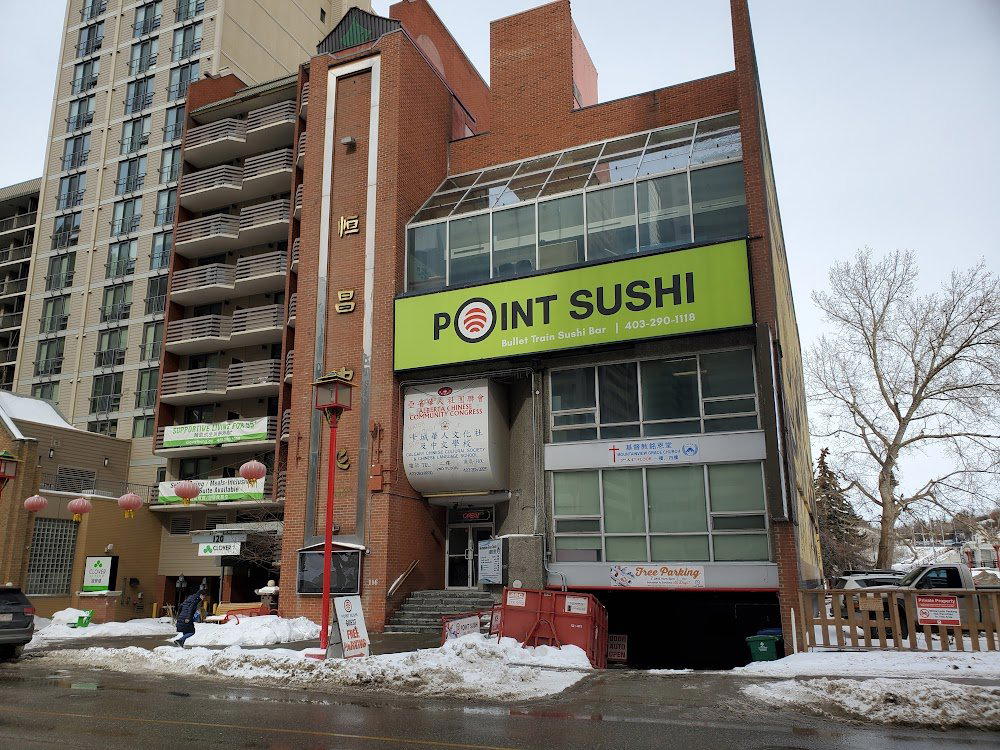
Point Sushi's bullet train conveyor format brings a distinct Japanese dining ritual to downtown Calgary, placing it firmly in the casual, counter-culture end of the city's sushi scene. The 116 2 Ave SW address puts it within the core of the business district, making it a natural lunchtime draw for weekday crowds. For the format alone, it occupies a different tier from Calgary's omakase-style counters.

Pearl is the En Primeur Club membership app — saves, bookings, and concierge access live there. Same editors, same standards.
- Address
- 116 2 Ave SW, Calgary, AB T2P 3C6, Canada
- Phone
- (403) 290-1118
- Hours
- Daily 11:30 AM–8:30 PM
- Website
- pointsushi.ca
- Directions
- Get directions
The Conveyor Belt as Counter Culture
In Japanese cities, kaiten-zushi — the rotating conveyor belt sushi format — occupies a specific and well-understood position in the dining hierarchy. It is fast, democratic, and tactile: you reach, you choose, you eat. There is no menu ceremony, no extended tasting arc, no deference required. What the format demands from an operator is consistency, throughput, and the discipline to keep a moving line of product at an acceptable standard. When that discipline holds, the experience delivers something that slower, more structured formats cannot, immediacy and self-determination at the table.
Point Sushi brings that format to downtown Calgary under the Bullet Train Sushi Bar banner, translating a Japanese dining convention into a prairie city context where sushi culture has matured considerably over the past decade. Calgary's sushi scene now spans from high-end omakase-style counters in the beltline to fast-casual rolls in food courts, and the conveyor format sits at a specific point in that range, more considered than a mall option, less ceremonial than a counter booking that requires planning weeks ahead.
What the Room Tells You Before You Sit Down
The address, 116 2 Ave SW, anchors Point Sushi in Calgary's downtown core, within the cluster of office towers and financial district streets that generate the lunch-hour traffic a conveyor format depends on. The spatial logic of a bullet train bar requires a floor plan organised around the belt itself: seating arranged to face the line, the kitchen operating as a kind of continuous performance visible through what the conveyor delivers rather than through an open pass. In the leading versions of this format, the physical flow of the room matches the rhythm of the meal, you arrive, you orient yourself to the moving track, and the pace is set for you.
That design proposition is fundamentally different from a standard table-service sushi restaurant, where the room's character is established by lighting, acoustics, and how staff move through the space. Here, the room is defined by the belt. The sound of the conveyor, the colour rotation of plates, the spatial logic of adjacent diners all reaching toward the same moving source, these are the sensory facts that define what it feels like to eat here. It is an efficient, somewhat industrial intimacy, and it works precisely because it makes no pretence of being something more contemplative.
The Format in a Calgary Context
Calgary's sushi market has followed a trajectory common to other mid-sized Canadian cities: early adoption through Japanese-Canadian hybrid menus in the 1990s and 2000s, followed by a gradual disaggregation into price tiers and format categories. The conveyor belt model arrived in that context as a recognisable format with strong Japanese cultural legibility, appealing to a customer base that understood the reference even if they had not encountered it in Japan itself.
Within that market, Point Sushi occupies the accessible end without being entry-level. The conveyor format carries its own kind of theater, the bullet train branding sharpens that theatrical dimension, framing the belt as a transportation metaphor that moves product toward you with precision and speed. That framing does real work in differentiating the venue from competitors in the same price neighbourhood. Calgary has other conveyor or grab-and-go sushi options, but the specific branding proposition of a bullet train aesthetic positions Point Sushi in a slightly more defined niche.
For comparison, Calgary's more formal cocktail and dining culture is represented at places like Proof and Shelter, where the experience is built around a slower, more curated arc. Point Sushi operates in a different register entirely, the kind of place you are in and out of within forty-five minutes, having made a series of small, satisfying decisions. For those who want to extend the afternoon into a drink afterward, Missy's or 33 Acres Brewing Company Calgary represent nearby options in the broader downtown and inner-city orbit.
Kaiten-Zushi Across Canada
The conveyor belt format is not unique to Calgary in the Canadian context, but it remains less common than in cities with larger Japanese-Canadian populations. In Toronto, where bar-format dining has developed considerable range, venues like Bar Mordecai represent a broader shift toward counter-and-stool formats that prioritise intimacy at the bar rail, a different expression of the same counter-culture instinct. In Montreal, Atwater Cocktail Club anchors a scene built around precision and program depth, while in Vancouver, Botanist Bar sits within the luxury hotel tier. Victoria's Humboldt Bar, Whistler's Bearfoot Bistro, Kingston's Grecos, and Honolulu's Bar Leather Apron each anchor their respective cities' premium casual scenes in ways that illustrate how format and physical design drive differentiation across markets.
What Point Sushi does within this broader Canadian picture is assert a specific Japanese dining format in a city that has room for it. Calgary's food culture has diversified significantly alongside its economic growth, and the downtown core now supports a wider range of format experiments than it did twenty years ago. A bullet train sushi bar in the financial district is a reasonable bet in that environment.
Planning a Visit
Point Sushi sits at 116 2 Ave SW in Calgary's downtown core, within walking distance of the central LRT network and the cluster of business district hotels. The conveyor format generally makes reservations less critical than at table-service restaurants, walk-in seating around the belt is the operational norm for this format, though peak lunch hours in a business district location can create waits. For a wider view of where Point Sushi fits within Calgary's dining options, our full Calgary restaurants guide maps the city's key venues across format and price tiers.
Pricing, Compared
Comparable options at a glance, pulled from our tracked venues.
| Venue | Price | Awards |
|---|---|---|
| Point Sushi - Bullet Train Sushi BarThis venue — the venue you are viewing | $20–30 | Not listed |
| Missy's | Not listed | World's 50 Best #79 · Star Wine List |
| Shelter | $30–50 | World's 50 Best #98 · Canada's 100 Best Bars #45 |
| Paper Lantern | Not listed | Canada's 100 Best Bars #33 |
Continue exploring
More in Calgary
Bars in Calgary
Browse all →
Restaurants in Calgary
Browse all →

Hotels in Calgary
Browse all →
Wineries in Calgary
Browse all →
Point Sushi - Bullet Train Sushi Bar
The drinks
Signature drinks: house special cone.
Details
- Modern
- Trendy
- Whimsical
- Group Outing
- Casual Hangout
- Family
- Design Destination
- Standalone
- Seated Bar
- Booth Seating
- Sake
Current opening hours
- Monday
- 11:30 AM–8:30 PM
- Tuesday
- 11:30 AM–8:30 PM
- Wednesday
- 11:30 AM–8:30 PM
- Thursday
- 11:30 AM–8:30 PM
- Friday
- 11:30 AM–8:30 PM
- Saturday
- 11:30 AM–8:30 PM
- Sunday
- 11:30 AM–8:30 PM
Hours can change for holidays and private events. Last verified .
Modern and playful atmosphere with a tech-forward ordering system; bright and energetic dining experience that appeals to families and those seeking novelty.