Bodega Trapiche


Bodega Trapiche occupies a distinctive position in Mendoza's Maipú district, where Italian Renaissance architecture meets high-altitude Andean viticulture. Awarded EP Club's Pearl 3 Star Prestige in 2025, it represents the long-standing case for Argentine Bordeaux varietals as a serious category. For visitors tracing the Mendoza wine corridor, it anchors the south end of a coherent tasting itinerary.
Where Architecture Meets Altitude in Maipú
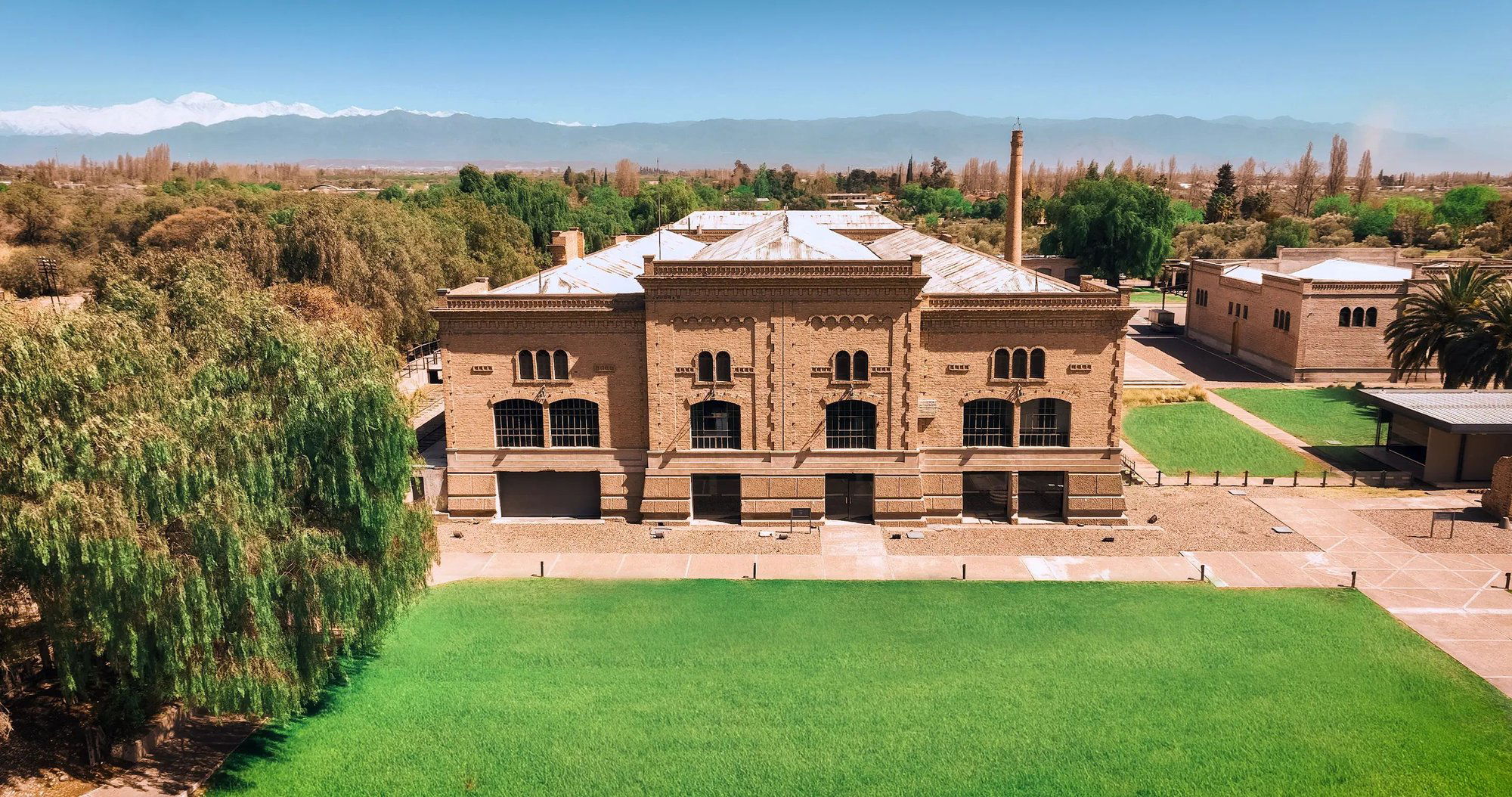
Approaching a winery through Mendoza's flatlands, the eye adjusts to a horizon of vine rows interrupted by the distant wall of the Andes. At Bodega Trapiche in Maipú, that visual rhythm breaks earlier than expected: the cellar building's Italian Renaissance façade — arched windows, dressed stone, a formal symmetry that belongs more to Lombardy than to a South American agricultural zone — announces itself against the blue-grey mountain backdrop before you reach the entrance. The architectural contrast is not incidental. It is, in a sense, the opening argument of what the winery has been making for well over a century: that serious wine production here answers to European precedent while drawing its character entirely from Argentine land.
Maipú sits within the broader Mendoza appellation, the region responsible for the majority of Argentina's premium export wine. The sub-zone is lower in altitude than Luján de Cuyo to its south and considerably lower than the high-elevation districts of the Valle de Uco further south still. That position matters. Maipú's soils carry more alluvial clay than the rocky, thin soils of Luján, and its diurnal temperature range, while significant, is less extreme than sites above 1,000 metres. Wines from here tend toward weight and texture rather than the taut, minerally precision you find further up the altitudinal ladder. Trapiche's Bordeaux-variety program reflects that: these are wines built on presence and depth, not on austerity.
The Terroir Case for Bordeaux Varietals in Mendoza
Mendoza's long identification with Malbec obscures a parallel history with Bordeaux grapes. Cabernet Sauvignon, Cabernet Franc, Merlot, and Petit Verdot have been cultivated here since the late nineteenth century, when European immigration brought both grape stock and winemaking method to the region. The climate case for these varieties is credible: Mendoza's intense sunlight accumulates sugar efficiently, while cold nights preserve acidity and extend phenolic development. The result in good vintages is fruit concentration without the jammy flatness that affects warm-climate Bordeaux-style wines elsewhere.
Trapiche's emphasis on this category, sustained across decades rather than adopted as a market trend, places it in a specific peer set within Argentine winemaking. Where producers at [Bodega DiamAndes in Tunuyán](https://www.enprimeurclub.com/wineries/bodega-diamandes-tunuyn-winery) or higher-altitude estates in the Valle de Uco have oriented toward freshness and altitude-driven tension, the Maipú expression favors a more classical weight. This is not a lesser ambition , it is a different one, and one with its own coherent logic grounded in what the land at this elevation consistently produces.
The comparison extends across Argentina's wine geography. At [Bodega El Esteco in Cafayate](https://www.enprimeurclub.com/wineries/bodega-el-esteco-cafayate-winery) in the northwest, the Calchaquí Valley's extreme altitude and arid conditions yield wines with a markedly different aromatic profile. At [Bodega Colomé in Molinos](https://www.enprimeurclub.com/wineries/bodega-colom-molinos-winery), some of the highest-planted vineyards in the world produce Malbec and Torrontés with a precision born of altitude stress. Trapiche operates at a different coordinate on that map , established, architecturally rooted, building its argument on history and scale rather than on geographical extremity.
Scale, Prestige, and the 2025 Recognition
In 2025, EP Club awarded Trapiche its Pearl 3 Star Prestige rating, positioning it among the top tier of the wineries tracked across the platform. That designation reflects not only wine quality but the coherence of the overall visitor proposition: the estate infrastructure, the depth of production across multiple tiers, and the consistency of its Bordeaux-variety program over time. Within the Mendoza wine corridor , a route that stretches from Maipú through Luján de Cuyo and south toward Tupungato , this places Trapiche at a peer level with properties like [Bodega Lagarde in Luján de Cuyo](https://www.enprimeurclub.com/wineries/bodega-lagarde-lujn-de-cuyo-winery) and [Rutini Wines (La Rural) in Tupungato](https://www.enprimeurclub.com/wineries/rutini-wines-la-rural-tupungato-winery), each of which carries historic weight and a multi-generational relationship with the appellation.
Scale matters here in a specific way. Trapiche is a large operation by Argentine standards, and that size has historically enabled investment in both vineyard sourcing across multiple Mendoza sub-zones and in cellar infrastructure. For the visitor, it means the tasting offer typically spans a wider range of variety, vintage, and price point than a boutique estate can present , a more complete survey of what the producer argues Argentine Bordeaux-variety wine can achieve across its portfolio tiers.
Reading the Estate in Context
The Italian Renaissance architecture is not simply decorative. It is a period document: the building dates to an era when Mendoza's wine industry was being constructed by European settlers who brought both capital and aesthetic ambition to the enterprise. Walking the estate, you are walking through the material history of how Argentina became a significant wine-producing nation. That context gives the visit a different quality than a tour of a purpose-built modern winery , it is, among other things, an argument about continuity.
For visitors constructing a broader Mendoza itinerary, [Escorihuela Gascón in Godoy Cruz](https://www.enprimeurclub.com/wineries/escorihuela-gascn-godoy-cruz-winery) presents a comparable historic-estate model in a different sub-zone, with its own architectural statement and long-standing Bordeaux program. The two estates make a logical pairing for anyone mapping the older stratum of Mendoza winemaking alongside the newer, higher-altitude generation. [Our full El trapiche wineries guide](https://www.enprimeurclub.com/wineries/el-trapiche) covers the broader regional picture, including which estates to prioritize depending on whether your emphasis is on altitude-driven freshness or the deeper, older-soil profiles of Maipú and Godoy Cruz.
Planning the Visit
Bodega Trapiche sits at Nueva Mayorga s/n in Maipú, within the Mendoza province wine belt. Maipú is accessible from Mendoza city by road , a short drive south , which makes Trapiche a practical anchor for a day that might also include stops at [Bodega Lagarde in Luján de Cuyo](https://www.enprimeurclub.com/wineries/bodega-lagarde-lujn-de-cuyo-winery) or the urban-adjacent [Escorihuela Gascón in Godoy Cruz](https://www.enprimeurclub.com/wineries/escorihuela-gascn-godoy-cruz-winery). Given the estate's scale and the breadth of wine tiers available for tasting, plan to spend at least two hours rather than a quick pour-and-go stop. Phone and website details are not available through our current record; contact information is leading confirmed through your hotel concierge in Mendoza or a local tour operator. Mendoza's prime visiting window runs roughly from late February through April, when harvest activity adds an additional layer to any winery tour and the weather remains warm without the mid-summer heat peaks of January.
Those extending beyond Mendoza toward Argentina's other major wine regions will find relevant comparisons at [Familia Schroeder in San Patricio del Chañar](https://www.enprimeurclub.com/wineries/familia-schroeder-san-patricio-del-chaar-winery) in Patagonia's Neuquén province, where cooler conditions produce a distinctly different structural profile. For the Buenos Aires-based visitor with a spirits focus, [Fratelli Branca Distillery in Buenos Aires](https://www.enprimeurclub.com/wineries/fratelli-branca-distillery-buenos-aires-winery) offers a parallel lens on Argentine beverage heritage from an entirely different production angle. Further afield, [Abadía Retuerta in Sardón de Duero](https://www.enprimeurclub.com/wineries/abada-retuerta-sardn-de-duero-winery) presents an instructive European reference point for how a historic-estate model combines heritage architecture with serious Bordeaux-variety production. [Our full El trapiche restaurants guide](https://www.enprimeurclub.com/restaurants/el-trapiche), [hotels guide](https://www.enprimeurclub.com/hotels/el-trapiche), [bars guide](https://www.enprimeurclub.com/bars/el-trapiche), and [experiences guide](https://www.enprimeurclub.com/experiences/el-trapiche) cover the supporting infrastructure for a visit to the area.
Frequently Asked Questions
- Is Bodega Trapiche more low-key or high-energy?
- Trapiche operates at a scale that makes it more structured than intimate. The estate's size, its architectural formality, and the depth of its production all point toward a deliberate, well-organized visit rather than a casual drop-in. EP Club's Pearl 3 Star Prestige rating in 2025 reflects the polished quality of what's on offer. This is a winery that rewards planned engagement over spontaneous stops.
- What is the leading wine to try at Bodega Trapiche?
- Trapiche's clearest editorial case rests on its Bordeaux varietals , Cabernet Sauvignon, Malbec-Cabernet blends, and the broader Bordeaux-influenced range that has defined the estate across decades. That program, rooted in Maipú's alluvial soils and long sunlight hours, is what earned consistent recognition and underlies the 2025 Pearl 3 Star Prestige award. Any tasting that doesn't include at least one wine from that tier is missing the estate's central argument.
- What makes Bodega Trapiche worth visiting?
- Three elements set it apart from a typical Mendoza winery visit: the Italian Renaissance architecture, which gives the estate a historic density rare in Argentine wine country; the depth of the Bordeaux-variety program, which provides a serious counterpoint to the Malbec-dominant narrative; and the Pearl 3 Star Prestige recognition from EP Club in 2025, which signals a consistently high-caliber overall visitor experience. Together, they make a visit as much about understanding Argentine wine history as about tasting it.
Quick Comparison
These are the closest comparables we have in our database for quick context.
| Venue | Cuisine | Price | Awards | Notes |
|---|---|---|---|---|
| Bodega Trapiche | Pearl 3 Star Prestige (2025); Italian Renaissance architecture is not the only thing to mark out the Trapiche winery from its Andean surroundings – its exemplary Bordeaux varietals have long; Italian Renaissance architecture is not the only thing to mark out the Trapiche winery from its Andean surroundings – its exemplary Bordeaux varietals have long; Italian Renaissance architecture is not the only thing to mark out the Trapiche winery from its Andean surroundings – its exemplary Bordeaux varietals have long | This venue | ||
| Bodega Colomé | ||||
| Bodega DiamAndes | ||||
| Bodega El Esteco | ||||
| Bodega Lagarde | ||||
| Bodega Norton |
Access the Cellar?
Our members enjoy exclusive access to private tastings and priority allocations from the world's most sought-after producers.
Access the Concierge