Our verdict
Poloz Mukuch sits on Jivani Street in Gyumri, Armenia's second city and a place where post-Soviet culinary traditions meet a slow-growing appetite for ingredient-driven cooking. The restaurant draws on the Shirak region's pastoral larder, positioning it within a small cohort of Gyumri addresses worth planning around rather than stumbling upon.

Pearl is the En Primeur Club membership app — saves, bookings, and concierge access live there. Same editors, same standards.
Gyumri's Table: What the Shirak Region Puts on the Plate
Armenia's second city does not announce itself the way Yerevan does. Gyumri moves at a different pace — the black tuff stone facades of the old merchant quarter absorb afternoon light rather than reflecting it, and the streets around Jivani carry the unhurried rhythm of a city that rebuilt itself slowly after 1988 and is still, in some ways, deciding what it wants to become. That ambiguity shapes the dining scene here more than any single restaurant. Where Yerevan has developed a recognisable tier of contemporary Armenian cooking — places like At Gayane's in Yerevan anchoring a serious conversation about national cuisine, Gyumri's restaurants operate closer to the source: regional, seasonal, and less mediated by international influence.
Poloz Mukuch sits on Jivani Street in this context. The address places it inside the older residential and commercial fabric of the city rather than near the tourist-facing squares, which tells you something about who the restaurant is primarily cooking for. In cities where ingredient-led kitchens draw most of their custom from locals rather than visitors, the food tends to stay honest to the regional larder in a way that export-facing operations sometimes don't.
The Shirak Larder and Why Provenance Matters Here
The Shirak plateau is high-altitude, cold-winter, and historically pastoral. The agricultural character of the region, livestock, grain, preserved vegetables, fermented dairy, has shaped Armenian cooking in this part of the country in ways that differ meaningfully from the fruit-forward, herb-heavy traditions of Ararat Valley cooking further south. Lamb raised at altitude tends toward leaner, more mineral-edged meat than lowland equivalents. Dried and fermented ingredients carry more weight in the winter diet than fresh produce. These are not romantic abstractions; they are the practical results of geography and climate that any kitchen drawing on local supply will reflect whether it intends to or not.
This is the framing in which Poloz Mukuch is worth understanding. The restaurants that have drawn the most serious attention globally for ingredient provenance, Atelier Moessmer Norbert Niederkofler in Brunico with its Alpine-sourcing discipline, or Reale in Castel di Sangro working the Apennine plateau, make the case that regional altitude and isolation produce ingredients worth treating with precision rather than compensating for. The Shirak region makes a structurally similar argument, even if the dining infrastructure around it remains far less developed.
For comparison, places like Piazza Duomo in Alba and Jordnær in Gentofte have built internationally recognised programs around hyper-local sourcing within distinct regional ecosystems. The Armenian highlands present an analogous opportunity, one that Gyumri's kitchens are better positioned to explore than their Yerevan counterparts, given proximity to the source.
What to Expect at the Table
What the broader pattern of Gyumri restaurants in this location type suggests, drawing on the regional cooking tradition, is a kitchen working with preserved meats, dairy preparations including Armenian matzoon and aged cheeses, legume-based dishes built around the plateau's pulse crops, and bread traditions that remain central to the meal structure rather than incidental to it. Armenian flatbread, lavash and its thicker regional variants, functions as both utensil and course in this part of the country, a culinary convention that European tasting-menu culture has largely abandoned but that retains real functional logic here.
Restaurants like Dilijan in Dilijan have shown that Armenian cooking, when given space to operate on its own terms rather than in dialogue with European fine dining, can hold the attention of a serious food traveller. Poloz Mukuch's Jivani Street location suggests a similar ambition pitched at a local audience rather than an international one, which in practice often means the food is less performed and more direct.
Elsewhere in the world, some of the most compelling ingredient-driven restaurants, Uliassi in Senigallia, Quattro Passi in Marina del Cantone, Dal Pescatore in Runate, have built long reputations on cooking that stays geographically and seasonally anchored. The operating logic is the same at every scale: when the supply chain is short and the kitchen is paying attention, the food reflects a place rather than a category.
Planning a Visit: Practical Notes
Gyumri is approximately 120 kilometres north of Yerevan and accessible by marshrutka or train, with the journey running roughly 90 minutes to two hours depending on the mode. The city receives a fraction of Yerevan's visitor traffic, which means restaurants here are not calibrated around the expectations of international tourists in the way that capital-city establishments increasingly are. That cuts both ways: pricing tends to be lower than Yerevan equivalents, but operating hours and booking infrastructure are less predictable. Gyumri's dining culture is generally earlier-evening in orientation, plan accordingly rather than arriving late.
For the broader Gyumri dining picture, including other addresses worth pairing with a visit here, see our full Gyumri restaurants guide. Travellers building a wider Armenian itinerary will also find relevant context in the Yerevan scene, where restaurants like At Gayane's offer a useful point of comparison for what Armenian cooking looks like when it operates at higher production values. For a sense of how destination restaurants at the sharp end of ingredient sourcing operate internationally, the programs at Le Calandre in Rubano, Quique Dacosta in Dénia, Waterside Inn in Bray, Le Bernardin in New York City, Lazy Bear in San Francisco, Atomix in New York City, Emeril's in New Orleans, and HAJIME in Osaka provide a useful frame for what regional sourcing discipline can look like at full resolution.
Frequently asked questions
Is Poloz Mukuch suitable for children?
Gyumri's neighbourhood restaurants generally run at a pace that accommodates families, and Poloz Mukuch on Jivani Street sits within a residential district of the city rather than a high-volume tourist corridor. The format — a grounded local address rather than a formal dining room — tends to suit all ages. Confirming specific facilities directly with the venue before visiting is advisable, as those details are not on public record.
What's the vibe at Poloz Mukuch?
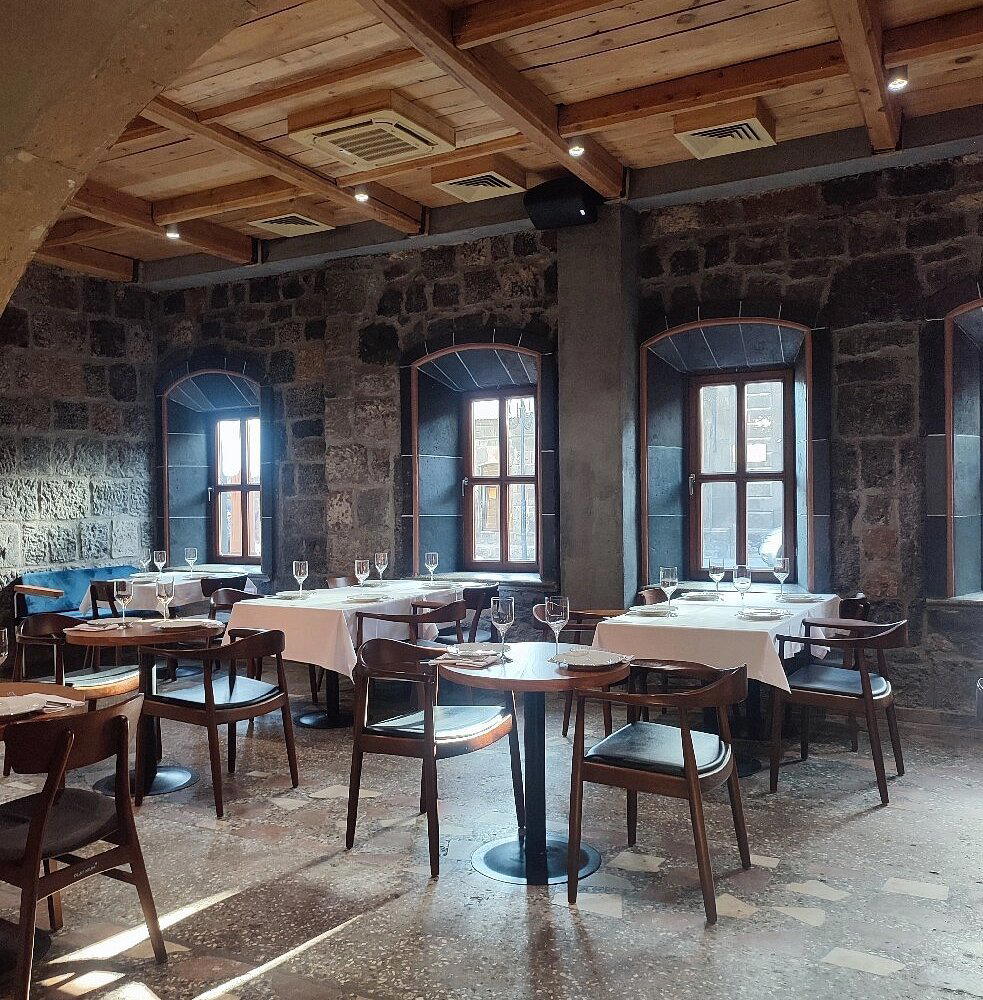
Poloz Mukuch is positioned on Jivani Street in Gyumri, Armenia's second city, where the tempo is slower and the built environment — black tuff stone, Soviet-era courtyards — shapes the atmosphere as much as any interior design decision. Expect a setting that reflects the city's character: unhurried, locally oriented, and rooted in the Shirak region's pastoral culture rather than in Yerevan's more cosmopolitan dining scene.
Is Poloz Mukuch a good choice for experiencing authentic Gyumri cuisine as opposed to Yerevan-style Armenian food?
Gyumri and Yerevan represent distinct culinary registers within Armenia: Yerevan's restaurant scene has increasingly absorbed international influences, while Gyumri's food culture remains anchored to the Shirak plateau's own larder and traditions. Poloz Mukuch, located on Jivani Street in Gyumri rather than in the capital, sits within that regional context by geography alone. For travellers arriving from Yerevan — roughly 120 kilometres south — the distinction in character between the two cities is tangible at the table as much as on the street.
What's the best thing to order at Poloz Mukuch?
The broader cooking tradition of Gyumri and the Shirak plateau leans heavily on preserved vegetables, high-altitude dairy, grain-based dishes, and slow-cooked meat — patterns consistent with the region's cold-winter, pastoral agricultural character. Asking what is freshest or most local on arrival is the most reliable approach at a restaurant of this type.
What part of town is Poloz Mukuch in?
Poloz Mukuch is located at Jivani St, Gyumri 3105, Armenia, Gyumri.
Comparison Snapshot
Comparable venues nearby, for context on price, style, and recognition.
| Venue | Cuisine | Price | Notes |
|---|---|---|---|
| Poloz MukuchThis venue (the venue you are viewing) | Modern Armenian | $10–20 | Not listed |
| Gabriel’s Brasserie | French Patisserie | Not listed | Kentron |
| Bar B. Q. | Modern Armenian BBQ Street Food | $1–10 | Pushkin street |
| The Club | New Armenian Cuisine | $20–30 | Tumanyan |
| Buzand Cafe Restaurant | Armenian and Mediterranean Cafe | $10–20 | Kentron |
| Flying Ostrich by Dolmama | Armenian Fusion with Ostrich Barbecue | Not listed | Dilijan |
Details
- Cozy
- Elegant
- Rustic
- Family
- Casual Hangout
- Historic Building
- Craft Cocktails
- A La Carte
- Family Style
- Vegetarian Friendly
Current opening hours
- Monday
- 10 AM–11 PM
- Tuesday
- 10 AM–11 PM
- Wednesday
- 10 AM–11 PM
- Thursday
- 10 AM–11 PM
- Friday
- 10 AM–11 PM
- Saturday
- 10 AM–11 PM
- Sunday
- 10 AM–11 PM
Hours can change for holidays and private events. Last verified .
Elegant interior blending traditional architecture with modern design, calm and lovely atmosphere.