My Saigon
In a Czech town defined by Gothic architecture and tourist menus, My Saigon on Panská 17 takes a different position, Vietnamese cooking in a setting where Central European staples dominate almost every other table. For visitors exhausted by the predictability of Český Krumlov's restaurant strip, it offers a clear alternative without requiring a journey to a larger city.
Pearl is the En Primeur Club membership app — saves, bookings, and concierge access live there. Same editors, same standards.
- Address
- Panská 17, 381 01 Český Krumlov
- Directions
- Get directions
 Saves & bookings on Pearl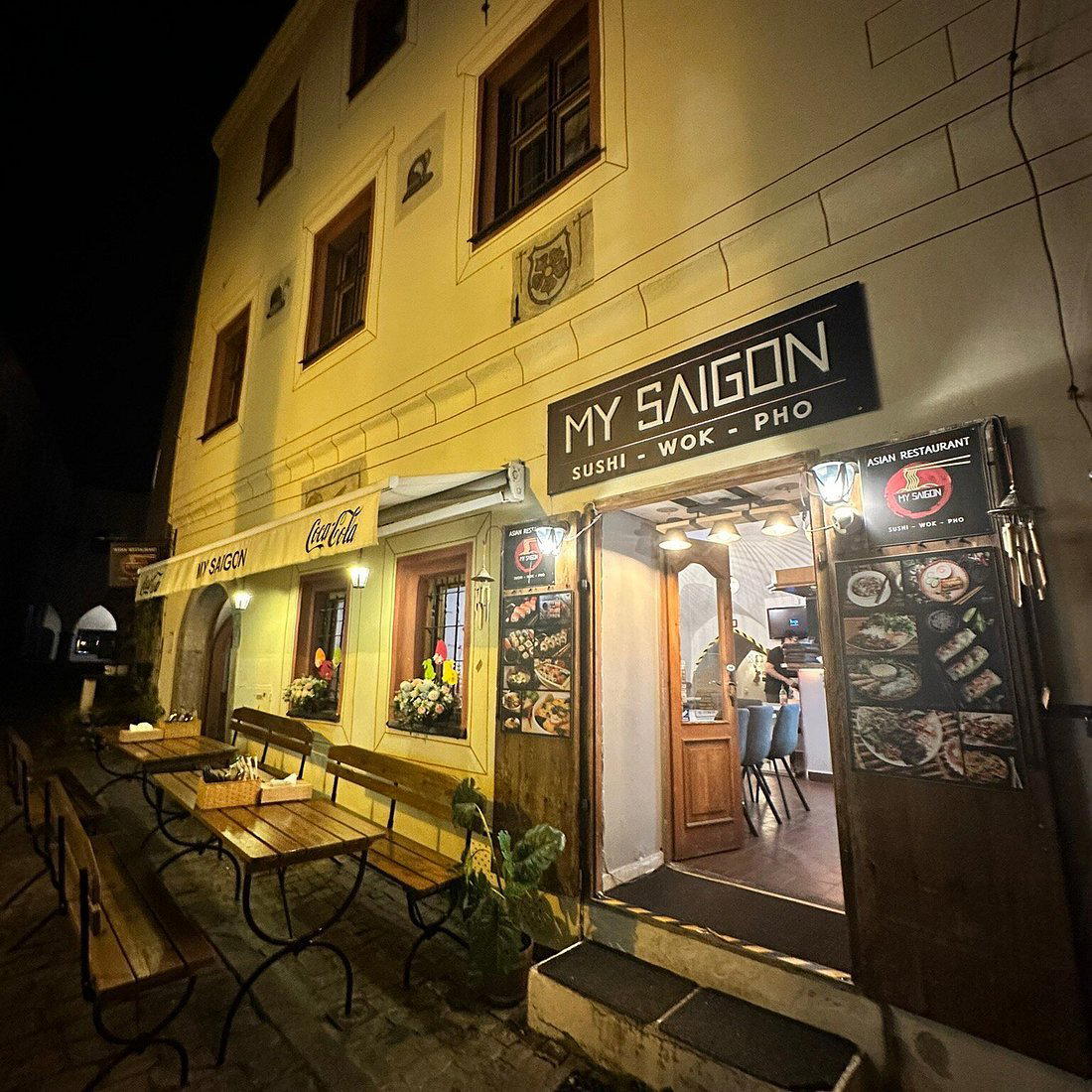
Vietnamese Cooking in a Town Built Around Other Priorities
Český Krumlov receives more visitors per square kilometre than almost any town its size in Central Europe. The consequence, familiar to anyone who has walked the cobbled loop around the castle, is a dining scene calibrated almost entirely toward high-turnover tourist demand: svíčková, goulash, trdelník, and Czech lager served at pace. Against that backdrop, the presence of a Vietnamese restaurant on Panská 17 is not incidental, it reflects a broader pattern playing out in Czech provincial towns, where Vietnamese communities established over decades of migration have created a parallel food infrastructure that most tourists walk past entirely. My Saigon sits in that category: a Vietnamese restaurant in Český Krumlov at Panská 17.
The address matters more than it might seem. Panská is not a back street, it runs through the older residential and commercial zone of Český Krumlov, away from the concentrated tourist corridor but still within the compact walkable core. Arriving, you are not hunting for something hidden so much as choosing to look slightly beyond the obvious. That distinction shapes who tends to eat here: locals who know the town past its castle season, and travellers with enough curiosity to cross the road from the medieval centre into a more ordinary street-level Czech reality.
What Vietnamese Cooking Means in This Context
Vietnamese cuisine in the Czech Republic occupies a specific historical position. The Vietnamese community in Bohemia dates to the socialist-era labour agreements of the 1970s and 1980s, making it one of the largest and longest-established Asian communities in Central Europe. That history produced a dense network of Vietnamese-run businesses across Czech cities and towns, including restaurants whose cooking reflects a practical, community-rooted food culture rather than the adapted or decorative versions of Vietnamese food common in Western European capitals. The result, at the better addresses, is cooking that draws on actual sourcing relationships, family-level knowledge of preparation, and a price point shaped by local economics rather than tourist premium.
This distinction matters when thinking about ingredient sourcing in a town like Český Krumlov, where supply chains for anything outside Czech or Austrian-border produce require deliberate effort. Vietnamese restaurants in smaller Czech towns typically rely on a combination of regional fresh produce, vegetables, herbs, some proteins, and specialist ingredients sourced through the Czech-Vietnamese wholesale networks centred in larger cities, particularly Prague's SAPA market district, which functions as the primary distribution hub for Vietnamese food businesses across Bohemia and Moravia. The degree to which any individual restaurant maintains that sourcing discipline is what separates a credible Vietnamese kitchen from a simplified version of one. The structural context of Czech-Vietnamese food supply is worth understanding before you arrive.
For comparison, the Vietnamese restaurant scene in other Czech cities shows how the category spans a range. Hello Vietnam in Karlovy Vary operates in a similarly tourist-heavy spa-town environment and illustrates how the same cuisine reads differently depending on local demand signals. At the other end of the Czech dining register, La Degustation Bohême Bourgeoise in Prague shows what happens when Czech food culture reaches for formal fine dining, a useful reference point for understanding how far the broader scene extends.
Where It Fits in the Town's Offer
The restaurant market in Český Krumlov is genuinely small. The town's permanent population is under eight thousand people; its dining infrastructure is sized for the tourist season, which peaks between May and September. Outside those months, the number of operating kitchens contracts sharply. An address like My Saigon, serving a cuisine outside the Czech mainstream, is operating in a market that does not naturally produce high demand for Vietnamese food from its residential base, which makes its continued presence a signal worth noting in itself.
Visitors planning around the summer season should account for the fact that Český Krumlov's tourist-facing restaurants can reach capacity quickly on weekends, particularly during July and August. My Saigon recommends reservations, and the practical constraint in high season is the town's overall saturation rather than any single venue's policy.
For those building a wider itinerary through South Bohemia and beyond, the region connects naturally to other distinctive Czech addresses worth knowing. Chapelle in Písek represents the kind of more formal regional dining that South Bohemia does produce. In Brno, BRATRS takes a different approach to modern Czech cooking entirely. For those moving through Bohemia more widely, Bylo, nebylo in Liberec, Bohém in Litomyšl, and Cattaleya in Čeladná each offer a regional character worth seeking at their respective stops. Further afield, ARRIGŌ in Děčín and U Lípy in Hřensko anchor the north Bohemian dining axis for anyone travelling that corridor. In Plzeň, La Chica handles a different cuisine category with comparable specificity. For wine-focused itineraries through the Czech Republic, Vinařství Gurdau in Kurdejov is the reference address in Moravian wine country.
Planning a Visit
The restaurant is located at Panská 17, 381 01 Český Krumlov. The address is walkable from the main tourist zone in a few minutes on foot. The restaurant recommends reservations. Pricing is about $15 per person, and the dress code is casual. Parking and public transport access to Český Krumlov itself are the standard constraints of a medieval town; the restaurant's central location means getting to Panská 17 once you are in town requires no additional logistics.
Comparable Venues
Comparable venues nearby, for context on price, style, and recognition.
| Venue | Cuisine | Price | Notes |
|---|---|---|---|
| My SaigonThis venue — the venue you are viewing | Vietnamese with Thai, Sushi & Asian Fusion | $$ | Not listed |
| Hosarowa | Korean BBQ & Shabu Shabu | $$ | Stare Mesto (Old Town) |
| Lehká hlava - vegetarian restaurant | Creative Vegetarian & Vegan | $$ | Stare Mesto |
| Grand Café Orient | Cubist Czech Cafe | $$ | Stare Mesto |
| Indická a Nepálská Restaurace Mountain | Indian and Nepalese | $$ | centrum |
| Pils 'n' Grill | Czech and International Grill | $$ | city center |
Continue exploring
More in Cesky Krumlov
Restaurants in Cesky Krumlov
Browse all →
Bars in Cesky Krumlov
Browse all →
At a Glance
- Cozy
- Rustic
- Casual Hangout
- Open Kitchen
- Street Scene
Cramped, dark interior blending Vietnamese and Czech traditional elements with a cozy street-side outdoor seating option amid church bells.