L'Osmose

In the village of Pleudihen-sur-Rance, L'Osmose brings Michelin-recognised cooking to a setting of bare stone walls and untreated timber. Chef Ludovic Dirscheri works Breton ingredients, scallops, boar, local dairy, alongside wider European influences, producing tasting menus at a price point well below comparable cooking in Rennes or Saint-Malo.8 from 279 reviews confirms the kitchen's consistency.
Pearl is the En Primeur Club membership app — saves, bookings, and concierge access live there. Same editors, same standards.
- Address
- 7 Pl. de l'Église, 22690 Pleudihen-sur-Rance, France
- Phone
- +33 2 96 83 38 75
- Website
- restaurant-losmose.com
- Directions
- Get directions
 Saves & bookings on Pearl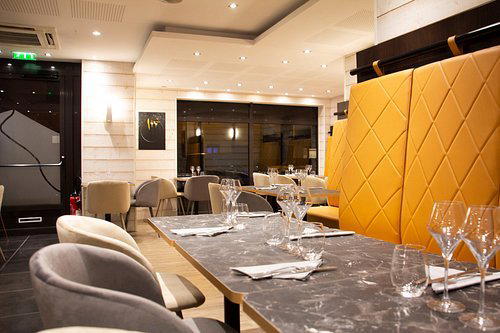
Stone Walls, Local Larder: Dining in a Brittany Village Square
The church square in Pleudihen-sur-Rance is the kind of place where Friday-afternoon traffic means a tractor and two cyclists. The village sits inland from the Rance estuary, roughly midway between Dinan and Saint-Malo, and its restaurant scene is exactly what that geography suggests: small, rooted, and oriented toward the local rather than the tourist circuit. L'Osmose occupies a position on that square that would, in a larger city, be unremarkable. Here, the bare stone façade and the low-lit interior visible through the window read as one serious dining option for several kilometres in any direction.
Inside, the design choices reinforce rather than contradict the setting. Untreated wood cladding runs alongside exposed local stone walls, materials that did not arrive in a shipping container from a Parisian interior supplier but were already present in the building's fabric. The effect is warmth without contrivance, the kind of room that makes a tasting menu feel like the natural pace of an evening rather than a formal occasion.
Where the Ingredients Come From, and Why That Shapes the Menu
Brittany's larder is among the more geographically coherent in France. The peninsula produces scallops in the Bay of Saint-Brieuc that carry appellation-level recognition, game from inland forests that runs through autumn and winter, root vegetables from a climate moderated by the Atlantic, and dairy that underpins the region's pastry tradition. A kitchen in Pleudihen-sur-Rance has direct access to all of it, and the menu at L'Osmose is structured around that access.
Scallops appear as carpaccio, dressed in olive oil and finished with a beetroot coulis, a preparation that keeps the shellfish raw enough to read as the estuary product it is, while the coulis introduces an earthiness that signals a cook thinking about contrast rather than decoration. Loin of roast boar, served with cream of parsnips and a red wine gravy, pulls from the inland side of that same larder: game and root vegetables in a pairing that respects the season and the source. The kouign-amann, the Breton butter cake that belongs to this region as specifically as canelé belongs to Bordeaux, is reframed with pistachio flavouring and halva ice cream, a bridge between the local pastry tradition and a broader Mediterranean and Middle Eastern pantry.
That last combination points to what distinguishes the cooking here from a direct regional menu. The sourcing is Breton, but the references travel. Olive oil on Atlantic scallops, halva alongside a Breton pastry: these are the moves of a chef who has absorbed influences from outside the region and chosen where to apply them. The result is a menu that reads as modern French in the precise sense, anchored in place and product, but not constrained by either.
Michelin Recognition at a Rural Address
France's decorated restaurant roll tends to cluster in Paris and the larger regional cities. Three-star addresses like Alléno Paris au Pavillon Ledoyen or Mirazur in Menton operate in locations with the infrastructure, hotel rooms, transport links, destination diners, to support that level of investment.
L'Osmose holds a Michelin Plate (2024), the guide's signal that the kitchen is producing food worth noting even without a star. Chef Ludovic Dirscheri is identified in Michelin's own framing as a star-pedigreed cook, which places the restaurant in a tier of serious provincial addresses where the quality of execution exceeds what the postcode would lead you to expect.
The price tier sits at €€, meaningfully below the €€€€ bracket occupied by Paris houses like Assiette Champenoise in Reims or internationally recognised rooms such as Flocons de Sel in Megève. For cooking with Michelin visibility and a chef CV that belongs in a more expensive room, the value arithmetic is direct.
How L'Osmose Sits in the Broader Brittany Dining Picture
Brittany has never produced the density of starred addresses that Burgundy or the Basque country can claim, but the region's ingredient quality has always given its leading kitchens a structural advantage. Saint-Malo and Rennes absorb most of the visitor dining traffic, leaving smaller addresses in the Rance valley corridor relatively undiscovered by the weekend-trip crowd. That dynamic has a practical consequence: booking is easier than the quality level might suggest, and the room retains the character of a local restaurant rather than a destination showcase.
For diners moving between Saint-Malo and Dinan, Pleudihen-sur-Rance sits directly on the logical route. The village is accessible by car from either direction in under thirty minutes, making the restaurant a natural lunch or dinner stop on a Rance valley itinerary rather than a standalone destination requiring dedicated logistics. For those building a fuller picture of what the area offers,
Planning Your Visit
The restaurant is located at 7 Pl. de l'Église, directly on the village square in Pleudihen-sur-Rance (22690). Given the kitchen's recognition level and the room's size, reservations are advisable, particularly for Friday and Saturday evenings when the limited covers fill quickly. The tasting menu format means the kitchen paces the evening rather than the diner, so arriving without a time constraint produces the better experience. For context, the cooking here occupies the serious provincial tier: technically accomplished, ingredient-led, and priced to reflect the address rather than the ambition.
At-a-Glance Comparison
Comparable venues nearby, for context on price, style, and recognition.
| Venue | Cuisine | Price | Awards | Notes |
|---|---|---|---|---|
| L'OsmoseThis venue — the venue you are viewing | Modern French Gastronomic | $$$$ | Michelin Plate | Not listed |
| Comète | Modern French Bistro | $$$ | Michelin Plate | Saint-Lunaire |
| Le 1825 - La Table | Modern French Fine Dining | $$$$ | Michelin Plate | Gesté |
| La Table du Balthazar | Modern French Fine Dining | $$$ | Michelin Plate | centre |
| Le Jardin de l'Abbaye | Gastronomic French | $$$ | Michelin Plate | Le Tronchet |
| Roscanvec | Modern Breton Fine Dining | $$$$ | Michelin Plate | Old Town Vannes |
Recognition history
Dated appearances from independent guides and award organizations, with the underlying list record or original source where available.
Michelin Plate
Michelin
Michelin Plate
Michelin
Continue exploring
More in Pleudihen-sur-Rance
Restaurants in Pleudihen-sur-Rance
Browse all →
Bars in Pleudihen-sur-Rance
Browse all →
At a Glance
- Cozy
- Intimate
- Romantic
- Elegant
- Date Night
- Special Occasion
- Business Dinner
- Standalone
- Extensive Wine List
- Local Sourcing
Current opening hours
- Monday
- Closed
- Tuesday
- 12–1:30 PM, 7–8:30 PM
- Wednesday
- 12–1:30 PM, 7–8:30 PM
- Thursday
- 12–1:30 PM, 7–8:30 PM
- Friday
- 12–1:30 PM, 7–8:30 PM
- Saturday
- 12–1:30 PM, 7–8:30 PM
- Sunday
- Closed
Hours can change for holidays and private events. Last verified .
Warm and comfortable dining room with untreated wood cladding, local stone walls, and a fireplace, creating an intimate and quiet atmosphere.