
A wood-fired Neapolitan pizza address in Lisbon's Rato district, Forno d'Oro centres its operation around a gold-tiled oven that functions as both the room's focal point and its cooking engine. Chef Tanka Sapkota runs a menu anchored in Neapolitan tradition, with seasonal variations and a drinks list built around craft beer and wine pairings selected to match the pizza format.
Rua Artilharia and the Question of Neighbourhood Pizza
Lisbon's more recognisable fine-dining addresses cluster around the waterfront and the historic centre. The Rato quarter, just off Avenida da Liberdade's southern end, sits at a slight remove from that circuit — residential in character, quieter in foot traffic, and consequently home to a different kind of dining proposition. Forno d'Oro occupies this position on Rua Artilharia 1, approximately two kilometres from the city's central axis, in a district where the audience tends to be local rather than transient. That context matters for understanding what the restaurant is trying to do: it is not positioning itself against the Michelin-chasing modernism of Belcanto or the progressive tasting menus at CURA. It is making a more specific argument — that Neapolitan pizza, executed with discipline and served in a considered room, belongs in a city whose own dining culture has been moving steadily upmarket for a decade.
Lisbon's restaurant scene has bifurcated in recent years. At one end, addresses like Eleven, 50 Seconds from Martin Berasategui, and 2Monkeys compete for the same internationally mobile, high-spending diner. At the other, a quieter tier of neighbourhood-led restaurants has emerged, oriented toward craft and product quality rather than theatre or innovation for its own sake. Forno d'Oro sits in that second tier, making its case through the credibility of its oven, its ingredients, and the intimacy of the room rather than through tasting-menu ambition.
The Oven as Architecture
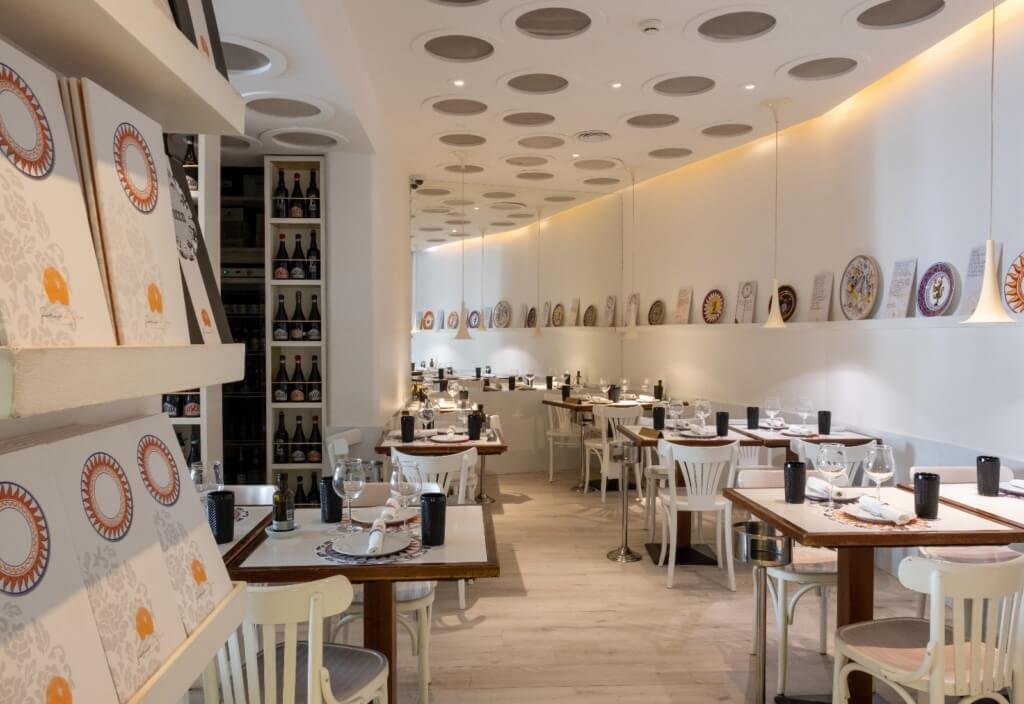
Wood-fired pizza ovens are common enough across Europe, but they are rarely treated as the primary visual and spatial statement of a room. At Forno d'Oro, the oven covered in golden tiles functions as the room's organising principle , the element around which the atmosphere is constructed. This is a deliberate design choice that reflects a broader Italian tradition: in Naples, the pizzaiolo and the forno are the show, and the dining room exists to frame them rather than compete with them. Placing that logic in a Lisbon side street is not simply a stylistic import; it signals a confidence in the format itself, an argument that the cooking process is worth watching.
The intimate atmosphere of the room reinforces that argument. The setting is described as welcoming rather than formal, with table settings and service attentiveness calibrated to support the food without overwhelming it. In practical terms, this positions Forno d'Oro as a restaurant suited to unhurried evenings rather than quick meals , the kind of place where the pacing of the wood-fired cook time and the rhythm of the service are aligned. For visitors to Lisbon planning an evening away from the more heavily trafficked tourist zones, the Rato location means a quieter approach and a room that skews toward regular diners rather than first-time visitors to the city.
Neapolitan Tradition in a Portuguese Room
Neapolitan pizza carries a formal set of expectations that are well documented: specific flour, San Marzano tomatoes, Fior di Latte rather than processed mozzarella, a cornicione with genuine leopard char from a very hot oven, and a base that is soft and pliable at the centre rather than crisp throughout. The degree to which any pizza restaurant outside Naples adheres to these markers is the primary measure of its seriousness within the category. Forno d'Oro's seasonal pizza , built on San Marzano tomatoes and Fior di Latte, with nettle pesto, burrata, and prosciutto as seasonal additions , follows the classical base while layering in variation that reflects the time of year. Seasonal menus in pizza formats are less common than in tasting-menu contexts, which makes the approach here a considered choice rather than a default.
Chef Tanka Sapkota leads the kitchen. The name suggests a Nepalese background, and while biographical detail in the public record is limited, the trajectory of chefs from South Asian culinary traditions into Italian pizza craft is a pattern that has appeared in several European cities over the past decade, often producing technically precise results from practitioners who approach the form with rigorous study rather than inherited familiarity. What matters in assessing the output is the discipline of the product, not the nationality of the cook , and the emphasis on authenticated ingredients and wood-fired technique points toward a kitchen that takes the Neapolitan brief seriously.
Drinks, Pairing, and the Craft Beer Argument
The drinks programme at Forno d'Oro is built around craft beers and wines selected specifically to accompany pizza. This is a more considered position than it might initially appear. In Naples, beer has historically been the default pizza pairing, and the craft beer movement has produced a tier of styles , lower-bitterness lagers, wheat beers, certain farmhouse ales , that interact productively with the acidity of tomato, the fat of cheese, and the char of a wood-fired crust. The decision to serve both craft beer and wine, with active pairing guidance, suggests a drinks list oriented toward the food rather than toward the wine-list conventions of broader fine dining. For a room that is not competing on tasting-menu terms, this is the right instinct.
The tiramisu noted as a menu fixture completes a format that is coherent from start to finish: Neapolitan pizza as the main event, a classic Italian dessert as the close, and a drinks list that frames both. The logic is Italian and disciplined, and it sits comfortably in the wider context of Lisbon's more ingredient-focused, less experimental restaurant tier.
Planning a Visit
Forno d'Oro is located at Rua Artilharia 1, 16b, in Lisbon's Rato district. The address places it within easy reach of the Marquês de Pombal area and Avenida da Liberdade, walkable from central Lisbon in under thirty minutes or accessible by metro via the Rato or Marquês de Pombal stations. Because the room is intimate rather than large-format, reservations are advisable, particularly for weekend evenings when neighbourhood demand from local regulars is likely to be at its highest. The seasonal pizza makes timing relevant: visiting during the period when the nettle pesto and burrata variation is on the menu adds a specific reason to come now rather than at any time of year. Specific hours and booking methods are not confirmed in the public record, so checking directly with the restaurant before planning a visit is recommended.
Forno d'Oro is one address in a city with considerable dining range. For a broader orientation, our full Lisbon restaurants guide covers the spectrum from neighbourhood specialists to Michelin-level tasting menus. Further context on where to stay, drink, and explore beyond restaurants is available through our Lisbon hotels guide, our Lisbon bars guide, our Lisbon wineries guide, and our Lisbon experiences guide. For those extending a Portugal trip beyond the capital, the country's broader fine-dining circuit includes Vila Joya in Albufeira, Antiqvvm in Porto, Casa de Chá da Boa Nova in Leça da Palmeira, Il Gallo d'Oro in Funchal, Ocean in Porches, and The Yeatman in Vila Nova de Gaia. For international reference points on what serious Italian-influenced or technically precise cooking looks like at the highest tier, Le Bernardin in New York City and Atomix in New York City offer useful framing for what disciplined, single-minded culinary focus produces at its most sustained.
Questions About Forno d'Oro
- What is the signature dish at Forno d'Oro?
- The kitchen is anchored in Neapolitan pizza, with the wood-fired oven as its central tool. The seasonal pizza, built on San Marzano tomatoes and Fior di Latte with additions including nettle pesto, burrata, and prosciutto, is the most specific expression of the format currently on the menu. The tiramisu functions as the standard dessert close. Chef Tanka Sapkota leads the kitchen, and the overall menu stays within the classical Neapolitan frame rather than branching into broader Italian or fusion territory.
- How far ahead should I plan for Forno d'Oro?
- Forno d'Oro is an intimate room in a residential Lisbon neighbourhood, which means capacity is limited and weekend tables fill with local regulars as well as visitors. Booking ahead rather than arriving without a reservation is the sensible approach, particularly for Friday and Saturday evenings. Specific advance booking windows are not confirmed in the public record. Given the seasonal pizza on the current menu, visiting within the season adds a time-specific reason to prioritise the visit sooner. Lisbon's dining options at the high end, including multiple Michelin-recognised addresses, require even longer lead times, but for a neighbourhood-tier specialist like Forno d'Oro, a few days to a week of advance planning is a reasonable baseline.
Reputation First
A fast peer set for context, pulled from similar venues in our database.
| Venue | Awards | Cuisine | Notes |
|---|---|---|---|
| Forno d’Oro | 1 awards | This venue | |
| Belcanto | Michelin 2 Star, World's 50 Best | Modern Portugese, Creative | Modern Portugese, Creative, €€€€ |
| Alma | Michelin 2 Star | Creative | Creative, €€€€ |
| Feitoria | Michelin 1 Star | Modern Cuisine | Modern Cuisine, €€€€ |
| 50 seconds from Martin Berasategui | Michelin 1 Star | Progressive Spanish | Progressive Spanish, €€€€ |
| CURA | Michelin 1 Star | Modern Portugese, Modern Cuisine | Modern Portugese, Modern Cuisine, €€€€ |
Need a table?
Our members enjoy priority alerts and concierge-led booking support for the world's most difficult tables.
Access the Concierge