
Tabelog 100 #7
Our verdict
Denkou Sekka Ekie hiroshima ten gives Hiroshima Station an okonomiyaki counter with serious local credentials: a Tabelog 100 Okonomiyaki selection in 2023, 2024, and 2025. The format suits travelers who want the city’s defining griddled dish without turning lunch or dinner into a long detour.

Pearl is the En Primeur Club membership app — saves, bookings, and concierge access live there. Same editors, same standards.
The menu
What to order
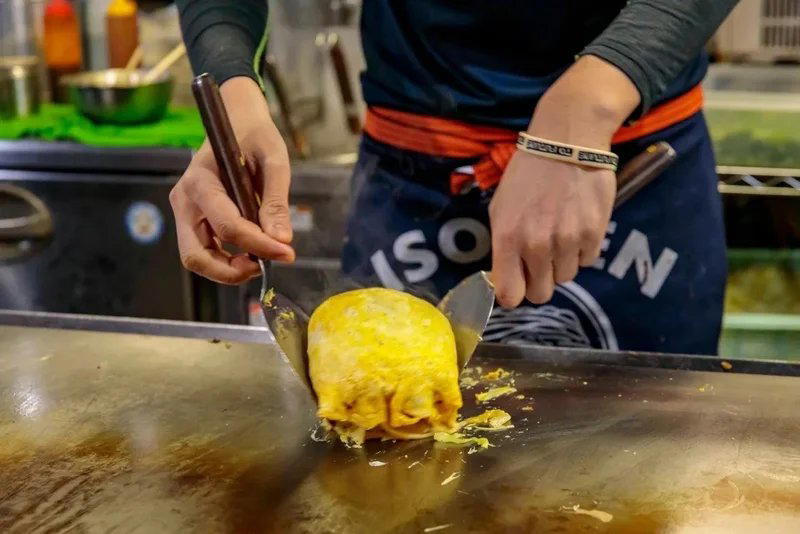
- Denkou Sekka signature Hiroshima-style okonomiyaki
- Omelet-style layered okonomiyaki
Hiroshima is not a neutral backdrop for okonomiyaki. The smell of hot griddles, sauce, cabbage, and noodles follows the city’s commuter rhythms, and casual restaurant floors can turn a regional dish into a first or final meal in the city. Denkou Sekka Ekie hiroshima ten sits inside that rhythm: not a hushed destination room, but a teppan-focused stop where Hiroshima’s everyday food culture meets a practical, easygoing format.
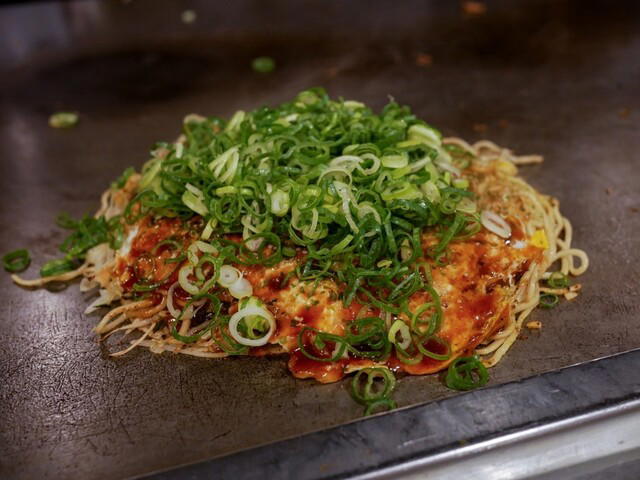
That context matters. Hiroshima-style okonomiyaki is often understood through layered construction: cabbage, noodles, egg, and toppings arranged on the griddle in a sequence that makes the cook’s timing visible. The city has turned the dish into a civic signature, but it remains working food as much as visitor food. A convenient restaurant has to serve both audiences, which is why recognition carries weight here. Selection for Tabelog 100 Okonomiyaki in 2025 places this address inside a narrow national conversation about a dish often judged by regulars with little patience for theatrics.
Hiroshima okonomiyaki, translated for easy access without losing the griddle
The useful way to read this restaurant is through category rather than ceremony. In Hiroshima, okonomiyaki houses range from small local counters to specialist rooms that visitors seek out because the dish has become shorthand for the city. A highly accessible setting changes the calculus. It favors clarity, speed, and a menu that can accommodate solo diners, families, and travelers moving through the day. The teppan remains central to the culture: the griddle is not decoration, it is the production line and the stage.
Denkou Sekka Ekie hiroshima ten also sits at the accessible end of Hiroshima’s dining spectrum. Compared with local higher-spend rooms such as Chinese Sai Kichijitsu or EPURE, this is a low-commitment meal built around a regional staple rather than a long-course format. Compared with okonomiyaki peers such as Tatsu or Icchan Honten, its practical positioning gives it an edge for tight itineraries. The question is not whether it replaces a deeper neighborhood crawl; it answers a different need, delivering a recognized version of Hiroshima okonomiyaki in a format designed for easy entry.
The experience signals the same balance between casual and local. Okonomiyaki and teppanyaki are the categories that define the visit, rather than a separate fine-dining narrative. The appeal is direct: a regional dish, a hot griddle, and a room that makes the food easy to understand for a broad audience. Those details do not make the experience formal. They make it usable, which is often what travelers need in a city where the more interesting food traditions can be hidden behind language, timing, or queue discipline.
What the recognition says about Hiroshima's everyday food culture
Okonomiyaki awards can be misunderstood by travelers accustomed to fine-dining hierarchies. Tabelog 100 in this category is not a signal for linen, tasting menus, or chef biography. It is a filter for consistency in a fiercely local genre, where small differences in griddle control, noodle texture, cabbage handling, and sauce balance become the basis for loyalty. In that sense, the 2025 selection says more about reliability inside a crowded field than about luxury.
That makes the restaurant a useful counterpoint to the wider Hiroshima table. The city is not only okonomiyaki, and a fuller itinerary should make space for other Hiroshima dining rooms, sweets, casual counters, and more contemporary restaurant cooking. But okonomiyaki remains the city’s democratic baseline. It is the dish that explains why Hiroshima’s food identity feels public, crowded, and tied to the grill rather than to reservation-only exclusivity.
For that reason, this kind of accessible version is not merely convenient. It reflects how regional food travels through Japan: local specialties are preserved, packaged, and made legible in practical settings without becoming detached from their origin. Travelers moving onward to other Japanese cities will see similar patterns with different dishes, from casual specialist counters to city-specific comfort food. For a broader Japan dining map, compare the way casual formats, regional staples, and quick-service specialist rooms shape daily eating across the country and, abroad, how Japanese drinking and rice-focused formats take different shapes in other cities.
Where it fits in a Hiroshima itinerary
The strongest use case is logistical: a first meal after arrival, a final meal before moving on, or a midday reset when crossing the city for a single plate makes no sense. The decision is more about timing and appetite than ceremony. The listed budget, at JPY 1,000 - JPY 1,999 for both lunch and dinner, keeps the meal in the low-commitment range, while the Tabelog score of 3.49 suggests a recognized, well-noted address rather than an obscure stop.
Because the restaurant is in Hiroshima, it also suits mixed groups who need a low-friction option built around a familiar local specialty. The categories are clear: okonomiyaki, the Japanese savory pancake associated so strongly with the city, and teppanyaki. Private-room formality and destination-dining theatre are not the point; this is better read as a casual teppanyaki and okonomiyaki stop than as a special-occasion room.
Readers building a fuller city plan should use it as an anchor rather than a whole argument for Hiroshima dining. Pair the meal with a deeper look at our full Hiroshima restaurants guide, then map the stay through our full Hiroshima hotels guide, our full Hiroshima bars guide, our full Hiroshima wineries guide, and our full Hiroshima experiences guide. The verdict is simple: for a recognized, accessible expression of Hiroshima okonomiyaki in the city, Denkou Sekka Ekie hiroshima ten earns its place in a practical itinerary.
Frequently asked questions
Is Denkou Sekka Ekie hiroshima ten good for families?
It can work well for families looking for a casual Hiroshima meal built around okonomiyaki and teppanyaki. The listed lunch and dinner budget of JPY 1,000 - JPY 1,999 keeps it within an easy everyday range.
What's the overall feel of Denkou Sekka Ekie hiroshima ten?
It reads as a casual okonomiyaki and teppanyaki room rather than a special-occasion dining room. The focus is on a practical, accessible expression of Hiroshima’s everyday griddle culture.
What price level is Denkou Sekka Ekie hiroshima ten?
Pricing at Denkou Sekka Ekie hiroshima ten is listed as JPY 1,000 - JPY 1,999 JPY 1,000 - JPY 1,999.
What days is Denkou Sekka Ekie hiroshima ten closed?
Specific closing-day information is not provided here; check the venue directly before planning around a visit.
Where exactly is Denkou Sekka Ekie hiroshima ten?
Hiroshima.
Budget and Context
Nearby venues at a similar price tier for orientation.
| Venue | Cuisine | Price | Awards | Notes |
|---|---|---|---|---|
| Denkou Sekka Ekie hiroshima tenThis venue (the venue you are viewing) | Hiroshima-style okonomiyaki & teppanyaki | $10–20 | Tabelog 100 #7 | Not listed |
| Okonomiyaki Hasshou | Hiroshima-style Okonomiyaki | $10–20 | Tabelog 100 #85 | Naka, Hiroshima-style Okonomiyaki |
| Jidan | Hiroshima-style okonomiyaki | $10–20 | Tabelog 100 #11 | Higashi, Hiroshima-style okonomiyaki |
| Teppanyaki to Okonomiyaki Mishimaya | Hiroshima Okonomiyaki & Teppanyaki | $10–20 | Tabelog 100 #45 | Minami, Hiroshima Okonomiyaki & Teppanyaki |
| Yagenbori Hassho | Hiroshima-style okonomiyaki | $20–30 | Tabelog 100 #84 | Naka, Hiroshima-style okonomiyaki |
| Tsukunejima | Traditional Japanese Tempura | $30–50 | Not listed | Naka, Traditional Japanese Tempura |
Recognition history
Dated appearances from independent guides and award organizations, with the underlying list record or original source where available.
Tabelog 100 #7 · No. 7
Tabelog · Tabelog 100 - Okonomiyaki - 2025
Continue exploring
More in Hiroshima
Restaurants in Hiroshima
All restaurants in Hiroshima →
Bars in Hiroshima
All bars in Hiroshima →
Details
- Lively
- Casual
- Cozy
- Casual Hangout
- After Work
- Family
- Group Dining
- Solo
- Late Night
- Open Kitchen
- Standalone
- A La Carte
- Counter Dining
Current opening hours
- Monday
- 11 AM–11 PM
- Tuesday
- 11 AM–11 PM
- Wednesday
- 11 AM–11 PM
- Thursday
- 11 AM–11 PM
- Friday
- 11 AM–11 PM
- Saturday
- 11 AM–11 PM
- Sunday
- 11 AM–11 PM
Hours can change for holidays and private events. Last verified .
Casual and bustling okonomiyaki restaurant inside Hiroshima Station’s ekie complex, with counter seating around the griddle and a lively, informal atmosphere suited to travelers and groups.