
Michelin Selected
The Westin Tashee Resort in Daxi, Taoyuan carries a 2025 Michelin Selected distinction, placing it among a small cohort of Taiwanese resort hotels recognised for consistent quality beyond the capital. Positioned in the Daxi hills east of Taoyuan city, the property trades on scale, landscape integration, and the kind of self-contained retreat infrastructure that differentiates full-service resorts from urban business hotels.

Pearl is the En Primeur Club membership app — saves, bookings, and concierge access live there. Same editors, same standards.
- Address
- No. 166, Rixin Road, Daxi, Taiwan
- Phone
- +886 3 272 5777
- Directions
- Get directions
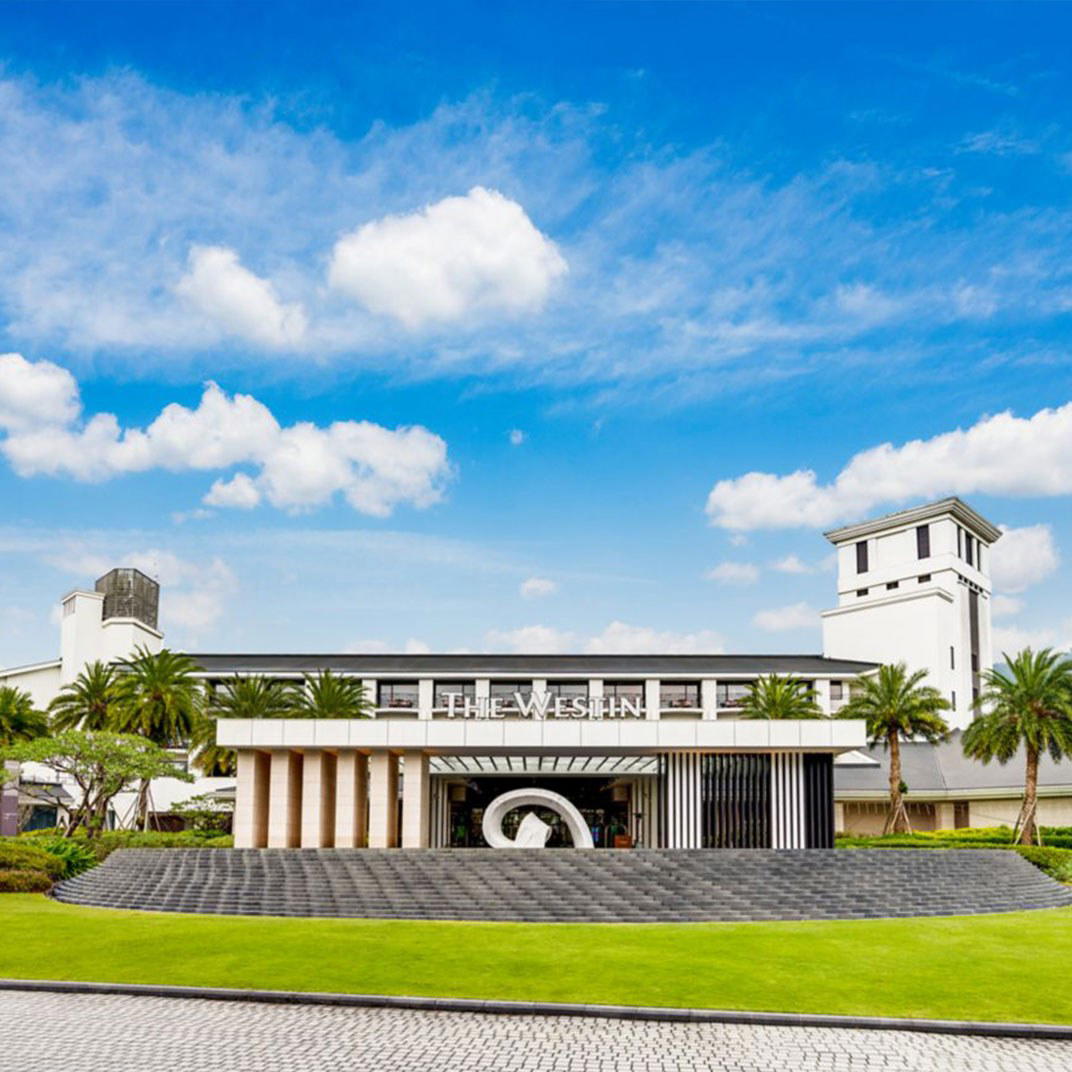
Where the Taoyuan Hills Define the Architecture
Taiwan's resort hotel tier divides cleanly between urban towers that happen to have pools and genuinely landscape-integrated properties where the site does most of the heavy lifting. The Westin Tashee Resort in Daxi belongs to the second category. Situated on Rixin Road in the Daxi district of Taoyuan — a stretch of rolling foothills that separates the congested Taoyuan basin from the Shimen Reservoir watershed — the property is designed to work with its elevation rather than against it. Approach roads rise through stands of subtropical greenery before the building mass comes into view, a sequencing that functions almost architecturally: the resort arrives as a destination, not as a roadside billboard.
This matters for a specific kind of traveller. Daxi sits roughly an hour southeast of Taipei Songshan and about forty minutes from Taoyuan International Airport, which makes the resort accessible from either direction without requiring the commitment of a remote mountain escape. That middle-distance positioning is a studied choice shared by several of Taiwan's more successful resort formats, where proximity to infrastructure allows the property to serve both leisure weekenders from Taipei and international arrivals looking to decompress immediately after landing.
Design Logic in a Resort Context
The architectural framework at properties of this scale in Taiwan's western foothills tends to follow one of two orientations: inward-facing around a central amenity core, or outward-facing to capture reservoir and ridge views. The Westin Tashee leans outward, with the surrounding terrain treated as a continuous visual element rather than a backdrop to block out. This approach, common to mid-century Japanese resort design and later absorbed into Taiwanese hospitality architecture during the 1990s expansion of mountain and reservoir-adjacent properties, gives the property a spatial generosity that purely urban hotels cannot replicate regardless of room count.
Westin's global design language, which trends toward warm neutrals, organic materials, and the brand's recognisable Heavenly Bed program, translates into this setting without the visual dissonance that sometimes affects international chain properties dropped into regional contexts. The resort format allows more square footage per guest, which in turn permits the kind of corridor-to-room spatial transitions that communicate quality before the guest ever opens a door. These transitional spaces, lobbies that open onto garden terraces, corridors that frame hill views through end-glass, function as design signals in their own right.
Michelin's hotel selection in Taiwan has concentrated heavily on Taipei properties such as the urban flagships that populate the capital's Xinyi and Zhongshan corridors, making a Daxi inclusion notable as a signal that the guide is extending its regional coverage. For context on how Taiwanese urban luxury hotels compare, see properties like W Taipei in Taipei or Hotel Indigo Taipei North in Zhongshan District, which represent the capital-city end of the same recognition spectrum.
The Resort's Position in Taiwan's Wider Hotel Geography
Taiwan's non-urban resort tier has expanded significantly over the past decade, with properties targeting three distinct audiences: domestic weekenders from Taipei and Taichung, Japanese leisure travellers drawn to Taiwan's Onsens and mountain environments, and international visitors arriving via Taoyuan who prefer a softer landing than a Taipei city hotel. The Westin Tashee's Daxi positioning captures all three segments to varying degrees, though the domestic weekend market arguably drives the most consistent occupancy.
Compared to reservoir and hot-spring resort developments further south, such as Grand Hilai Sun Moon Lake in Yuchi or the spa-focused format at Volando Urai Spring Spa & Resort in Wulai District, the Westin Tashee operates closer to metropolitan infrastructure. This proximity shapes the guest profile and, consequently, the amenity mix: the property carries the full-service expectations of the Westin brand rather than the stripped-back tranquility that defines more remote alternatives.
Eastern Taiwan's resort model, represented by properties like Hualien Farglory Hotel in Yanliau and coastal options such as YOHO Beach Resort in Pingtung, requires longer travel commitments and serves a different itinerary logic entirely. The Westin Tashee's comparative advantage is convenience without sacrificing the sense of physical remove from the city, a balance that fewer properties manage to sustain as Taoyuan's suburban footprint continues to expand northward.
For travellers oriented toward design-forward smaller properties, Taiwan's independent hotel scene offers alternatives worth considering: The Old England Manor in Ren'ai and The One Nanyuan in Xinpu occupy a different scale and aesthetic register entirely, while Grasse Grace Manor in Miaoli demonstrates what smaller operators in Taiwan's mid-island hill country are doing with European-inflected design language. The Westin Tashee makes no claim to that independent-hotel register; it is a full-service chain resort operating at the top of its format category, and the Michelin recognition reflects assessment within that frame.
Planning a Stay
Daxi is accessible from Taipei via National Freeway 3 and the Provincial Highway 7 corridor, with the drive from Taipei city centre running approximately seventy to ninety minutes depending on traffic conditions on the Freeway 3 interchange near Daxi. From Taoyuan International Airport, the route is more direct and considerably shorter. Public transport options into Daxi are limited relative to Taipei's MRT network, and most guests arriving without private vehicles will rely on taxi or ride-share services from Taoyuan HSR station or the airport. Weekend bookings, particularly over national holidays and the October-November period when hill temperatures moderate, book ahead more aggressively than midweek stays.
For travellers using the resort as a base for regional exploration, Our full Daxi restaurants guide covers the town's historic old street, traditional tofu producers, and the lower-key dining scene that distinguishes Daxi from more tourist-saturated Taiwanese day-trip destinations. The Westin Tashee functions well as a headquarters for that kind of slow, town-and-countryside itinerary rather than as a transit stop.
Across Taiwan's broader Michelin-recognised hotel tier, international comparison points exist at properties like Badrutt's Palace Hotel in St. Moritz and Hôtel de Paris Monte-Carlo in Monte Carlo for a sense of how Michelin's hotel selection criteria translate across very different price points and geographic contexts. The Westin Tashee sits in a more accessible band than either of those properties, which is precisely the point of the Michelin Selected tier as a recognition category.
Quick Comparison
| Venue | Price | Awards |
|---|---|---|
| The Westin Tashee Resort, TaoyuanThis venue — the venue you are viewing | $200–300 | Michelin Selected |
| Shangri-La's Far Eastern Plaza Hotel, Taipei | Not listed | Michelin Selected · La Liste Top Hotels |
| Grand Hyatt Taipei | $200–300 | Michelin Selected · Forbes Recommended |
| Mandarin Oriental, Taipei | $300–500 | 1 Michelin Key · La Liste Top Hotels |
| W Taipei | $200–300 | Michelin Selected · Forbes 4-Star |
| Regent Taipei | $200–300 | Michelin Selected · La Liste Top Hotels |
Recognition history
Dated appearances from independent guides and award organizations, with the underlying list record or original source where available.
Michelin Selected
Michelin
Continue exploring
More in Daxi
Hotels in Daxi
Browse all →
Bars in Daxi
Browse all →
Restaurants in Daxi
Browse all →
Wineries in Daxi
Browse all →
Details
- Scenic
- Modern
- Elegant
- Quiet
- Sophisticated
- Family Vacation
- Wellness Retreat
- Weekend Escape
- Group Retreat
- Romantic Getaway
- Destination Spa
- Garden
- Panoramic View
- Private Dining
- Wi Fi
- Pool
- Spa
- Fitness Center
- Room Service
- Concierge
- Kids Club
- Airport Shuttle
- Restaurant
- Bar
- Parking
- Garden
- Mountain
- Wheelchair Accessible
- Elevator
A serene, resort-like atmosphere with Balinese-inspired tropical pool areas, natural light, and a calm, luxurious feel; guest and press descriptions emphasize peace, spaciousness, and a wellness-oriented escape.