The Empire Brunei


Forbes Recommended · Preferred Hotels Member
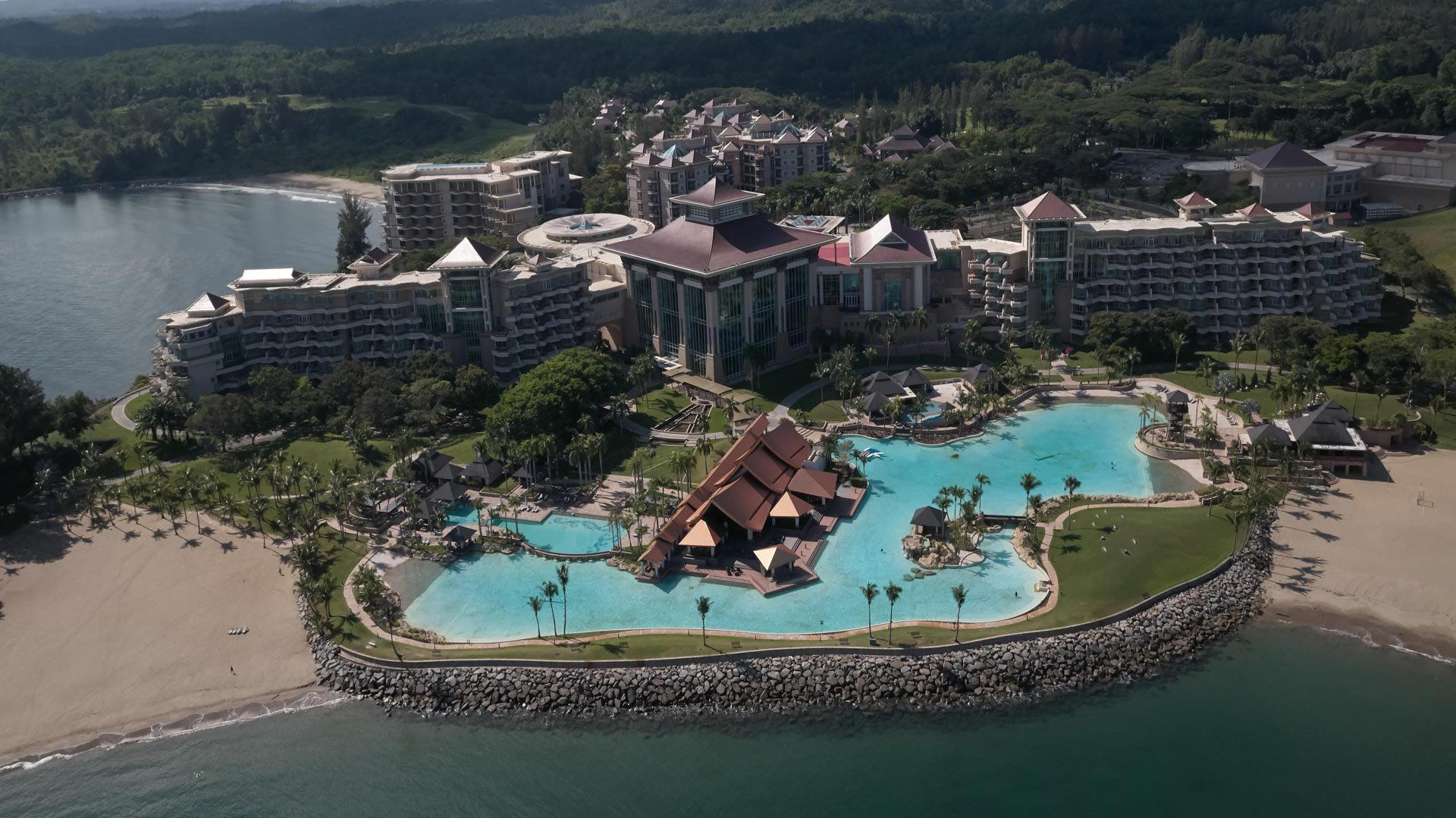
A former royal guesthouse scaled to resort proportions, The Empire Brunei occupies a stretch of Borneo's northwestern coast with 522 rooms built in the ceremonial architectural language of the Bruneian sultanate.

Pearl is the En Primeur Club membership app, where members save venues, book tables and use the concierge.
A Palace Grammar on the Bornean Coast
Arrive at The Empire Brunei from the Muara-Tutong Highway and the first impression is deliberately monumental. The structure reads like a translation of Bruneian royal architecture into resort scale: domed rooflines, colonnaded facades, and a massing that signals state-level ambition rather than commercial hospitality. This is not an accident of styling. The property began as a royal guesthouse, built to receive guests of the Sultanate of Brunei at a standard commensurate with one of Southeast Asia's wealthiest sovereign states. That origin shapes everything about the physical experience, the proportions are ceremonial, the materials weight-bearing in their symbolism, and the approach roads long enough to register as a threshold rather than a mere driveway.
In Southeast Asian luxury, properties at this scale tend to split into two broad categories: those that inherit their grandeur from a colonial period and those built from sovereign wealth in a deliberate act of architectural projection. The Empire Brunei belongs firmly to the second group, comparable in intent if not in form to the kinds of state-sponsored grand hotels that punctuate Gulf capitals and Brunei's own regional neighbours. Where properties like the Mandarin Oriental Bangkok carry their prestige through decades of accumulated history, The Empire operates on a different register, one where the architecture itself is the primary credential.
Scale, Rooms, and the Logic of 522 Keys
At 522 rooms, The Empire occupies a tier of hospitality where the guest experience is shaped as much by the volume and variety of accommodation as by individual room quality. Properties at this count, well above the 50-to-120-key range favoured by design-led boutique hotels, make a different kind of argument. The pitch is comprehensiveness: multiple room categories, suite configurations suited to diplomatic and family travel alike, and public spaces large enough to absorb significant occupancy without feeling crowded.
For comparison, properties like Badrutt's Palace Hotel in St. Moritz or the Hotel Plaza Athénée in Paris operate on a similarly grand European palace model, where room count supports a full ecosystem of dining, leisure, and event infrastructure. The Empire's Bruneian equivalent builds that ecosystem around the coastal setting of Jerudong, with the South China Sea as its primary natural asset. The property's position along Borneo's northwestern shore means the site itself carries weight that no interior design decision can replicate.
Architecture as Credential
The architectural language at The Empire draws directly from Islamic Bruneian tradition, the same grammar visible in the Omar Ali Saifuddien Mosque and the Istana Nurul Iman, the Sultan's official residence and the largest residential palace in the world. Pointed arches, gilded detailing, and the persistent use of symmetry as an organizing principle give the property a coherence that goes beyond pastiche. This is a building that understands its references and applies them at resort scale without the awkwardness that often accompanies that kind of translation.
That design discipline puts The Empire in interesting company globally. Grand hotels built in explicit dialogue with national or royal architectural traditions, whether Hôtel de Paris Monte-Carlo or Hotel Sacher Wien, rely on the legibility of their cultural context to anchor the guest experience. At The Empire, that context is the Bruneian sultanate itself, which gives the property a specificity that international branded luxury cannot manufacture. You are, in a meaningful architectural sense, staying inside a visual argument about what Brunei looks like at its most formal.
Bandar Seri Begawan as a Hotel Destination
Bandar Seri Begawan receives a fraction of the luxury travel volume that flows through Singapore, Kuala Lumpur, or Bali. That relative quiet is itself a feature for a certain kind of traveller. The capital remains small, navigable, and largely free of the congestion that now characterises many Southeast Asian urban centres. The Empire's location in Jerudong, along the Muara-Tutong Highway rather than in the city centre, places it closer to the coast than to the urban core, a positioning that prioritises the resort experience over proximity to Bandar Seri Begawan's cultural sites, including the water village of Kampong Ayer and the Royal Regalia Museum.
Travellers arriving primarily for the capital's sights would want to factor in transfer times. Those arriving for the property itself, for the architecture, the coastal setting, and the particular experience of sovereign-scale Bruneian hospitality, will find Jerudong an appropriate base. For a wider survey of what the city offers beyond the property, our full Bandar Seri Begawan guide covers the dining and cultural picture in more detail.
Where The Empire Sits in the Global Palace-Hotel Tier
The category of hotel that The Empire occupies, state-adjacent, architecturally monumental, built to receive sovereign-level guests, has direct analogues in other parts of the world, though they are rarely the properties that dominate international luxury travel coverage. The Aman Venice and Cipriani, A Belmond Hotel, Venice occupy palazzo structures with comparable origins in aristocratic and institutional patronage. The Cheval Blanc Paris and Le Bristol Paris operate within the French grand-hotel tradition where scale and formality remain competitive signals rather than liabilities.
What distinguishes The Empire from most of those peers is the rarity of its context. Brunei is not a volume luxury destination, and the sultanate's formal hospitality infrastructure exists in a different relationship to international tourism than European palace hotels. The Empire is, in effect, the primary expression of what luxury accommodation looks like inside a sovereign Bornean state, a position that carries its own authority, regardless of how it indexes against international rating systems.
For travellers cross-referencing palace-hotel experiences across regions, properties like Hotel Du Cap-Eden-Roc on the French Riviera or The Beverly Hills Hotel offer useful reference points for grand-resort grammar in their own geographic contexts, even if the cultural registers differ substantially.
Planning Your Stay
The Empire Brunei sits in Kg Jerudong along the Muara-Tutong Highway, accessible from Brunei International Airport with a transfer that, depending on traffic, runs under 30 minutes. Given Brunei's position as a transit point between Kota Kinabalu, Kuala Lumpur, and Singapore, the property is a workable addition to a broader Borneo itinerary rather than requiring a standalone routing. Booking is leading handled directly through the property, and given the hotel's scale at 522 rooms, availability is generally more consistent than at lower-key regional alternatives, though peak periods around national celebrations and school holidays across the region warrant earlier planning.
Recognition history
Dated appearances from independent guides and award organizations, with the underlying list record or original source where available.
Forbes Recommended
Forbes
Preferred Hotels Member
Preferred Hotels
Continue exploring
More in Bandar Seri Begawan
Restaurants in Bandar Seri Begawan
Browse all →
Details
- Elegant
- Scenic
- Quiet
- Sophisticated
- Family Vacation
- Romantic Getaway
- Weekend Escape
- Beachfront
- Infinity Pool
- Golf Course
- Wi Fi
- Pool
- Spa
- Fitness Center
- Room Service
- Concierge
- Business Center
- Valet Parking
- Kids Club
- Golf Course
- Waterfront
- Wheelchair Accessible
- Elevator
Luxurious and serene with tranquil pools, beachfront settings, and spacious elegant interiors; guests highlight peaceful, quiet nights and relaxing atmosphere.