

Fodor's Most Incredible Hotels in the World · Small Luxury Hotels of the World Member
Tanjong Jara Resort sits on Terengganu's east coast, its timber pavilions and pitched rooflines drawn from 17th-century Malay palace architecture. The South China Sea frames one side; primary jungle presses in from the other. For travellers willing to make the journey to Dungun, the resort offers a distinctly Malaysian alternative to the region's more internationally branded luxury properties.

Pearl is the En Primeur Club membership app, where members save venues, book tables and use the concierge.
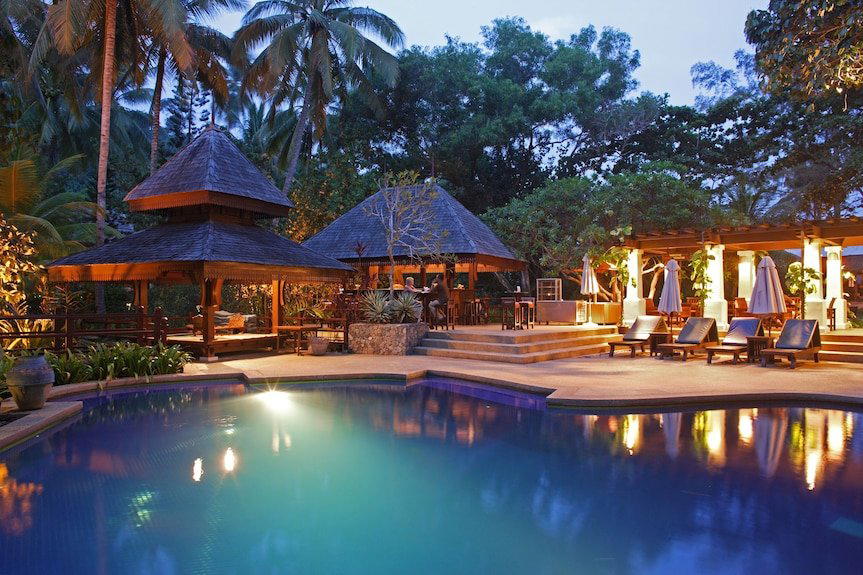
A Malay Architectural Tradition, Made Habitable at Scale
The east coast of Peninsular Malaysia operates on a different register from Kuala Lumpur or even Penang. Towns like Dungun move slowly, fishing boats still work the shore at dusk, and the South China Sea runs clear enough to read the seabed in the shallows. Into this setting, Tanjong Jara Resort places itself not as an interruption but as an extension of local building tradition, referencing the timber palace architecture of 17th-century Malay royalty at a scale that makes the reference legible from the approach road.
The design language is specific: steeply pitched rooflines, hand-carved timber fretwork, and open-sided pavilions that manage airflow the way traditional Malay vernacular architecture always has, through orientation and elevation rather than sealed mechanical systems. Where many resort properties in the region import a generic tropical aesthetic, Tanjong Jara commits to a single cultural reference point and holds it across the entire property. For guests arriving from Kuala Lumpur or connecting through Kuala Terengganu, the shift in visual register is immediate. This is not the glass-and-limestone vocabulary of a city-centre hotel; it is something considerably harder to replicate and considerably more specific to place.
Broader pattern of Malaysian luxury hospitality has split between large-footprint international chain properties and smaller, culturally rooted alternatives. The Datai in Langkawi occupies a similar niche on the west coast, trading on rainforest immersion and a distinct design sensibility. Tanjong Jara makes an analogous argument on the east coast, though its architectural vocabulary is more explicitly historical, and its landscape context, primary jungle meeting a long stretch of beach, is less developed commercially than Langkawi's resort corridor.
What the Building Actually Does
Malay palace architecture was never purely ornamental. The pitched rooflines shed monsoon rain quickly and allow hot air to escape from the apex of the structure. The raised floor levels manage ground moisture and catch coastal breezes. At Tanjong Jara, these functional principles are not merely decorative quotations: the pavilion layout and orientation follow the logic of the tradition rather than simply borrowing its surface appearance.
This approach places Tanjong Jara in a specific design tier, closer to properties like Pangkor Laut Resort in Lumut or Borneo Rainforest Lodge in Lahad Datu, where the physical environment and architectural approach are the primary editorial argument, rather than F&B; programming or spa treatment menus. The jungle backdrop presses close, the beach is wide and relatively uncrowded, and the South China Sea horizon is unobstructed by development on either side.
Terengganu's east coast closes to most international visitors during the northeast monsoon, which runs roughly from November through February. The sea becomes rough, beach conditions deteriorate, and some resort operations scale back. The window from March through October represents the functional high season, with the clearest water and most stable beach conditions in the June-to-August period. Guests planning around diving or snorkelling proximity to the Perhentian Islands, roughly three hours north by road, should build their itinerary around that calendar.
The Food Context: Eating in Terengganu
Terengganu cooking is among the more underrepresented regional Malaysian traditions in international food media. The state's kitchen draws heavily on the South China Sea's catch, with fish prepared through techniques that reflect both Malay and Thai coastal influence. Keropok lekor, a fish cracker unique to the region, is made and sold fresh along the roadsides near Dungun; nasi dagang, rice cooked in coconut milk and served with tuna curry, is the canonical Terengganu breakfast dish. The resort's positioning around locally sourced fish, supplied by fishermen working the same coastline the property faces, places its food programme in dialogue with a genuine regional tradition rather than constructing a generic tropical menu.
This is where Tanjong Jara's remoteness becomes an editorial point rather than a logistical drawback. Properties closer to major cities typically serve food traditions that have been mediated by supply chains, chef training outside the region, and guest expectation. A resort drawing directly from local fishing boats operates within a supply chain that is shorter, more variable, and more honest about where the food actually comes from. That is not a trivial distinction in a region where the distance between provenance claims and plate reality is often considerable.
For a wider read on comparable Malaysian resort properties that take a similar place-rooted approach to food and environment, the Mangala Estate in Kuantan offers a parallel case on the same east coast corridor, while Cameron Highlands Resort demonstrates how the same design sensibility translates into a highland rather than coastal setting.
Getting Here and Planning the Stay
Dungun sits on the Terengganu coast, approximately eight kilometres from the town centre by the address coordinates at Batu 8 off Jalan Dungun. The practical access routes run through Sultan Mahmud Airport in Kuala Terengganu, served by domestic connections from Kuala Lumpur, or overland from Kuala Lumpur via the East Coast Expressway, a drive of roughly five to six hours depending on departure point. Neither route is effortless, which is precisely why the property's setting retains the character it does. Coastal resorts that require genuine travel commitment tend to attract guests who are prepared to be present, rather than using the property as a staging point for day trips.
Booking directly through the property is the standard approach for east coast resort properties of this tier. Guests considering Malaysia's east coast as part of a longer circuit might also look at Sukau Rainforest Lodge in Kinabatangan or Borneo Eagle Resort in Kota Kinabalu for a Borneo pairing, or remain on the Peninsula and consider Soori in Penang Island for a design-led west coast counterpoint. Our full Dungun guide maps the wider area for context.
That coherence is rarer than it sounds in a market where resort design has become increasingly interchangeable across sites. Whether the distance from major airports reads as inconvenience or as part of the offer depends entirely on what the traveller is seeking. For those who prioritise cultural specificity and physical immersion over programming breadth, the journey is proportionate to what is at the end of it.
Comparable Spots, Quickly
Comparable venues nearby, for context on price, style, and recognition.
| Venue | Cuisine | Price | Awards | Notes |
|---|---|---|---|---|
| Tanjong Jara ResortThis venue (the venue you are viewing) | Luxury beachfront resort evoking 17th-century Malay palace architecture with local timber and rich fabrics. | $300–500 | Fodor's Most Incredible Hotels in the World · Small Luxury Hotels of the World Member | Not listed |
| Highlands Hotel at Resorts World Genting | Luxury resort hotel integrated with entertainment complex | $100–200 | Forbes Recommended | Genting Highlands |
| Genting Grand at Resorts World Genting | Signature luxury resort hotel with Forbes 4-star and Ministry of Tourism 5-star ratings | $100–200 | Forbes Recommended | Genting Highlands |
| Park Hyatt Kuala Lumpur | Ultra-luxury contemporary design hotel positioned as a sky sanctuary, blending modern sophistication with Malaysian cultural heritage elements. | $500–750 | 1 Michelin Key · Star Wine List | City Centre |
| Angsana Teluk Bahang, Penang | Contemporary Asian beach resort | Not listed | World Luxury Hotel Awards WLHA Regional Winner | Teluk Bahang |
| Pangkor Laut Resort | Luxury boutique resort blending minimalist contemporary design with natural rainforest integration; architecture respects the ecosystem while delivering five-star amenities. | $100–200 | Small Luxury Hotels of the World Member · World Travel Awards | Pangkor Laut Island |
Recognition history
Dated appearances from independent guides and award organizations, with the underlying list record or original source where available.
Fodor's Most Incredible Hotels in the World
Fodor's
Small Luxury Hotels of the World Member
Small Luxury Hotels of the World
Details
- Romantic
- Quiet
- Elegant
- Scenic
- Sophisticated
- Ornate
- Honeymoon
- Romantic Getaway
- Wellness Retreat
- Family Vacation
- Anniversary
- Beachfront
- Infinity Pool
- Private Villa
- Destination Spa
- Wi Fi
- Pool
- Spa
- Fitness Center
- Room Service
- Concierge
- Tennis
- Beach Access
- Waterfront
- Garden
- Wheelchair Accessible
- Step Free Entrance
Serene tropical atmosphere with immaculate grounds, spacious rooms offering sea or garden views, and a peaceful blend of jungle and beach settings praised for its relaxing and intimate feel.