
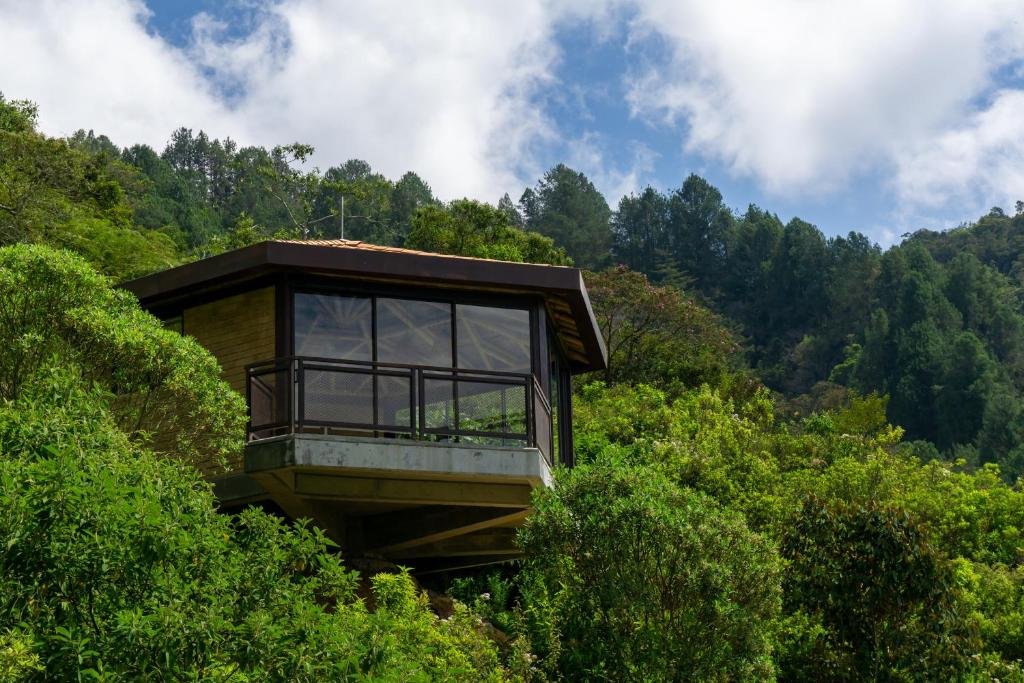
Cannúa Lodge sits on a mountainside in Antioquia's Valley of San Nicolás, where 18 rooms and free-standing cabañas built from estate-sourced bricks look out over one of Colombia's more dramatic highland panoramas. The lodge combines loft-influenced design with a permaculture-driven restaurant, pre-Hispanic hiking trails, and a social sustainability model rooted in the surrounding community. Rates start at $179 per night.
Where the Valley Opens Up
The road to Cannúa Lodge climbs through coffee-growing hillsides east of Medellín, past the kind of working Antioquian landscape that most visitors to Colombia see only from a car window. By the time the lodge appears, perched on a mountainside above the Valley of San Nicolás, the altitude has already shifted the air. The approach matters here: the physical sensation of arriving at elevation, with the valley floor spread far below through gaps in cloud, is the opening argument the property makes before a single room has been seen.
Deep-forest eco-lodges arrived later in Colombia than in Costa Rica, Ecuador, or the Colombian Pacific coast, where sustainability-led hospitality had already formed a recognisable category by the early 2010s. Cannúa belongs to a smaller cohort of Antioquian properties that have since moved to close that gap, and it does so with a level of material specificity that sets it apart from peers who lean on the label without following through on the architecture. For broader context on where Cannúa sits relative to other design-led stays across the country, see our full Marinilla hotels guide.
Built From the Ground, Literally
The design logic at Cannúa starts with its bricks. The building material was crafted on site from the soil of the estate itself, a decision that ties the structure to its specific geography in a way that imported materials, however well chosen, cannot replicate. In Latin American eco-architecture, this kind of hyper-local sourcing has precedent in vernacular traditions, but applying it within a loft-influenced contemporary frame is less common. The result is a building that reads as modern in its proportions and fenestration while remaining materially grounded in Antioquian earth.
The ten rooms and eight free-standing cabañas are distributed across the mountainside in a configuration that maximises the view from each unit without clustering guests together. Vast windows are the consistent design element across the accommodation types: they function architecturally as frames for the valley panorama, turning the exterior into the primary decorative feature of every interior. The contrast between clean-lined, loft-inspired interiors and the organic, far-ranging view outside is the central tension the design exploits throughout. Properties that achieve this balance between interior restraint and exterior spectacle are rare; properties that achieve it at a starting rate of $179 per night, across 18 rooms, are rarer still.
This approach to design-led eco-lodging in highland Colombia sits in a different competitive register than the urban luxury market. Properties like Elcielo Hotel and Restaurant in Medellín operate in the city-hotel category with different design priorities, while destination lodges in the rural Antioquia corridor are working with landscape as their primary asset. Cannúa's closest design-philosophy peers internationally might be properties like Amangiri in Canyon Point, where architecture defers to terrain, or Castello di Reschio in Lisciano Niccone, where material honesty and landscape integration are the dominant design languages, though the scale and price points are quite different.
The Pre-Hispanic Trail and What It Signals
Access to a hiking trail established by pre-Hispanic indigenous people is not a feature that can be engineered after the fact. It is either present in the land or it is not, and at Cannúa it is present, running through the estate in a way that connects guests to a pre-colonial geography of movement through the Andes. This kind of historical layering, where the land itself carries a record of human use that predates the colonial period, is one of the stronger arguments for the lodge's connection to place as something substantive rather than decorative.
Birding excursions and coffee and chocolate tastings round out the activity offering, the latter two drawing on Antioquia's position as one of Colombia's most productive agricultural departments. The Valley of San Nicolás specifically sits within a zone where smallholder coffee farming and traditional cacao cultivation remain active, meaning tasting experiences here draw on a genuine regional supply chain rather than a curated tourism product assembled from distant sources. For more on what the region offers beyond the lodge itself, our full Marinilla experiences guide covers the wider options.
Permaculture Kitchen, Community Table
The restaurant operates on ingredients grown in the lodge's own permaculture garden, a model that is more demanding to maintain than farm-to-table sourcing agreements but that produces a different kind of menu discipline. When a kitchen is limited to what its own land yields in a given week, seasonal variation is not a marketing concept but an operational reality. Contemporary Colombian cooking has developed considerable range across the country's different culinary regions, from the coast to the highlands to the Amazon basin, and a mountain kitchen working within the constraints of a highland permaculture plot occupies a specific and interesting corner of that broader field. For context on where this fits in the regional dining picture, see our full Marinilla restaurants guide.
The social sustainability dimension of the lodge extends beyond the kitchen. The connection to the local community is described as authentic rather than transactional, a distinction that is easier to claim than to demonstrate, but that the combination of on-site brick production, permaculture gardening, and local trail access at least makes plausible. The spa rounds out the on-site offering, providing a recovery option after trail excursions that keeps guests on the property rather than pushing them toward Marinilla or the wider Rionegro corridor for services.
Planning Your Stay
Cannúa Lodge sits at Vda Gaviria KM 7+200, approximately seven kilometres outside Marinilla in Antioquia, placing it within reasonable driving distance of José María Córdova International Airport, which serves the greater Medellín metropolitan area and connects through Bogotá to international routes. The 18-room property at this scale books tightly during Colombian holiday periods and long weekends, when Antioquian families and Medellín residents use the eastern highlands as a retreat corridor. Arriving on a weekday reduces competition for the free-standing cabañas, which offer more privacy and separation from the main lodge building. Rates begin at $179 per night. Basic connectivity including wi-fi and private bathrooms is standard across all room types, which matters in a mountain setting where the assumption of roughing it is sometimes used to justify infrastructure gaps that need not exist.
For broader travel planning across the region, EP Club's guides cover Marinilla bars, Marinilla wineries, and the full Marinilla experiences circuit. Travellers routing through Colombia's hotel network more widely may also find useful reference in properties across different city registers, from Casa Pestagua in Cartagena and Movich Casa del Alférez in Cali to Tau House in Guatapé, which occupies the same eastern Antioquia region and offers a useful point of comparison for how design-led lodging in this corridor approaches landscape differently depending on whether the setting is lakeside or highland forest. The Bio Habitat Hotel in Armenia rounds out the Colombian eco-hospitality picture for travellers with time to extend into the coffee axis.
Frequently Asked Questions
- What should I expect atmosphere-wise at Cannúa Lodge?
- The atmosphere is shaped primarily by elevation and open landscape. The lodge sits on a mountainside in Antioquia with views across the Valley of San Nicolás, and the design reinforces that orientation through vast windows in every room. Interiors are modern and clean-lined, built from bricks made on-site from estate soil, which gives the spaces a grounded, material quality rather than the polished anonymity of a branded eco-resort. The 18-room scale keeps the property quiet even at moderate occupancy. Rates start at $179 per night. For the broader Marinilla context, see our full Marinilla hotels guide.
- What is the leading accommodation option at Cannúa Lodge?
- The eight free-standing cabañas represent the most private accommodation format the lodge offers. Separated from the main building and from each other, they follow the same design language as the ten lodge rooms, with modern interiors, estate-sourced brick construction, and the expansive valley views that define the property, but with added separation that makes them the stronger choice for couples or guests prioritising solitude. The lodge does not publish a tiered suite designation in available records, but the cabaña format is the clear step up from standard rooms at the $179 starting rate. Comparable design-led private-cabin formats in Colombia's eco-lodge category can be cross-referenced against Tau House in Guatapé.
Preferential Rates?
Our members enjoy concierge-led booking support and priority upgrades at the world's finest hotels.
Access the Concierge