
A cocktail bar set against one of Rome's most arresting ancient backdrops, Salotto 42 occupies Piazza di Pietra with the Temple of Hadrian's columns as its immediate view. Recognized on the World's 50 Best Bars list in 2010, it operates as a hybrid space where drinks, books, and design objects share the same considered environment. Arrival time and seat choice matter here.
A Roman Piazza as Bar Architecture
Piazza di Pietra is not a piazza that announces itself loudly. It sits just off the main tourist corridors between the Pantheon and Trevi Fountain, and its dominant presence is the eleven surviving columns of the Temple of Hadrian, incorporated into the wall of what is now Rome's Chamber of Commerce. The square is quiet by Roman standards, which makes it an unlikely address for a bar that appeared on the World's 50 Best Bars list in 2010 at number 49. But the setting is precisely the point. Salotto 42 does not compete with the city; it uses the city as its primary design element.
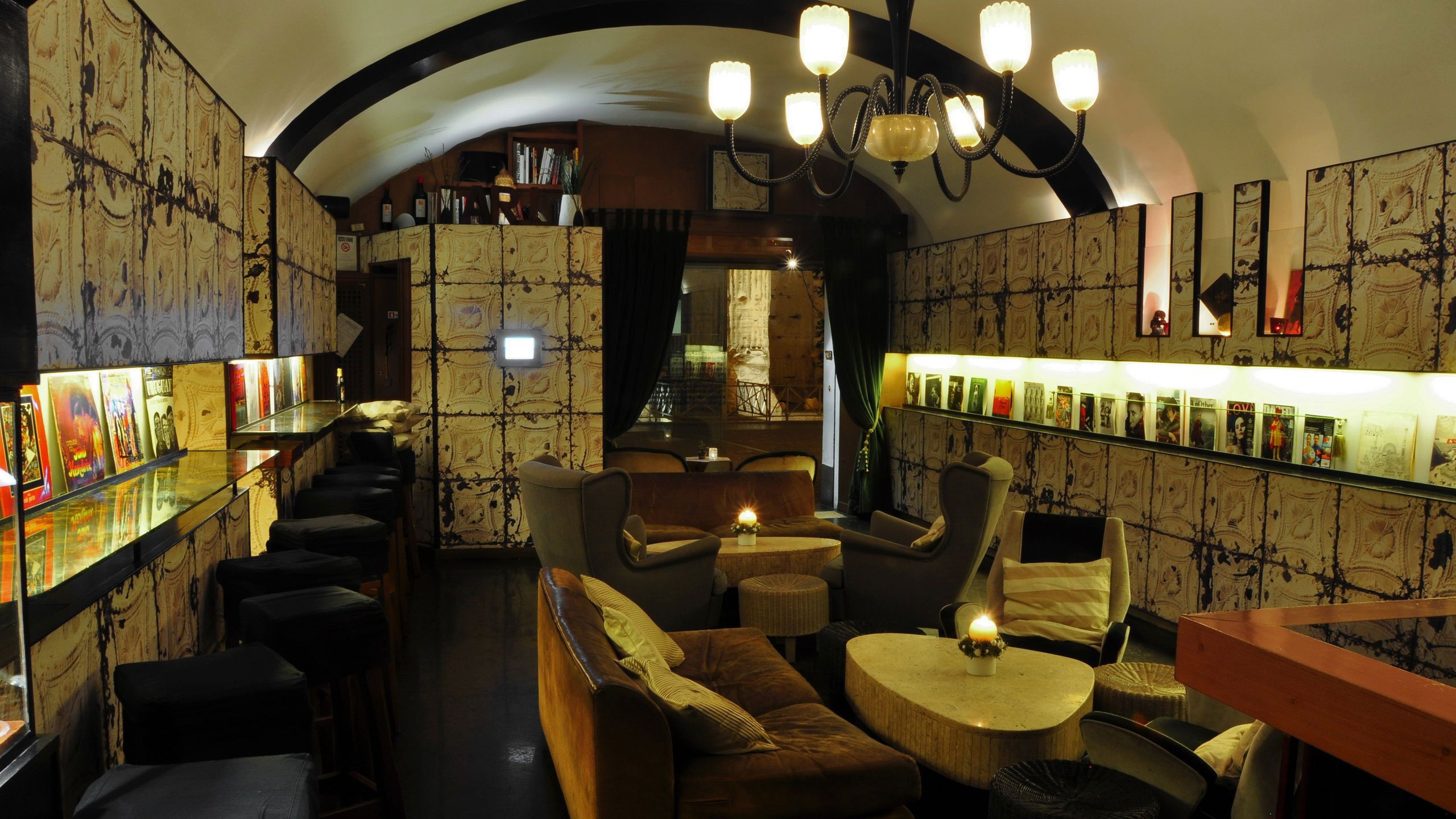
The name translates loosely as 'living room 42', a reference to the address at number 42 on the square. That framing is not incidental. The interior reads more as a considered residential space than a conventional bar: design monographs line the shelves, furniture is curated rather than standard hospitality issue, and the pace is calibrated toward lingering rather than turnover. This is the category of bar that emerged in European capitals in the mid-2000s, where the drink program was one component of a broader spatial and cultural proposition. In Rome, where bar culture had traditionally split between the espresso-and-out counters of the centro storico and the loud aperitivo circuit of Trastevere and Pigneto, this format was a specific departure.
The Aperitivo Framework and What It Reveals
The editorial angle that makes most sense for Salotto 42 is not the cocktail list in isolation but the structure around which the bar organizes its offer. The aperitivo hour is the operative concept. In the Italian tradition, the aperitivo is not merely a drink before dinner; it is a social institution with its own timing logic, its own food accompaniments, and its own expectation of atmosphere. Bars that take the format seriously treat it as a menu category in its own right, not an add-on to a cocktail program imported from London or New York.
Salotto 42's positioning within that tradition is important context for understanding how it compares to other Rome bars that have attracted international recognition. Drink Kong, for instance, operates with an explicit technical cocktail focus and a late-night orientation; its recognition comes from a different part of the bar spectrum. Freni e Frizioni built its reputation on the Trastevere aperitivo model, where volume and crowd energy are part of the offer. Jerry Thomas Speakeasy operates on a speakeasy reservation format with a high technical bar. Salotto 42 sits at none of those coordinates exactly: it is quieter than Freni e Frizioni, less theatrical than Jerry Thomas, and more integrated into a daytime-to-evening arc than Drink Kong.
That arc matters. The bar is used differently at noon, at six in the evening, and after dinner. The design-book format and the square's relative calm mean it functions as a working space and meeting spot during the day, then transitions into aperitivo mode as the afternoon light shifts off the Hadrian columns. This is the kind of temporal layering that the leading neighbourhood bars in any city develop over years of use, and it is not something that can be replicated quickly by a new opening regardless of budget.
Position on the Broader Italian Bar Circuit
When Salotto 42 entered the World's 50 Best Bars ranking in 2010, the list itself was in an early phase, and the methodology weighted atmosphere and cultural integration alongside cocktail technique. That context explains something about the bar's recognition: it was not placed primarily for a specific house cocktail or a named bartender's technique, but for what it represented as a total proposition in a city not previously associated with international bar culture recognition.
Italy's bar culture has since developed considerably. 1930 in Milan has pushed Italian cocktail into a more technically demanding and speakeasy-influenced direction. Gucci Giardino in Florence represents the fashion-house-meets-aperitivo format that has found a specific luxury niche. The Rome scene, through venues like Drink Kong and Jerry Thomas, has developed programs that sit comfortably in contemporary international comparison. Against that backdrop, Salotto 42 occupies an older part of the conversation: the bar as cultural space with a drink program rather than a drink program that also happens to have a space.
That is not a criticism. It is a positioning statement. The bars that last in competitive cities often do so because they have a function that transcends any particular menu cycle. A reading-room-aperitivo-bar with a direct sightline to Roman antiquity is not a format with many direct competitors. The Google review score of 4.1 across 2,373 reviews indicates sustained engagement from a broad audience, which in Rome's centro storico typically means a mix of informed visitors and local regulars rather than a single demographic.
Visiting: Timing, Location, and Approach
Piazza di Pietra sits in the dense historic center, walkable from both the Pantheon and the Campo de' Fiori axis. The square itself sees foot traffic, but nothing approaching the crush of the Pantheon's immediate surroundings a few hundred meters west. For visitors using Rome's centro storico as a base, the range of hotels in the area places Salotto 42 within easy reach without transport. For those building a broader evening, the bar sits naturally on a route that could incorporate the centro storico restaurant circuit or extend into a longer exploration of Rome's evening culture.
Timing is the most consequential variable. The aperitivo window, broadly between 18:00 and 21:00, is when the bar operates at the register it was designed for: the square dims, the columns take on a different weight in the fading light, and the interior's residential warmth contrasts with the stone exterior. Arriving outside that window, particularly in the middle of the day, gives a different experience that is valid but distinct. Seating on the terrace facing the Temple of Hadrian is the most sought-after configuration; arriving early in the aperitivo period improves the chances of securing it.
For a wider sense of where Salotto 42 sits on the Rome bar spectrum, the full Rome bars guide covers the range from technical cocktail programs through neighbourhood aperitivo institutions. Those interested in how the Italian bar scene compares across cities might also note Boeme as another Rome reference point, and for international comparison outside Italy, Bar Leather Apron in Honolulu represents a similarly design-integrated, atmosphere-forward bar format in a different geography. Winery visits around Rome are documented in the Rome wineries guide for those extending their stay beyond the city.
FAQs: Salotto 42
What cocktail do people recommend at Salotto 42?
Salotto 42 built its reputation, including its 2010 appearance at number 49 on the World's 50 Best Bars list, partly on its aperitivo-forward offer rather than a single signature cocktail. The bar's design and cultural positioning mean the Aperol Spritz and Negroni variations sit naturally in its Italian context. Without confirmed current menu data, specific cocktail recommendations cannot be made with confidence, but the aperitivo category is the bar's operational core.
What makes Salotto 42 worth visiting?
The combination of a considered interior design, a direct view of the Temple of Hadrian's columns from Piazza di Pietra, and a format that rewards staying rather than passing through places Salotto 42 in a different register from most bars in Rome's tourist center. Its World's 50 Best Bars recognition in 2010 confirmed international standing at a time when Rome had few entries on that list. The price of entry is an aperitivo-period drink in a piazza that most visitors to the Pantheon walk past without stopping.
How hard is it to get in to Salotto 42?
If you are in Rome during peak tourist season (April through October), arriving at Salotto 42 during prime aperitivo hours (18:00 to 20:00) without a reservation carries a real risk of finding terrace seats taken. The bar does not operate on the same reservation-only model as Jerry Thomas Speakeasy, which requires advance booking by format, but the square-facing terrace fills quickly. The interior typically has more availability. Arriving before 18:00 or after 21:00 significantly reduces the friction. Confirming booking options directly via the bar's own channels is advisable given the absence of a confirmed public booking system in this record.
Is Salotto 42 known for anything beyond cocktails?
The bar's design-book library and furniture selection are part of its identity in a way that goes beyond conventional bar decor. Salotto 42 has positioned itself since at least the mid-2000s as a space where design culture and drink culture occupy the same room, which connects it to a broader European bar format rather than a purely Italian one. That hybrid identity, acknowledged in its World's 50 Best Bars entry in 2010, is part of why the bar has maintained a profile in Rome's competitive centro storico across an extended period.
Standing Among Peers
A quick comparison pulled from similar venues we track in the same category.
| Venue | Awards | Cuisine | Notes |
|---|---|---|---|
| Salotto 42 | (2010) World's 50 Best Best Bars #49 | This venue | |
| Drink Kong | World's 50 Best | ||
| Freni e Frizioni | World's 50 Best | ||
| Boeme | World's 50 Best | ||
| Jerry Thomas Speakeasy | World's 50 Best | ||
| Bulgari Bar |
Need a Table?
Our members enjoy priority alerts and concierge-led booking support for the world's most difficult bars and lounges.
Access the Concierge