
Feudi del Pisciotto is a Sicilian wine estate in Niscemi where terroir, architecture, and hospitality operate as one system. The appeal is the Val di Noto setting: Nero d’Avola, Frappato, Grillo, Chardonnay, Syrah, and Merlot grown near the Sughereta di Niscemi Nature Reserve, then framed by an 18th-century manor, restored palmento, guided tastings, and a wine-relais rhythm.

Pearl is the En Primeur Club membership app — saves, bookings, and concierge access live there. Same editors, same standards.

Approach Feudi del Pisciotto as a study in Sicilian scale: old agricultural stone, vineyard rows, a restored palmento, and the quieter cadence of the Val di Noto rather than the showier grammar of coastal resort Italy. The estate’s power lies in how completely it ties wine to place. Niscemi gives it inland heat, proximity to the Sughereta di Niscemi Nature Reserve, and enough coastal influence to keep the wine conversation from becoming only about ripeness.
That matters in southeastern Sicily, where the serious estates are often judged by their ability to hold freshness inside a warm-climate frame. Feudi del Pisciotto works with native varieties such as Nero d’Avola, Frappato, and Grillo, alongside Chardonnay, Syrah, and Merlot. The portfolio reads as contemporary Sicily rather than museum-piece Sicily: local grapes remain central, but international varieties are used as part of the estate’s broader argument about site, structure, and export-facing polish.
Val di Noto terroir, read through native grapes and coastal moderation
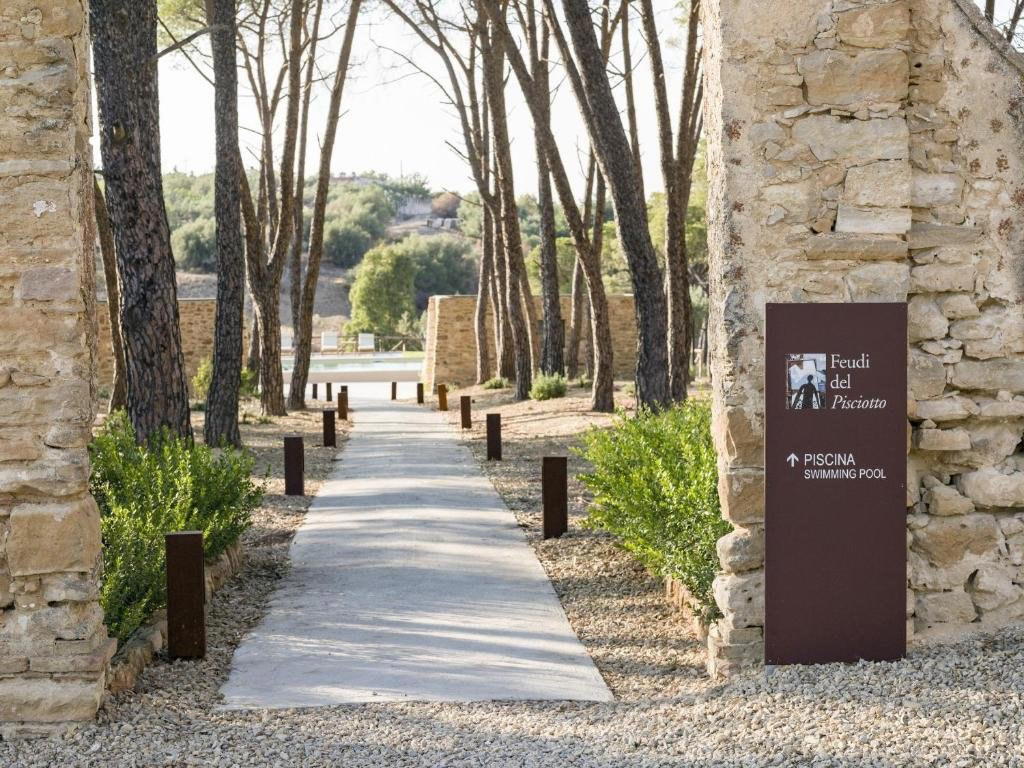
The estate sits in the Cerasuolo di Vittoria DOCG orbit, an important signal in Sicilian wine because that appellation is built on the dialogue between Nero d’Avola and Frappato. Feudi del Pisciotto’s strongest editorial interest is not simply that it grows these grapes, but that it places them within a mixed agricultural and cultural field: a rural estate, a nature-reserve edge, a restored production building, and a hospitality program designed around wine rather than added after the fact.
The vineyard footprint is substantial: 43 hectares planted to vine within a 187-hectare estate. That ratio gives the property room to present itself as more than a cellar with a view. It is a wine estate in the older Sicilian sense, where non-vine land, manor architecture, working production, and guest spaces all contribute to the identity. The modern cellar is built for production up to 10,000 hectolitres, while the historic palmento keeps the site anchored in pre-industrial Sicilian winemaking architecture.
Grape mix also explains the house style better than any single label could. Nero d’Avola brings the expected Sicilian depth; Frappato pulls the conversation toward lift and red-fruit clarity; Grillo and Chardonnay place the estate in the island’s white-wine revival; Syrah and Merlot point to the Tachis-era confidence that international varieties could speak convincingly in southern Italian conditions. Giacomo Tachis is part of the estate’s modern credibility, and the connection to Domini Castellare places the project within a wider Italian quality-wine group rather than a solitary countryside venture.
For readers mapping Sicilian wine travel beyond one stop, the city hub matters. The full Niscemi wineries guide is the natural companion, while broader trip planning may also pull in the Niscemi restaurants guide, Niscemi hotels guide, Niscemi bars guide, and Niscemi experiences guide.
A restored palmento turns the tasting into architectural context
Many winery visits separate tasting from production history. Here, the restored palmento gives the format a stronger spine. A palmento is not decorative vocabulary in Sicily; it was the working space where grapes were pressed and must was moved through gravity and labour. Preserving that structure, then connecting it to a contemporary cellar, creates a useful contrast between heritage and technical modernity.
The signature experience is built around that tension: a historic palmento with a glass-floor view into the barrel room, guided tastings, vineyard context, and wine tasting with local products. The tour duration is listed at 60 minutes, and tastings are offered in Italian and English. That makes the experience legible for visitors who want more than a pour at a counter, but less ceremony than a full-day wine-school format.
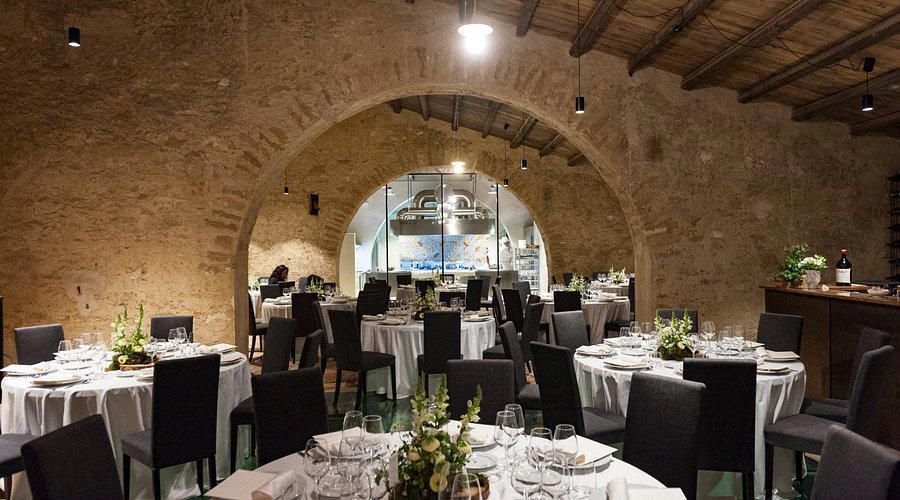
The hospitality layer deepens the estate’s positioning. Rooms, restaurant, and winery form one system, closer to a wine relais model than a tasting-room model. The restaurant setting in the restored estate architecture keeps the food side aligned with the wine program, while the smart-casual tone and quiet atmosphere point toward couples, wine-focused travellers, small groups, corporate use, and special-occasion stays rather than high-energy social drinking.
The winery opened in its modern form in 2007, which places it among the post-millennial Sicilian projects that treated design, export identity, and hospitality as part of the wine proposition from the start. Its wines have been associated with international recognition, including Wine Spectator’s Top 100, though the estate’s more persuasive strength for a visitor is the total composition: grapes, architecture, cellar, restaurant, and rural setting all reinforcing the same regional story.
How to read the estate within an Italy-wide wine itinerary
Italy’s wine travel now divides into two broad modes. One is the cellar-door visit, efficient and bottle-led. The other is the estate stay, where lodging, food, landscape, and production combine into a slower argument about place. The winery belongs firmly to the second category. Its case is strongest for travellers who want Sicily understood through architecture and agriculture, not only through appellation names.
That makes it useful to compare structurally across regions, even without treating those producers as local peers. Travellers building a broader Italian wine map can place it alongside northern and central references such as 3GP SRL in Treviso, 47 Anno Domini in Trebaseleghe, Abbadia Ardenga in Torrenieri, Abbazia Monte Oliveto in Asciano, and Abbazia Santa Anastasia in Castelbuono. Southern and Adriatic-leaning itineraries might also connect it with A Mano Wine in Noci, a6mani in Fragagnano, and Abbazia di Crapolla in Neapel.
The estate is less compelling for travellers chasing only trophy labels or rapid tasting-room turnover. Its value is cumulative: the restored 18th-century manor house, the palmento, the vineyard setting, the Cerasuolo di Vittoria context, and the blend of native and international grapes. For cross-border wine travellers, it can sit in a wider notebook beside »der Steiner« Hans Steiner in Podersdorf am See and & Handwein in Mannheim, but its identity is unmistakably Sicilian: warm-climate wine moderated by sea air, old stone, and a sense that hospitality is part of terroir rather than a separate amenity.
Recognition history
Dated appearances from independent guides and award organizations, with the underlying list record or original source where available.
Falstaff Winery - Listed
Falstaff
At a Glance
- Scenic
- Rustic
- Elegant
- Sophisticated
- Quiet
- Romantic Getaway
- Special Occasion
- Wine Education
- Corporate Event
- Group Outing
- Historic Building
- Barrel Room
- Private Tasting
- Design Destination
- Vineyard Tour
- Garden
- Vineyard
- Cerasuolo Di Vittoria DOCG
- Nero D'avola
- Frappato
- Grillo
- Chardonnay
- Syrah
- Merlot
- Still Red
- Still White
- Sparkling
- Dessert
- Guided Tasting
- Wine Tasting With Local Products
A restored 18th-century manor house and palmento set in a rural Sicilian estate, combining historic architecture with a polished boutique-hotel and wine-relais atmosphere.