
Tabelog 100 #53
Our verdict
Yoshitomo brings counter-format tempura into Hamamatsu’s serious dining tier, with Tabelog Tempura 100 selections in 2023 and 2025 placing it among Japan’s closely watched specialists. The appeal is not scale but discipline: a small counter, nihonshu focus, non-smoking room, and a price band that signals a composed evening rather than a casual stop.

Pearl is the En Primeur Club membership app, where members save venues, book tables and use the concierge.
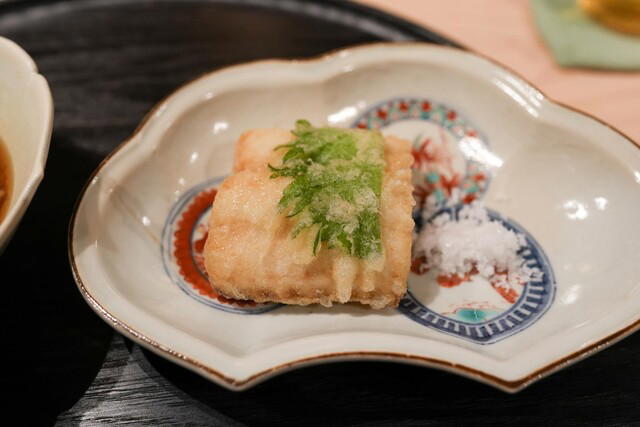
Yoshitomo is best understood as a focused tempura restaurant in Hamamatsu, where the appeal lies in attention, sequence, and restraint rather than menu sprawl. Frying is not treated as background labor in this category; it is the central craft, measured through timing, oil management, batter control, and the short interval between preparation and eating. In a city with a broad local dining scene, that format carries a particular charge. Yoshitomo belongs to the school of Japanese dining where the guest reads the meal through pace and progression as much as through individual ingredients.
Tempura’s cultural weight comes from its contradiction: it looks simple, yet punishes excess. The tradition depends on clean oil management, seasonal awareness, and a batter that protects rather than masks. At serious tempura restaurants, the point is not abundance but control. The meal’s rhythm depends on immediacy, with each piece losing some of its force as it cools. That is why the service style around tempura matters so much; the category works best when the kitchen’s timing and the diner’s attention stay closely aligned.
Hamamatsu's tempura restaurant in a city better known for regional staples
Hamamatsu’s dining identity has a strong local base, but the city also supports a quieter tier of restaurants that operate with the codes of larger Japanese dining capitals: limited distraction, fixed pacing, and recognition from national restaurant platforms. Yoshitomo’s inclusion in Tabelog’s Tempura Hyakumeiten in 2025 places it inside that national specialist conversation rather than only a local one. The distinction is meaningful because Tabelog’s Hyakumeiten lists are category-specific; tempura is judged against tempura, not against a general fine-dining field.
That category lens is useful for travelers deciding how to spend one serious meal in the city. Tenkin, Shukou Yuzen Jinen, Kitanose, Seirin, and 彩席かわかみ each help show how Hamamatsu’s better Japanese options separate by format, mood, and occasion, not only by cost. Those distinctions are not minor. Tempura restaurants ask the diner to value focus over breadth, and Hamamatsu’s better Japanese options separate quickly by format, not only by price band.
The broader Japan context also matters. Tokyo and Osaka dominate international attention for specialist dining, yet regional cities often give the format a sharper sense of place because the meal is not competing with a dozen global tasting-menu signals. In Hamamatsu, the ingredients conversation naturally connects to the surrounding region and to sake-friendly dining. Yoshitomo fits that regional conversation without needing to imitate the capital’s luxury vocabulary.
Why the tempura format changes the meal
A tempura-focused restaurant compresses the experience. There is less room for distraction, less tolerance for uneven pacing, and a clearer view of the craft choices that define the category: how long an ingredient rests, how quickly it is served, and how the sequence moves from lighter pieces toward richer ones. This is why serious tempura can feel closer to other precise Japanese specialist formats than to a conventional fried-food meal. It depends on a short handoff between preparation and diner, and it exposes technical decisions in real time.
Recognition from Tabelog matters here because the platform’s Japanese audience is particularly attentive to category specialists and repeat consistency. A 2025 Tempura Hyakumeiten selection indicates that the restaurant is being read within its own specialist category. That trust signal is more useful than vague praise. For a traveler, it frames the meal as a serious tempura appointment in Hamamatsu, not merely a polished local restaurant with fried courses on the menu.
The focused model also changes who should go. This is better suited to diners who enjoy watching a narrow craft language unfold, and less suited to groups looking for a broad, free-form evening. Solo dining can be a natural fit for tempura because the format gives a single diner something to follow course by course. At Yoshitomo, the structure of the meal is the point: close attention, steady pacing, and a category with very little room for disguise.
How to place it within a Hamamatsu itinerary
For visitors building a city stay, the restaurant belongs on the same mental map as Hamamatsu’s more serious Japanese dining rather than its everyday regional-food circuit. The practical decision is not whether tempura is “worth it” in the abstract, but whether a tightly paced specialist meal is the right anchor for the evening. Travelers using Our full Hamamatsu restaurants guide can set it beside other local dining styles; those planning a wider stay may also want Our full Hamamatsu hotels guide, Our full Hamamatsu bars guide, Our full Hamamatsu wineries guide, and Our full Hamamatsu experiences guide.
Within Japan’s broader dining file, the comparison is less about cuisine overlap than about format intelligence. Other Hamamatsu dining rooms show how narrow specialization can define a restaurant more clearly than a long menu, while Yoshitomo’s particular focus is tempura. For readers looking beyond Hamamatsu, Japan’s range includes countless regional specialist rooms, casual shops, and everyday neighborhood addresses. The Japanese-dining conversation also travels well abroad, though those are different cultural translations rather than direct peers.
The editorial read is clear: Yoshitomo is for diners who want Hamamatsu through disciplined Japanese tempura rather than only through the city’s more familiar regional signatures. The 2025 Tabelog Hyakumeiten recognition supplies the trust signal; the tempura focus supplies the reason to pay attention. In a city where many visitors chase local staples first, this is the table for understanding how a regional restaurant can participate in a national craft category without becoming generic.
Frequently asked questions
Is Yoshitomo okay with children?
Yoshitomo runs as a focused tempura restaurant in Hamamatsu, so it suits children who can sit through a careful, paced meal. The format is tighter than a broad family-style room, and the service is built around attention to the tempura.
What is the atmosphere like at Yoshitomo?
Expect a focused, calm setting. The format puts attention on the tempura as it is served, which makes the room feel more concentrated than a broad, casual dining room.
What does dinner at Yoshitomo typically cost?
Pricing at Yoshitomo is listed as JPY 15,000 - JPY 19,999 JPY 15,000 - JPY 19,999 View spending breakdown.
Where do I go for Yoshitomo?
Hamamatsu.
Pricing, Compared
Nearby venues at a similar price tier for orientation.
| Venue | Cuisine | Price | Awards | Notes |
|---|---|---|---|---|
| YoshitomoThis venue (the venue you are viewing) | High-end Tempura Omakase | $100–150 | Tabelog 100 #53 | Not listed |
| 彩席かわかみ | Shizuoka Kaiseki | $100–150 | Not listed | 第一通り (Daiichi-dori), Shizuoka Kaiseki |
| Ton Kara Ten | Tonkatsu & Oyako-don Specialist | $20–30 | Tabelog 100 #36 | Chuo Ward, Hamamatsu City, Tonkatsu & Oyako-don Specialist |
| Shukou Yuzen Jinen | Japanese Izakaya | Not listed | Tabelog 100 #81 | Tamachi, Naka-ku, Japanese Izakaya |
| Torihama | Traditional Japanese Chicken Specialty | Not listed | Tabelog 100 #74 | Naka-ku, Traditional Japanese Chicken Specialty |
| Sushi Hiroya | Modern Omakase Sushi | $150–200 | Tabelog 100 #35 | Hamamatsucho, Modern Omakase Sushi |
Recognition history
Dated appearances from independent guides and award organizations, with the underlying list record or original source where available.
Tabelog 100 #53 · No. 53
Tabelog · Tabelog 100 - Tempura - 2025
Continue exploring
More in Hamamatsu
Restaurants in Hamamatsu
All restaurants in Hamamatsu →
Hotels in Hamamatsu
Browse all →
Details
- Elegant
- Intimate
- Cozy
- Special Occasion
- Date Night
- Business Dinner
- Solo
- Chefs Counter
- Standalone
- Sake Program
- Tasting Menu
- Omakase
- Counter Dining
- Sake
- Beer
- Pescatarian Friendly
An intimate 8-seat non-smoking counter-only space with a relaxed, refined atmosphere, designed as a quiet hideout where guests enjoy tempura and sake in a focused setting.