Tembo Plains Camp

Relais Chateaux Award
Our verdict
Tembo Plains Camp sits in Zimbabwe's Mana Pools region, one of southern Africa's most carefully protected wilderness corridors, where the Zambezi River sets the pace and large-canvas suites frame an uninterrupted bush horizon. Chef Zamani Sibelo leads the kitchen with an African cuisine focus that reflects the region's larder and traditions. Holding, it draws travellers serious about both wildlife and the table.

Pearl is the En Primeur Club membership app — saves, bookings, and concierge access live there. Same editors, same standards.
- Address
- Uganda
- Phone
- +256 772 957850
- Website
- bwanatembo.com
- Directions
- Get directions
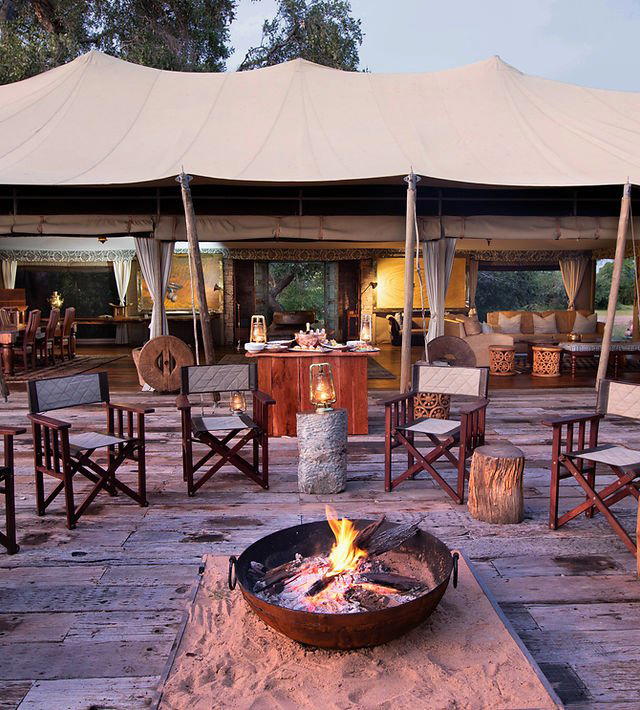
Where the Zambezi Sets the Tempo
The Mana Pools region operates on a different register from Zimbabwe's more trafficked safari corridors. Designated a UNESCO World Heritage Site, the floodplain between the Zambezi River and the escarpment supports one of the continent's densest concentrations of elephant, wild dog, and predator activity — yet it receives a fraction of the visitor numbers that crowd the Okavango or the Serengeti. Camps here are few and deliberately limited in capacity, which shapes everything from the dining experience to the rhythms of a day. The table at Tembo Plains Camp, where Chef Zamani Sibelo directs the kitchen, exists inside that scarcity by design.
Arriving by light aircraft from Harare International Airport, roughly 281 kilometres to the south (GPS coordinates -15.6547, 29.6846), guests cross a distance that is as psychological as it is physical. The tarmac world recedes. What replaces it is a landscape defined by albida woodland, oxbow lakes, and the wide grey-green current of the Zambezi. The large-canvas suites that distinguish the camp here operate as transparent membranes between interior comfort and the open bush — a format that has become the standard-bearer for serious wilderness lodges across southern and East Africa, where architecture is asked not to announce itself but to disappear.
African Cuisine in a Bush Context
The category of African cuisine, as practised at serious safari camps, has evolved considerably over the past two decades. Early-generation lodge cooking borrowed heavily from colonial-era European formats, three courses, Continental technique, imported ingredients. The shift now running through premier camps across Zimbabwe, Botswana, and Kenya treats the surrounding region as the primary larder: indigenous grains, wild herbs, river fish, and slow-cooked preparations that reflect actual southern African domestic traditions rather than a projection of what international guests might expect to find.
Chef Zamani Sibelo works inside that tradition. The editorial angle on Sibelo is not biographical sentiment but professional positioning: a chef operating in a remote Zimbabwean wilderness camp who carries the name Zamani, deeply Nguni in its resonance, brings a grounding in local food culture that shapes sourcing instincts and flavour decisions in ways that a classically European-trained kitchen would not replicate. In a category where the most interesting cooking now comes from chefs who can triangulate between technique, regional identity, and logistical constraint, that positioning matters. It is the same directional pull visible at ol Donyo Lodge, African Cuisine in Chyulu Hills - Amboseli, where proximity to a specific East African ecosystem shapes both menu and sourcing philosophy.
The constraint factor is real in Mana Pools. Supply chains to remote wilderness areas require planning weeks ahead, which tends to concentrate kitchens on what is reliably available locally rather than what might be flown in at cost. That constraint, far from being a limitation, often produces the most focused cooking. When the menu is determined partly by what the river and the surrounding region can provide, the resulting dishes carry a legibility, a sense that the food belongs to the place, that is harder to achieve in urban fine dining, regardless of the technical sophistication on display in rooms like Le Bernardin in New York City or Alain Ducasse- Louis XV in Monte Carlo.
The Safari Camp Format: What It Demands from a Guest
Safari camps sit in a distinct hospitality category. Unlike urban restaurants where the meal is the destination, or hotels where dining is a secondary amenity, the lodge dining experience is woven into a day structured around dawn game drives, midday rest, and late-afternoon departures back into the bush. Meals become anchor points, communal, unhurried, and often conducted under open sky or on a deck overlooking a waterhole or river bend. The social logic is different from any city restaurant, which affects pacing, service tone, and what a kitchen is actually trying to accomplish.
Tembo Plains Camp's private swimming pool signals a tier of camp where the infrastructure supports extended daylight hours between activities, where the experience is designed for guests who want to settle in rather than move through. That is a meaningful distinction within the Mana Pools accommodation market, where camps range from unfenced walking-focused operations to more formally amenitied properties. For travellers comparing options across [our full Mana Pools Region hotels guide](), the pool and large-canvas suite format positions Tembo Plains at the comfort-forward end of a spectrum that does not sacrifice access to serious wildlife territory.
Wildlife Conservation as Operational Context
The wildlife conservation program attached to Tembo Plains Camp is not peripheral to the guest experience, it is part of the operational logic that determines who the camp is for and how it prices itself. Conservation-integrated camps across southern Africa have demonstrated, through the Botswana model and its equivalents in Zimbabwe, that high-value, low-volume tourism is the most durable economic argument for keeping wilderness intact. Guests staying at conservation-partnered properties in Mana Pools are, in effect, part of the funding mechanism that keeps the ecosystem functioning. The Zambezi River safari component extends that logic onto the water, where boat-based game viewing adds a dimension unavailable in landlocked bush camps.
That combination, Zambezi access, wildlife conservation alignment, and a kitchen led by a chef rooted in African culinary tradition, makes Tembo Plains relevant to a specific traveller profile: one who weighs the ecological and cultural credentials of a camp alongside its comfort standards, and who wants the dining table to reflect the same seriousness as the game drive programme. It is a different calculation from booking Lazy Bear in San Francisco or Atomix in New York City, but the underlying logic, place credibility, operator integrity, and the expertise of the person in charge of your experience, translates across categories.
Planning a Stay: Access and Timing
Harare International Airport is the primary entry point for Mana Pools, at approximately 281 kilometres from the camp. Charter flights connect Harare to a network of bush airstrips serving the floodplain; most guests arrive by a combination of commercial flight to Harare and light aircraft onward. The dry season, running roughly from May through October, concentrates wildlife along the Zambezi and its tributaries as water sources inland diminish, this is the conventional high season for Mana Pools, when game viewing is most reliable and the roads between the escarpment and the river floor are accessible.
For broader orientation across the region's dining, drinking, and experience options, see [our full Mana Pools Region restaurants guide](), [our full Mana Pools Region bars guide](), our full Mana Pools Region experiences guide, and [our full Mana Pools Region wineries guide]().
Frequently asked questions
Does Tembo Plains Camp work for a family meal?
The camp is structured as a full safari lodge rather than a standalone dining destination, so families travelling together on a Mana Pools itinerary are the natural fit. Meals under Chef Zamani Sibelo follow an African cuisine approach within the lodge format, meaning the dining experience is tied to the rhythm of the safari day. Families seeking a single restaurant outing in the Mana Pools region will find limited alternatives — this is deep wilderness, not a resort strip.
What kind of setting is Tembo Plains Camp?
Tembo Plains Camp sits within the Mana Pools region of Zimbabwe, a UNESCO World Heritage wilderness area bordering the Zambezi River. Accommodation runs in large-canvas suites, each with a private swimming pool, giving guests direct engagement with the surrounding bush. The camp's wildlife conservation program shapes daily operations, so the environment outside the suite is as central to the stay as anything inside it.
What's Tembo Plains Camp known for in terms of accolades?
Tembo Plains Camp has received recognition including: HIGHLIGHTS: • LARGE CANVAS SUITES • WILDLIFE CONSERVATION PROGRAM • ZAMBEZI RIVER SAFARI • PRIVATE SWIMMING POOL DIRECTIONS & ACCESS: Directions By plane Harare International Airport 281 km GPS coordinates -15.6547 29.6846 MEMBER SINCE: 5/5.
What's the best thing to order at Tembo Plains Camp?
The kitchen operates under Chef Zamani Sibelo with an African cuisine focus drawing on regional ingredients and southern African cooking traditions. Because the camp runs on a lodge schedule tied to game drives and river activities, meals are typically structured around the day's itinerary rather than an à la carte menu. Specific dishes are not listed in available documentation, so the most reliable approach is to confirm the current menu format directly with the camp at booking.
Where exactly is Tembo Plains Camp?
Tembo Plains Camp is located at Uganda, Mana Pools Region.
Is there a head chef associated with Tembo Plains Camp?
The chef associated with Tembo Plains Camp is Zamani Sibelo.
Recognition history
Dated appearances from independent guides and award organizations, with the underlying list record or original source where available.
Relais Chateaux Award
Relais Chateaux
Full recognition history (2 entries)
Relais Chateaux Award
Relais Chateaux
Tembo Plains Camp
The wine
- Wine program
- Curated wine list
- Extensive wine list
Details
- Scenic
- Rustic
- Elegant
- Intimate
- Sophisticated
- Special Occasion
- Waterfront
- Hotel Restaurant
- Extensive Wine List
- Waterfront
- A La Carte
- Vegetarian Friendly
Serene and luxurious atmosphere in dense riverine forest with canvas and stone design, evoking ancient Zimbabwe Ruins, featuring open-plan lounges, spa, and deck dining under the stars.