Momed
Our verdict
Momed brings Eastern Mediterranean cooking to Atwater Village, occupying a corner of Los Angeles where the neighborhood's low-rise character and the region's mezze tradition fit together without friction. The format rewards sharing and slow pacing rather than individual plating, placing it closer to a Levantine dining ritual than a typical California-casual meal. It is a useful counterpoint to the city's more performance-driven restaurant culture.

Pearl is the En Primeur Club membership app, where members save venues, book tables and use the concierge.

Where the Meal Is the Pace
Atwater Village does not announce itself the way Silver Lake or Los Feliz do. The stretch of Casitas Avenue where Momed sits is quieter than the main commercial corridor, and that register carries into the room. Eastern Mediterranean dining has a structural logic that suits a neighborhood like this: the table fills gradually with small plates, bread arrives early, and the meal expands or contracts based on how long you want to stay. That rhythm is not common in Los Angeles, where tasting menus at places like Somni and counter-format omakase operations at Hayato impose strict choreography on the diner. Momed operates on the opposite principle: the pacing is yours to set.
This distinction matters in a city where the dominant fine-dining mode, from Providence to Kato, is structured around sequential courses and a single narrative arc per evening. The Levantine mezze tradition does not work that way. Dishes are ordered in clusters, replenished as the table empties, and the meal finds its shape through conversation and appetite rather than a kitchen's predetermined sequence. At Momed, that tradition is the format, not a stylistic flourish imposed on top of a conventional service model.
The Ritual of Shared Tables
The Eastern Mediterranean approach to a meal is less about individual dishes than about the accumulation of small decisions across an evening. You order what looks right, adjust mid-meal, and the table's surface tells you where you are in the arc. This is different from the curatorial precision of tasting menus at The French Laundry or Alinea, where the kitchen controls every variable. It requires a more active kind of attention from the diner, and it rewards that attention with a different quality of hospitality: one that feels reciprocal rather than delivered.
Los Angeles has a long relationship with Mediterranean and Middle Eastern food at every price point, from the denser Lebanese and Persian communities in Westwood and Glendale to the more design-conscious iterations appearing across the Eastside. Momed occupies a position in that range where the cooking is taken seriously without the format becoming ceremonial. The address on Casitas Avenue keeps it grounded in a neighborhood context rather than a destination-restaurant one, which is part of what makes the experience feel like a natural extension of how people in this part of the city actually want to eat.
Reading the Menu Against the Room
Eastern Mediterranean menus are typically organized around shared function rather than Western-style courses: spreads, grilled proteins, grain dishes, and vegetables appear as a category rather than a progression. The order in which they arrive matters less than the balance across the table. This contrasts sharply with the New American idiom practiced at venues like Blue Hill at Stone Barns or Single Thread Farm, where the sequence is an intentional argument the kitchen is making.
At Momed, the argument is more open-ended. The menu format invites lateral movement across the table rather than forward movement through a fixed arc. That suits groups better than solo dining, and it suits the kind of occasion where the conversation is as much the point as the food. Compared to peers in the Los Angeles Eastside range, the dining ritual here is closer to what you find at a Beirut or Tel Aviv restaurant than to what the city's trendier Mediterranean-adjacent spots produce. That fidelity to the source tradition is not accidental: it is the quality that separates competent Mediterranean-inflected cooking from a dining format that actually carries the culture of the region.
Positioning in the Los Angeles Dining Field
Los Angeles has developed a number of serious restaurant corridors over the past decade, and the Eastside has been one of the more productive zones for chef-driven, neighborhood-scaled restaurants. Momed sits in that map, though it does not position itself alongside the more headline-generating Michelin-tracked operations like Osteria Mozza or the newer fine-dining arrivals drawing national attention. It occupies a different tier: one where the cooking is consistent and the format is distinct, but the ambition is about quality within a tradition rather than about expanding what a restaurant can be.
That positioning makes it a useful addition to any multi-night stay in Los Angeles, functioning as a lower-pressure evening alongside harder-to-book experiences. Visitors planning around the city's more demanding reservations, at Hayato or Somni for example, will find that Momed requires less logistical planning while still delivering a meal with a clear point of view. For a broader orientation to the city's options, our full Los Angeles restaurants guide maps the range across neighborhoods and price tiers.
Among American restaurants where the dining ritual itself is foregrounded as part of the experience, there is a useful comparison to be made with operations like Lazy Bear in San Francisco, where the communal table and the fixed format make the social dimension explicit. Momed achieves something similar through the mezze structure rather than through theatrical staging. The result is less produced but no less intentional.
Planning a Visit
The venue is located at 3245 Casitas Ave, Los Angeles, CA 90039, in Atwater Village. The table below positions Momed against its nearest Los Angeles peers on the dimensions most relevant to planning.
| Venue | Price Tier | Format | Booking Lead Time |
|---|---|---|---|
| Momed | Not confirmed | Mezze / shared plates | Not confirmed |
| Kato | $$$$ | Tasting menu | Several weeks minimum |
| Hayato | $$$$ | Omakase counter | One to two months |
| Osteria Mozza | $$$ | A la carte / shared | One to two weeks |
For context on how Los Angeles compares to other American cities with developed Mediterranean dining scenes, it is worth noting that venues like Addison in San Diego, Bacchanalia in Atlanta, and The Inn at Little Washington represent the more formal end of the American dining register. Momed operates in a register that is deliberately less formal, which is its own form of editorial position.
Frequently asked questions
What's the address for Momed?
Momed is located at 3245 Casitas Ave, Los Angeles, CA 90039, Los Angeles.
Is Momed a good restaurant for a group dinner in Los Angeles?
The Eastern Mediterranean mezze format at Momed is structurally built for groups: multiple small dishes arrive across the table, and the experience scales in proportion to the number of diners ordering. A party of four or more can move through spreads, proteins, and vegetable preparations in a way that a solo diner or couple cannot replicate with the same range. For Eastside Los Angeles group dinners that favour a communal pace over a linear tasting structure, the format at 3245 Casitas Ave is well-suited.
What's the best thing to order at Momed?
At an Eastern Mediterranean table like Momed's, ordering strategy shapes the meal more than any single dish. The mezze format rewards groups that layer spreads, grilled proteins, and grain dishes across the table rather than ordering one plate per person. Build from the cold preparations outward, and resist the impulse to under-order in the first round, the shared-plate format at 3245 Casitas Ave is designed for accumulation, not restraint.
How far ahead should I plan for Momed?
Momed's Atwater Village address puts it in a quieter residential corridor compared to the higher-volume reservation queues in Silver Lake or Los Feliz, which suggests same-week booking is often feasible. That said, weekend evenings at well-regarded Eastside spots in Los Angeles can fill quickly without the Michelin visibility that drives weeks-ahead demand. Checking availability three to five days out is a reasonable starting point.
What do critics highlight about Momed?
What does register is its placement in Atwater Village, a neighbourhood that has attracted some of Los Angeles's more considered, format-driven restaurants over the past decade. The Eastern Mediterranean shared-plate approach it represents has earned serious critical attention across the city, even where individual venues sit outside the formal awards tier.
Cuisine and Recognition
Comparable venues nearby, for context on price, style, and recognition.
| Venue | Cuisine | Price | Notes |
|---|---|---|---|
| MomedThis venue (the venue you are viewing) | Modern Mediterranean | $30–50 | Not listed |
| The Semi-Tropic | Mediterranean Bar Food | $30–50 | Echo Park |
| Chainsaw | Venezuelan Comfort Cafe & Pies | $20–30 | Melrose Hill |
| Little Dom's | Italian-American | $30–50 | Los Feliz |
| Wilde’s | Cal-British Seasonal Fare | Not listed | Los Feliz |
| The Oyster Gourmet | Fresh Oyster Bar & Wine | $20–30 | Financial District |
Continue exploring
More in Los Angeles
Restaurants in Los Angeles
All restaurants in Los Angeles →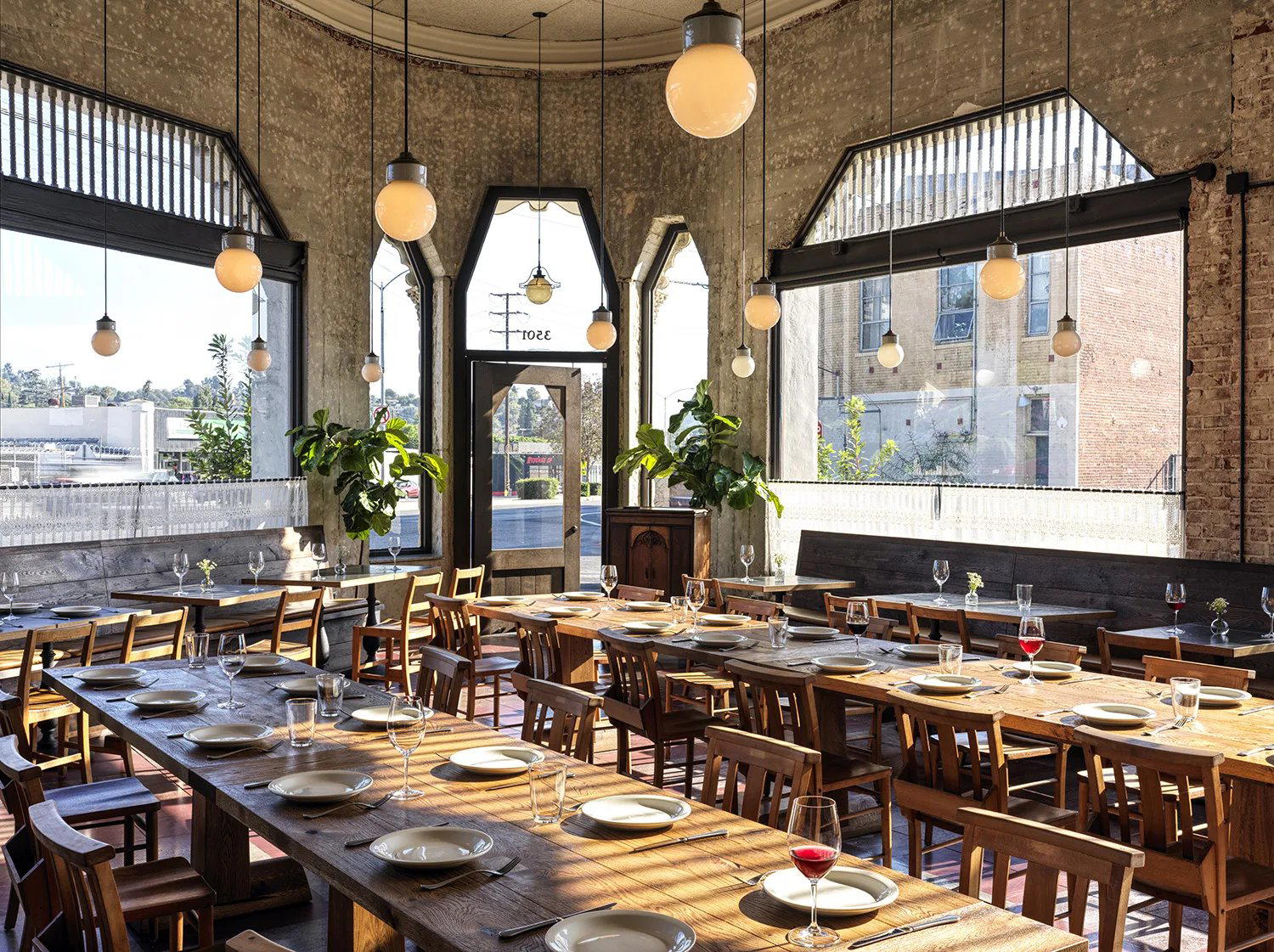

Bars in Los Angeles
All bars in Los Angeles →
Hotels in Los Angeles
All hotels in Los Angeles →
Wineries in Los Angeles
All wineries in Los Angeles →

Details
- Modern
- Trendy
- Cozy
- Date Night
- Casual Hangout
- Brunch
- Open Kitchen
- Terrace
- Craft Cocktails
- Local Sourcing
- A La Carte
- Vegetarian Friendly
- Vegan Options
- Gluten Free Options
Current opening hours
- Monday
- 5–9 PM
- Tuesday
- 12–2:30 PM, 5–9 PM
- Wednesday
- 12–2:30 PM, 5–9 PM
- Thursday
- 12–2:30 PM, 5–9 PM
- Friday
- 12–2:30 PM, 5–10 PM
- Saturday
- 10 AM–3 PM, 5–10 PM
- Sunday
- 10 AM–3 PM, 5–9 PM
Hours can change for holidays and private events. Hours as of .
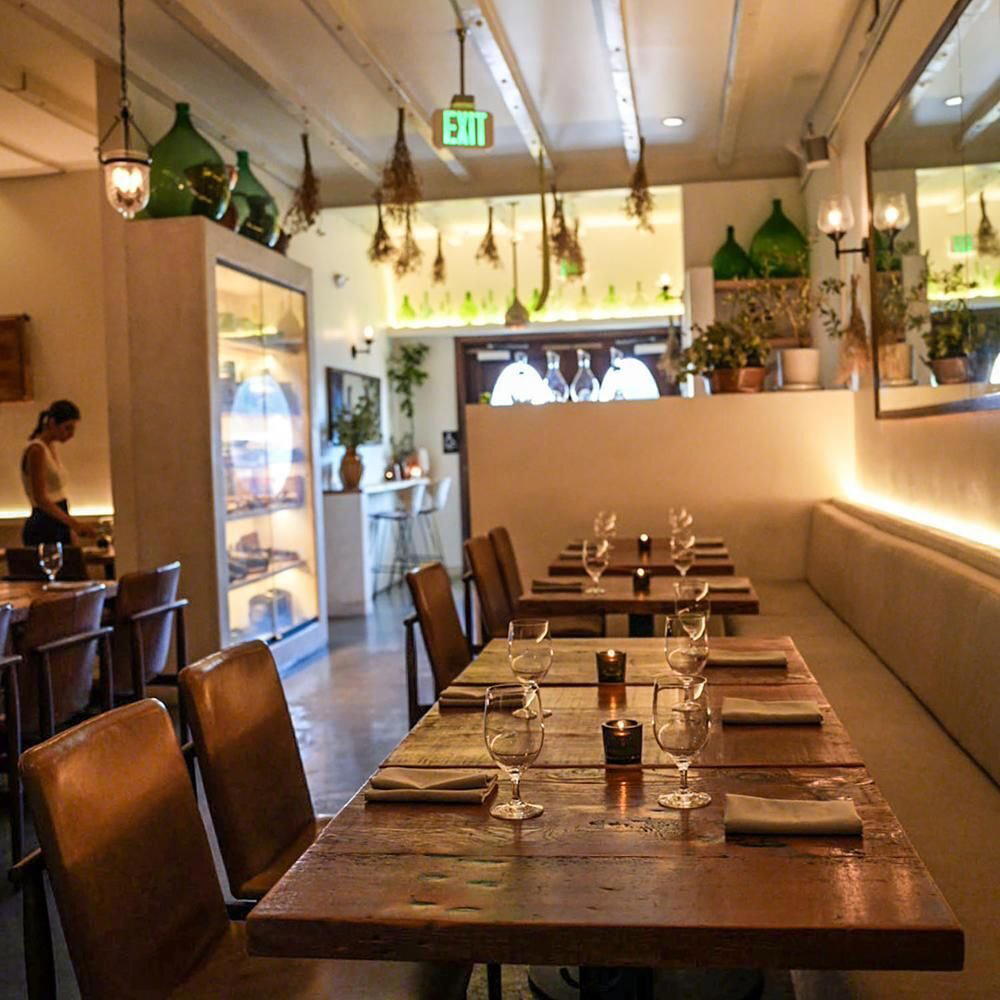
Warm, inviting atmosphere with minimal design, cabana seating, full bar, and long communal tables fostering casual, laidback vibes.