Chapel Market Kitchen Oyster Bar & Grill


On a corner site along Islington's busy Chapel Market, this neighbourhood restaurant threads Mediterranean-influenced technique through a menu built on market-fresh produce, raw bar seafood, and grill work. Chef-Owner Maoz Alonim brings experience from Tel Aviv's Jaffa Market district to North London, and the result is an accessible, flexible format with a wine list that punches well above the room's modest scale.
Pearl is the En Primeur Club membership app — saves, bookings, and concierge access live there. Same editors, same standards.
- Address
- 2 Chapel Market, London N1 9EZ, United Kingdom
- Phone
- +44 20 3621 2023
- Website
- chapelmarketkitchen.com
- Directions
- Get directions
 Saves & bookings on Pearl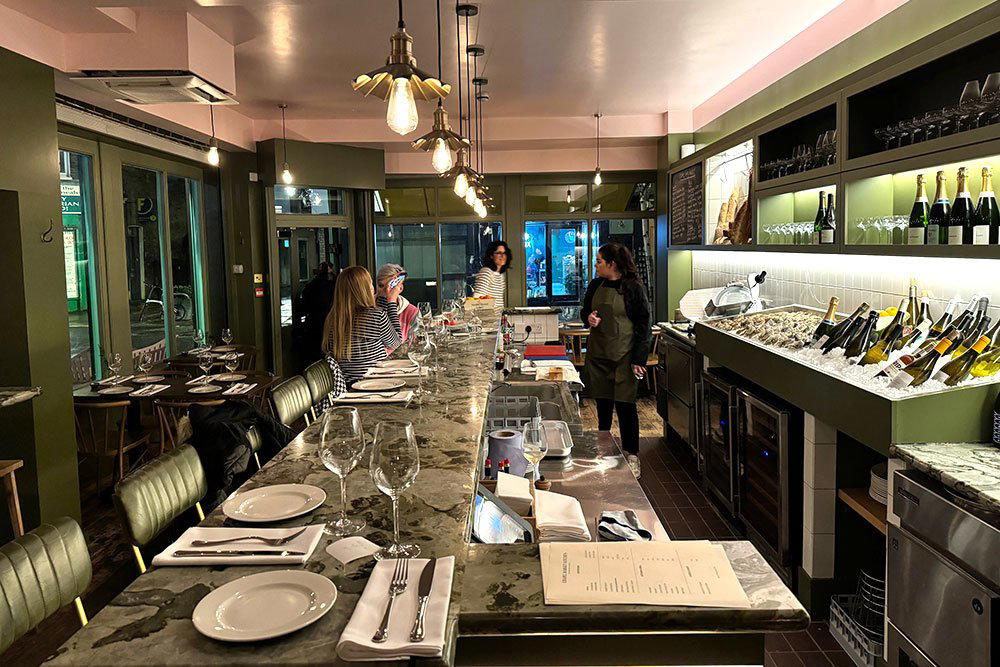
Where the Market Comes Inside
Chapel Market in Islington runs on a different register from the neighbourhood's polished restaurant strips. It is a working street market, functional and unreconstructed, and it has been feeding Angel-area residents since the 1860s. On its corner site at number two, Chapel Market Kitchen Oyster Bar and Grill occupies the kind of position that used to belong to greasy spoons and betting shops, a spot that catches passing trade from the stalls outside rather than diners who have crossed the city with a reservation in hand. The energy in the room reflects that: relaxed, unhurried, and visibly local.
The format here belongs to a category London has been slowly expanding for the past decade: the neighbourhood restaurant that draws on a non-British culinary tradition without announcing it loudly. Rather than a destination address with a concept and a PR strategy, it operates as a local that happens to be doing something more considered than the surroundings suggest. The raw bar and oyster focus positions it alongside a tier of London seafood-led neighbourhood spots, while the Mediterranean-inflected grill work and homemade pasta add range that keeps regulars returning across the week.
Market to Menu: A Tel Aviv Sensibility in North London
The restaurant's approach to sourcing carries a specific logic. Maoz Alonim's years running a restaurant adjacent to Tel Aviv's Jaffa Market inform the kitchen's approach to sourcing. That same relationship with Chapel Market's traders shapes how the kitchen here operates: ingredients from the stalls outside find their way onto the menu in a supply chain measured in metres rather than food miles.
This kind of hyper-local sourcing, where the kitchen and the street market share an address, is rarer in London than the city's farm-to-table rhetoric implies. Most restaurants sourcing from markets do so wholesale, at distance. The proximity of Chapel Market creates a different dynamic, one closer to the covered market restaurants of Barcelona's Boqueria or Valencia's Mercado Central, where the menu reflects what arrived that morning rather than what a quarterly supplier contract dictates. In London, that model sits in sharp contrast to the tightly engineered tasting menus at places like CORE by Clare Smyth or The Ledbury, where every element is controlled and fixed weeks in advance.
The result is a menu that reads as genuinely flexible rather than strategically flexible. Oysters and a raw bar anchor one end. Homemade pasta and grill cuts occupy the middle and far end. The Mediterranean influence runs through the technique and the seasoning rather than through theme-park geography, this is not a restaurant pretending to be a taverna or a trattoria. It is a North London kitchen that has absorbed influences from the eastern Mediterranean and deploys them on whatever the market is producing well.
The Wine List as a Statement of Intent
The wine list is notably serious. In neighbourhood restaurants of this scale and price positioning, the list tends toward the perfunctory: a handful of crowd-pleasing labels, markup on volume, minimal by-the-glass choice. Chapel Market Kitchen operates differently. The selection by the glass is broad enough to actually match across the menu's range, and the service is described as knowledgeable rather than recited-from-script.
A wine program with genuine by-the-glass depth at a local neighbourhood scale signals something about the operator's priorities. It places this restaurant closer to the wine-forward neighbourhood model that has become a marker of serious intent in London's mid-market, a tier that includes natural wine-led neighbourhood spots in Hackney and Peckham, than to the casual Mediterranean-branded chains that have colonised much of the city's accessible dining segment. For those planning a wider London visit, the contrast with maximalist destination dining at Sketch, The Lecture Room and Library or Restaurant Gordon Ramsay is instructive: the same city produces both registers, and knowing when each serves your evening matters.
How Chapel Market Kitchen Fits the Wider London Picture
London's dining geography has a well-documented bias toward the centre and the south. The destination addresses, the three-Michelin-star counters, the hotel dining rooms with celebrated names, cluster in Mayfair, Knightsbridge, and Chelsea. North London's restaurant identity is more fragmentary, built from neighbourhood independents in Islington, Stoke Newington, and Crouch End rather than a coherent scene with international recognition. Chapel Market Kitchen sits squarely in that independent north London tradition.
For visitors who have already covered the formal end of London's restaurant spectrum, whether that means Dinner by Heston Blumenthal in Knightsbridge or trips out to benchmark countryside kitchens like The Fat Duck in Bray, L'Enclume in Cartmel, or Moor Hall in Aughton, an evening at a market-adjacent neighbourhood restaurant in N1 provides calibration in the other direction. It is a reminder that interesting food cities sustain good eating at every price point, and that technique and sourcing rigour are not the exclusive property of formal dining rooms. The same principle applies internationally: the market-proximity model that Chapel Market Kitchen follows has parallels at the higher end in places like Le Bernardin in New York City for seafood focus, or at the technique-meets-locality intersection that drives Atomix in New York City. Scale and ambition differ; the underlying logic of placing sourcing at the centre of the operation connects them.
For those exploring the wider region, comparable degrees of local ingredient seriousness applied at different price points appear at Gidleigh Park in Chagford, Hand and Flowers in Marlow, and hide and fox in Saltwood.
Planning Your Visit
Comparable Venues
Comparable venues nearby, for context on price, style, and recognition.
| Venue | Cuisine | Price | Awards | Notes |
|---|---|---|---|---|
| Chapel Market Kitchen Oyster Bar & GrillThis venue — the venue you are viewing | Mediterranean Seafood Oyster Bar & Grill | $$$ | Michelin Plate | Not listed |
| Oystermen | British Seafood Oyster Bar | $$$ | Not listed | Covent Garden |
| Rick Stein Barnes | British Seafood | $$$ | Not listed | Mortlake |
| Mangal 2 | Modern Turkish Ocakbaşı | $$$ | Not listed | Shacklewell |
| Faber Wine & Seafood Restaurant | British Coastal Seafood | $$$ | Not listed | Brook Green |
| Story Cellar | Modern French Rotisserie Bistro | $$$ | Michelin Plate | St Giles |
Recognition history
Dated appearances from independent guides and award organizations, with the underlying list record or original source where available.
Michelin Plate
Michelin
Star Wine List
Star Wine List
Continue exploring
More in London
Restaurants in London
Browse all →

Bars in London
Browse all →

Hotels in London
Browse all →




At a Glance
- Cozy
- Lively
- Trendy
- Date Night
- Casual Hangout
- Open Kitchen
- Extensive Wine List
- Local Sourcing
Current opening hours
- Monday
- 12–11 PM
- Tuesday
- Closed
- Wednesday
- 5–11 PM
- Thursday
- 12–11 PM
- Friday
- 12–11 PM
- Saturday
- 12–11 PM
- Sunday
- 10 AM–8 PM
Hours can change for holidays and private events. Last verified .
Modern yet cozy atmosphere with a nice buzz, friendly service, and an open kitchen vibe.