Puro Surf Hotel

Michelin Selected
Selected by the Michelin Guide Hotels 2025, Puro Surf Hotel sits along El Salvador's Pacific coast at El Zonte, a stretch of black-sand shoreline that has attracted serious surf culture for decades. The property's design draws directly from its coastal setting, making it a reference point for how Central American surf hospitality intersects with considered architectural restraint and Michelin-level recognition.

Pearl is the En Primeur Club membership app, where members save venues, book tables and use the concierge.
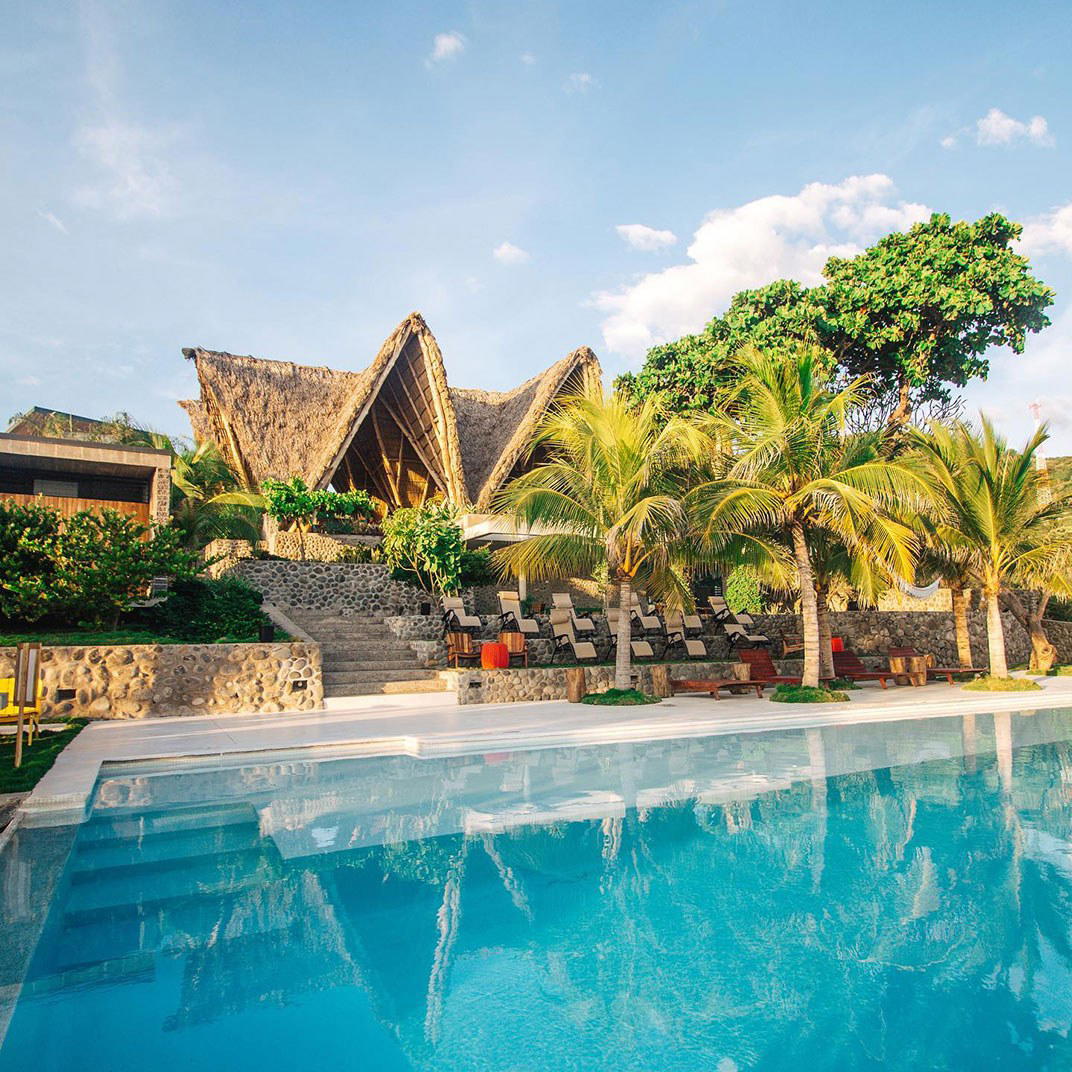
Where the Pacific Sets the Design Brief
El Zonte sits roughly 52 kilometres west of San Salvador along the Carretera El Litoral, a coastal highway that threads past fishing villages and black-sand beaches before arriving at one of Central America's most closely watched surf communities. The village became a reference point in surf culture long before it attracted international hospitality attention, and it is precisely that sequence, surf culture first, design-conscious accommodation second, that gives Puro Surf Hotel its architectural logic. Properties that follow the surf scene's lead rather than imposing resort conventions onto it tend to read very differently from the usual beach hotel formula, and that distinction is visible at Km 52.
Michelin's hotel selection programme, which expanded aggressively into Latin America through its 2025 cycle, operates on criteria that weight quality of space, sense of place, and coherence of hospitality concept alongside more standard service metrics. Earning inclusion in the Michelin Selected Hotels 2025 list places Puro Surf Hotel inside a global cohort that includes deeply capitalized urban flagships, properties like Le Bristol Paris in Paris, Bvlgari Hotel Tokyo in Tokyo, and Hotel Sacher Wien in Vienna, yet the El Zonte property earns its place on entirely different terms. Where those hotels derive authority from historical pedigree or brand engineering, Puro Surf Hotel's Michelin recognition reads as an endorsement of the opposite approach: restraint, context-specificity, and a design vocabulary rooted in the Pacific coast rather than imported from elsewhere.
Architecture as Response to Environment
The design conversation in surf-adjacent hospitality has shifted considerably over the past decade. Early surf camps prioritized function almost exclusively: shelter, board storage, proximity to breaks. The generation of properties that followed overcompensated, layering boutique hotel conventions onto coastal sites without much consideration for how those conventions fit. What has emerged more recently, particularly along Central and South America's Pacific coasts, is a third approach, one that takes the surf environment seriously as an architectural prompt. Natural ventilation over air conditioning, open structures that blur the threshold between interior and exterior, materials that weather honestly rather than demanding maintenance against the salt air. This is the register in which Puro Surf Hotel operates.
The Pacific coast of El Salvador provides a specific set of conditions that shape what architecture can credibly do: consistent onshore and offshore wind patterns, intense light, volcanic black sand that retains heat, and a social culture organized around early mornings and the rhythm of swell cycles rather than the conventional hotel day. Properties that acknowledge these conditions in their spatial organization feel coherent in a way that those which ignore them do not. The contrast becomes clearer when you consider how design-led beach properties in other hemispheres handle similar briefs: Hotel Esencia in Tulum, One&Only; Mandarina in Riviera Nayarit, and Castello di Reschio in Lisciano Niccone each demonstrate how a property can draw physical identity from its landscape rather than despite it. Puro Surf Hotel belongs in that conversation, albeit at a different price point and with a more compressed, activity-specific focus.
El Zonte in the Surf Property Hierarchy
El Zonte's position in the Central American surf scene is well established. The break at the mouth of the Río El Zonte is a left-hander that works across a range of swell sizes, making it consistent enough to anchor extended stays and technical enough to attract intermediate and experienced surfers who find the more crowded breaks further north too saturated. The village itself remained low-profile for years, which contributed to its credibility within surf culture, a community that tends to distrust destinations that market themselves aggressively.
The hospitality infrastructure at El Zonte reflects that history. Properties here operate on a different logic than, say, the hotel corridor at a major surf resort. The scale is smaller, the programming more focused, and the competitive set is defined by surf-specific functionality rather than by room count or spa amenities. In this context, a Michelin selection functions less as a fine-dining parallel and more as a signal that the property has cleared a threshold of seriousness, that the quality of experience is held to a standard that extends beyond surf access into the organization of space, the coherence of design, and the reliability of service.
For a broader sense of what Michelin hotel selection implies in terms of peer company, it helps to look at the range the 2025 list covers globally: from palace hotels like Badrutt's Palace Hotel in St. Moritz and Hôtel de Paris Monte-Carlo in Monte Carlo to more intimate, design-forward properties like Casa Maria Luigia in Modena and The Siam in Bangkok. Puro Surf Hotel's inclusion alongside that range signals that Michelin's selection criteria genuinely accommodate diversity of format and price tier, the credential is about quality of concept, not category of luxury.
Planning a Stay
El Zonte is accessible from San Salvador's Monseñor Óscar Arnulfo Romero International Airport, with a drive along the coastal highway placing the property approximately an hour from the terminal depending on traffic. The surf season along this stretch of El Salvador's coast peaks between April and October, when Pacific swells from the south generate consistent, larger waves; the November-to-March period brings smaller, cleaner conditions that suit intermediate surfers and make the beach environment more relaxed. Those travelling primarily for surf should factor swell forecasts into their planning, as the break's character changes significantly across the season.
Booking directly through the property is the standard approach for this category of coastal hotel in El Salvador, and the Michelin recognition is likely to have tightened availability during peak surf months. Visitors spending time in El Zonte beyond the hotel itself will find the broader El Salvador coastal scene covered in our full El Zonte restaurants guide, which addresses the dining options along this stretch of the Litoral. For those building a wider Central American itinerary or benchmarking Puro Surf Hotel against other design-led coastal properties in the Michelin orbit, the contrast with urban selections like Aman New York in New York City, Cheval Blanc Paris in Paris, or Hotel Plaza Athénée in Paris underlines how differently the same quality standard can express itself across contexts. Puro Surf Hotel's version of that standard is grounded entirely in the Pacific coast, in the surf community, and in what it means to build a considered space at Km 52 of the Carretera El Litoral.
Recognition history
Dated appearances from independent guides and award organizations, with the underlying list record or original source where available.
Michelin Selected
Michelin
Continue exploring
More in El Zonte
Details
- Modern
- Trendy
- Scenic
- Bohemian
- Wellness Retreat
- Weekend Escape
- Group Retreat
- Beachfront
- Infinity Pool
- Panoramic View
- Wi Fi
- Pool
- Fitness Center
- Spa
- Beach Access
- Restaurant
- Waterfront
- Wheelchair Accessible
Laid-back and friendly with modernist lines, local craft decor, soothing ocean sounds, and tranquil oceanfront setting.