
A 17th-century Esterházy family palace beside Tata Castle, redesigned by Hungarian designer Zoltán Varró into a 21-room boutique hotel that threads antique detail through contemporary fixtures. Starting from $159 per night, it sits less than an hour from Budapest and pairs a long-standing gastronomic restaurant with a newer bistro concept next door.
A Palace Beside a Castle
Rural Hungary has an unusual concentration of aristocratic architecture relative to how little of it ends up as hotel accommodation. The lakeside town of Tata, less than an hour by car from Budapest, is a case in point: its castle, one of the country's most-visited historic sites, draws visitors from the capital regularly, but the surrounding area has historically offered limited places to stay that match the quality of the setting. Platán Manor, in a 17th-century palace on Kastély tér that once formed part of the Esterházy estate, addresses that gap directly. It is one of the few small-scale properties in the region that places genuine design investment alongside historic credentials, which puts it in a different peer set than the larger branded hotels in Tata or the grand international properties in Budapest, such as Al Habtoor Palace.
The Varró Redesign: What the Design Actually Does
Design-led boutique hotels in Central Europe occupy a niche between institutional heritage properties and international luxury brands. The better ones use architecture and interiors to make the history of a building legible without turning it into a museum. Platán Manor's redesign, carried out by Hungarian designer Zoltán Varró, belongs to that approach. Varró was given latitude to work across centuries of visual reference, and the result is a scheme that holds antique structural details in tension with contemporary fixtures and furnishings rather than forcing them into a single period idiom.
The most discussed interior is the Hunter's Room, a salon whose moss-patterned carpet sets a forest reference point that recurs in different registers throughout the building. This is a deliberate compositional choice: using a single motif at different scales and in different materials to create continuity across rooms that are otherwise formally distinct. It is the kind of decision that separates a coherent design program from a collection of decorated rooms. The 21 bedrooms extend the same logic, placing antique elements alongside modern fixtures in combinations that read as intentional rather than eclectic. Compare this with properties that apply a uniform aesthetic to all rooms for operational simplicity: Platán Manor's approach is architecturally more demanding and, when it works, more spatially interesting.
For guests who find this kind of historically-grounded design compelling, there are comparable approaches at properties like Castello di Reschio in Umbria or Casa Maria Luigia in Modena, both of which similarly use a single design sensibility to reinterpret historic structures rather than preserve them under glass. At a different scale and price point, BOTANIQ Castle of Tura in nearby Tura represents the Hungarian castle-hotel category more broadly.
The Mirror Spa and Exterior Architecture
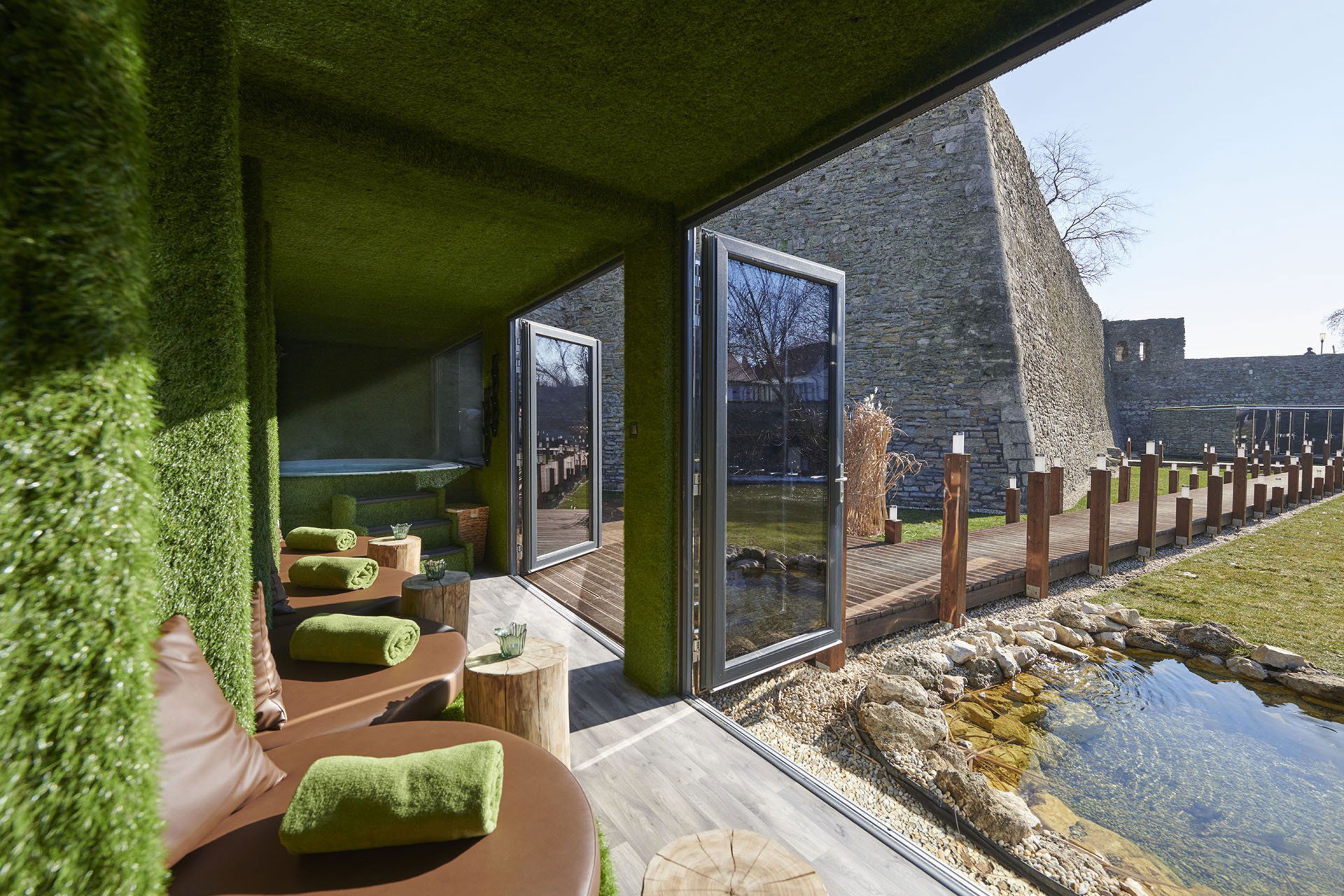
The spa at Platán Manor sits beside the old castle moat, and its exterior design is worth noting independently of what is inside. The reflective cladding, which gives the Mirror Spa its name, is architecturally deliberate: it creates a visual dialogue with the water of the moat and makes the structure less imposing against the historic building mass beside it. Inside, the approach reverses to warm wood and forest textures, which creates a notable contrast between exterior and interior that is not accidental. Spa design in this category of hotel often defaults to generic wellness neutrality; the Mirror Spa's material choices position it more specifically within the forest-and-nature reference system that Varró established in the main building.
The Culinary Program
Platán Manor's gastronomic restaurant predates the property's current incarnation as a boutique hotel, which is an unusual sequence. Most hotel restaurants are conceived as amenities after the accommodation offer is established; here, the dining program was the anchor around which the broader hospitality concept developed. That history gives the restaurant a degree of independence from the hotel's identity that is uncommon at this scale. A more recent bistro concept in an adjacent space extends the food offer without displacing the formal restaurant, giving the property two distinct dining registers. For context on what is available in the wider area, see our full Tata restaurants guide.
Expansion Plans and What They Signal
The planned expansion at Platán Manor is worth reading as a signal about the property's trajectory. The additions described include additional Varró-designed rooms and suites arriving in stages, underground parking, e-bikes, and an electric boat for summer use. The staged rollout of rooms is common among design-led boutique properties that fund expansion from operating revenue rather than upfront investment; it keeps the guest count low during the development phase and allows the design program to be extended incrementally. The e-bikes and electric boat are infrastructure choices that suit the Tata setting: the town's lakes and surrounding landscape are oriented toward slow, low-impact movement rather than high-speed activity. These additions make Platán Manor progressively more self-contained as a destination stay rather than a transit stop on the way to Budapest or Vienna. For other experiences in and around Tata, our full Tata experiences guide covers what the broader area offers.
Placing Platán Manor in the Regional Hotel Picture
The relevant comparison set for Platán Manor is not the large business hotels in Budapest but the smaller, design-attentive properties elsewhere in the region that have built reputations around architecture and setting. Hotel Petit Bois in Balatonfüred represents a similar scale and sensibility on the lake circuit. Internationally, the format of a small-count, design-led historic property with a meaningful food program is well established: properties like Aman Venice or Cipriani, A Belmond Hotel, Venice occupy the leading end of that category, while Platán Manor's 21-room format and price point starting at $159 per night position it as an accessible entry into this typology without the operating overhead of a fully branded luxury group.
Tata's castle and lake setting give the property a locational argument that is difficult to replicate in a city centre. Guests looking for alternatives to Budapest's larger hotel stock, including properties like the Hotel Sacher Wien in Vienna or the grand-hotel tier represented by Hôtel de Paris Monte-Carlo, will find Platán Manor operates at a different register entirely: quieter, smaller, and rooted in a specific place rather than a brand identity.
Getting There and Planning Your Stay
Platán Manor sits at Kastély tér 6 in Tata, less than an hour's drive from Budapest Ferenc Liszt International Airport and approximately ninety minutes from Vienna International Airport. The hotel arranges transfers from both airports on request, which removes the main logistical friction of visiting a small town without direct rail connections to the major hubs. For drivers, the position on the main Budapest-Vienna corridor makes it a viable stop-off rather than a detour. Booking in advance is advisable given the 21-room count; the expansion program will add capacity in stages, but the property is likely to remain small by design. For broader context on what the town and surrounding area offers, see our full Tata bars guide, our full Tata wineries guide, and our full Tata experiences guide.
Frequently Asked Questions
What should I expect atmosphere-wise at Platán Manor?
Platán Manor reads as a small aristocratic residence that has been carefully updated rather than a hotel built from scratch with period references bolted on. The 21-room scale keeps it quiet; the Varró interiors, with their antique-modern combinations and recurring forest motifs, give it a specific visual personality rather than the generic neutrality of larger branded properties. The position next to Tata Castle and the old moat adds an external atmosphere that the architecture of the Mirror Spa is designed to engage with directly.
What is the most popular room type at Platán Manor?
With only 21 rooms in the current inventory and an ongoing expansion adding further Varró-designed suites in stages, the suite tier is likely to be in the highest demand given the small total count. The design program applies across all room categories, so the distinction between room types is more about scale than about whether the Varró scheme is present.
What is the defining thing about Platán Manor?
The building is a 17th-century Esterházy family palace beside one of rural Hungary's most-visited castles, redesigned by a Hungarian designer with full creative latitude. That combination of documented historical provenance, site-specific location, and a coherent contemporary design program is what separates it from both generic rural accommodation and the larger international hotel brands in Budapest. The gastronomic restaurant, which predates the hotel's current form, adds a food dimension that is not merely an amenity. Rooms start from $159 per night.
How hard is it to get in to Platán Manor?
At 21 rooms, availability is inherently limited relative to the property's profile and its proximity to Budapest. The gap between current room count and demand is likely to tighten as the expansion-phase additions attract more attention. Booking well in advance is the practical answer, particularly for summer stays when the lake setting and the planned electric boat become operational assets. The hotel arranges airport transfers on request, which simplifies arrival logistics once a booking is in place.
Preferential Rates?
Our members enjoy concierge-led booking support and priority upgrades at the world's finest hotels.
Access the Concierge