

Fowlescombe Farm


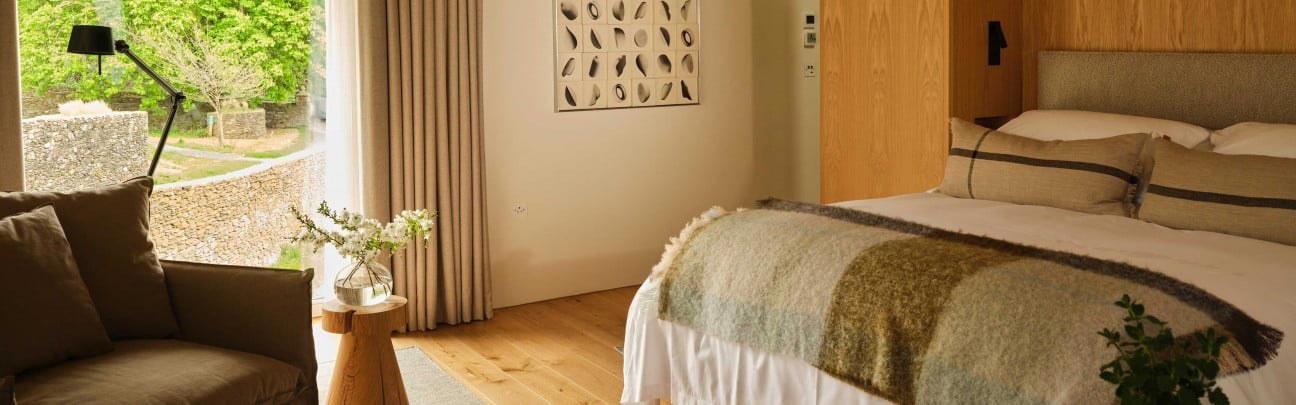
A 450-acre regenerative livestock farm in South Devon that launched 10 suites across a Victorian farmhouse and two stone barns, Fowlescombe Farm sits in a small tier of UK farm stays where working agricultural credentials and serious design intent genuinely coexist. Rooms are finished with custom oak furniture, Welsh sandstone floors, and Naturalmat mattresses filled with wool from the farm's own Manx Loaghtan flock. Rates from $852 per night.

Where the Building Material Is Also the Landscape
The farm-stay category in the UK has splintered in recent years. At one end sit glamping sites with hot tubs and fire pits; at the other, a smaller group of properties where the agricultural operation is genuine and the design brief is serious. Fowlescombe Farm, on the southern edge of Dartmoor near Ugborough in Devon, belongs firmly to the latter. The Owens family farm 450 acres of regenerative livestock land, and the 10 suites that opened last year across the Victorian farmhouse and a pair of repurposed stone barns were designed to make that legible rather than decorative.
The design palette reads as a deliberate material inventory of the farm itself. Welsh sandstone covers the floors. Custom oak furniture fills the rooms. The mattresses are made by Naturalmat using wool clipped from the farm's own Manx Loaghtan sheep, a rare-breed flock that also provides, by all accounts, something close to comic relief when supervised by the farm dog Tiggs. The result is interiors where provenance is traceable not in the marketing copy but in the physical objects guests sleep on and move around. That specificity of material choice places Fowlescombe in a different register from country house hotels that deploy reclaimed timber and sheepskin throws as atmosphere rather than fact.
Stone Barns and Victorian Proportions
Three structures housing the suites give the property an architectural range that single-building retreats rarely achieve. The Victorian farmhouse carries the formal proportions of its era, while the repurposed stone barns introduce lower ceilings, heavier walls, and a different quality of light altogether. Both barn conversions retain enough structural honesty to read as agricultural buildings rather than agricultural-themed hotel rooms, which is a distinction that matters in this tier of the market.
This approach to adaptive reuse of farm buildings has become a recognisable format across the rural UK, most successfully at properties where the intervention is restrained enough not to override the original character. At Fowlescombe, the use of natural and locally sourced materials across all three structures creates continuity between buildings without imposing a uniform aesthetic. Each suite connects to the working farm not through views of a curated vegetable garden but through the actual materials underfoot and overhead. For comparison, design-led rural retreats like The Newt in Somerset or Lime Wood in Lyndhurst operate at the more polished end of this spectrum, where the estate narrative is carefully managed. Fowlescombe sits closer to the working-farm end, where the sign on the barn door naming the dog employee of the month is not ironic but entirely in keeping.
The Refectory and How the Food Connects
The communal dining format matters architecturally as much as gastronomically. The Refectory, where guests eat the four-course evening suppers, is set up around a shared table with an open kitchen, a layout that positions cooking as an observable process rather than a back-of-house operation. Executive chef Elly Wentworth works from a changing menu that draws on the farm's own produce, with dishes such as shorthorn beef agnolotti and roasted wild bass representing the kind of cooking that requires supplier relationships rather than a standing order from a central distributor.
The communal table format is common in this category of property, used at farm stays and small rural retreats across the West Country and beyond, partly because it suits low room counts and partly because it reinforces the shared-experience logic that distinguishes this tier from standard hotel dining. At Fowlescombe's scale of 10 suites, it works: the table does not require strangers to perform sociability but creates a context where conversation happens without being engineered. The informality is structural rather than performative.
What the Activities Program Signals
Weekly rotating program at Fowlescombe covers farm tours, gin tastings, and yoga in the greenhouse. The greenhouse setting for the yoga session is worth noting as a design choice: it places a wellness activity inside a working agricultural structure, which maintains the farm's visual and functional logic rather than importing a spa aesthetic that would sit at odds with the barns and sandstone floors. This coherence between activity format and architectural setting is something the more polished end of the rural retreat market sometimes sacrifices in favour of dedicated wellness infrastructure.
Head gardener Shelley's role in guest experience, including conversations about what is currently growing, reflects a wider trend in farm stays toward making agricultural knowledge part of the offer rather than keeping it backstage. Properties like Estelle Manor in North Leigh and Kilchoan Estate in Inverie operate in related territory, where the land's productive character is part of what guests are paying to access.
Placing Fowlescombe in Its Competitive Set
UK farm-stay market now contains properties across a wide price and credibility range. At the higher end, rates reflect genuine land management, architectural investment, and kitchen programs that depend on what the farm actually produces. Fowlescombe's rates from $852 per night position it at the serious end of that range, alongside properties where the agricultural operation is not decorative.
Comparison set for a guest evaluating Fowlescombe would include other regenerative-farm-backed rural retreats in the West Country rather than conventional country house hotels or spa resorts. The absence of a pool, a spa wing, or a destination-restaurant identity is not a gap but a coherent editorial position: this is a working farm with well-designed rooms and a kitchen that cooks what the farm raises, priced accordingly. Guests oriented toward properties like Longueville Manor in Jersey or Gleneagles in Auchterarder are buying a different product entirely. For broader context on what is available across the region, see our full Ugborough restaurants guide.
Other UK rural properties worth considering for comparison include Farlam Hall Hotel and Restaurant in The Lake District, Langass Lodge in the Outer Hebrides, and Dunluce Lodge in Portrush, each of which occupies a distinct position in the UK's small-property, land-connected accommodation tier. For those looking beyond rural formats entirely, urban alternatives include The Savoy in London, Hotel du Vin at One Devonshire Gardens in Glasgow, The Rutland in Edinburgh, Oddfellows on the Park in Manchester, and Dakota Leeds. For international reference points at the more formal end of the luxury spectrum, Badrutt's Palace Hotel in St. Moritz and Hôtel de Paris Monte-Carlo represent the grand-hotel tradition that Fowlescombe is consciously not.
Planning a Stay
Fowlescombe Farm is located at Ugborough PL21 0HW in South Devon, within reach of Dartmoor's southern edge. The property runs 10 suites across the Victorian farmhouse and two stone barns, with the four-course suppers in The Refectory forming a central part of the stay rather than an optional add-on. The weekly activity program changes, so guests with specific interests in farm tours or other programming should confirm the schedule at booking. Rates start from $852 per night, placing the property at the upper end of the regenerative farm-stay tier in the UK. Additional properties in this general category worth reviewing include Whisky Lodges Coleburn in Longmorn, Crossbasket Castle in High Blantyre, Thornton Hall Hotel and Spa in Heswall, Aviator Hotel in Farnborough, The Vineyard Hotel and Spa in Newbury, Muir, A Luxury Collection Hotel in Halifax, Antonia's Pearls in Charlestown Harbour, and The Fifth Avenue Hotel in New York City for those extending travel.
A Quick Peer Check
These are the closest comparables we have in our database for quick context.
| Venue | Cuisine | Price | Awards | Notes |
|---|---|---|---|---|
| Fowlescombe Farm | This venue | |||
| Lime Wood | ||||
| Muir, A Luxury Collection Hotel, Halifax | Michelin 1 Key | |||
| The Connaught | World's 50 Best | |||
| Raffles London at The OWO | World's 50 Best | |||
| Bvlgari Hotel London |
At a Glance
- Quiet
- Rustic
- Scenic
- Cozy
- Intimate
- Romantic Getaway
- Family Vacation
- Weekend Escape
- Garden
- Historic Building
- Wifi
- Garden
- Terrace
- Restaurant
- Ev Charging
- Garden
Quietly luxe contemporary interiors blending with historic stone barns and farmhouse, creating an intimate and restorative rural atmosphere.