
A Michelin Selected property on Lower Tukcha Road in Leh, Dolkhar Ladakh occupies a tier of Indian mountain hospitality where local material traditions and high-altitude architectural thinking matter more than brand scale. For travellers approaching Ladakh as a serious destination rather than an adventure checkbox, it represents a considered entry point into the region's premium accommodation scene.
Pearl is the En Primeur Club membership app — saves, bookings, and concierge access live there. Same editors, same standards.
- Address
- Lower Tukcha Rd, opposite Community Hall, Leh, Ladakh 194101
- Phone
- +91 78894 97040
- Website
- dolkharladakh.com
- Directions
- Get directions
 Saves & bookings on Pearl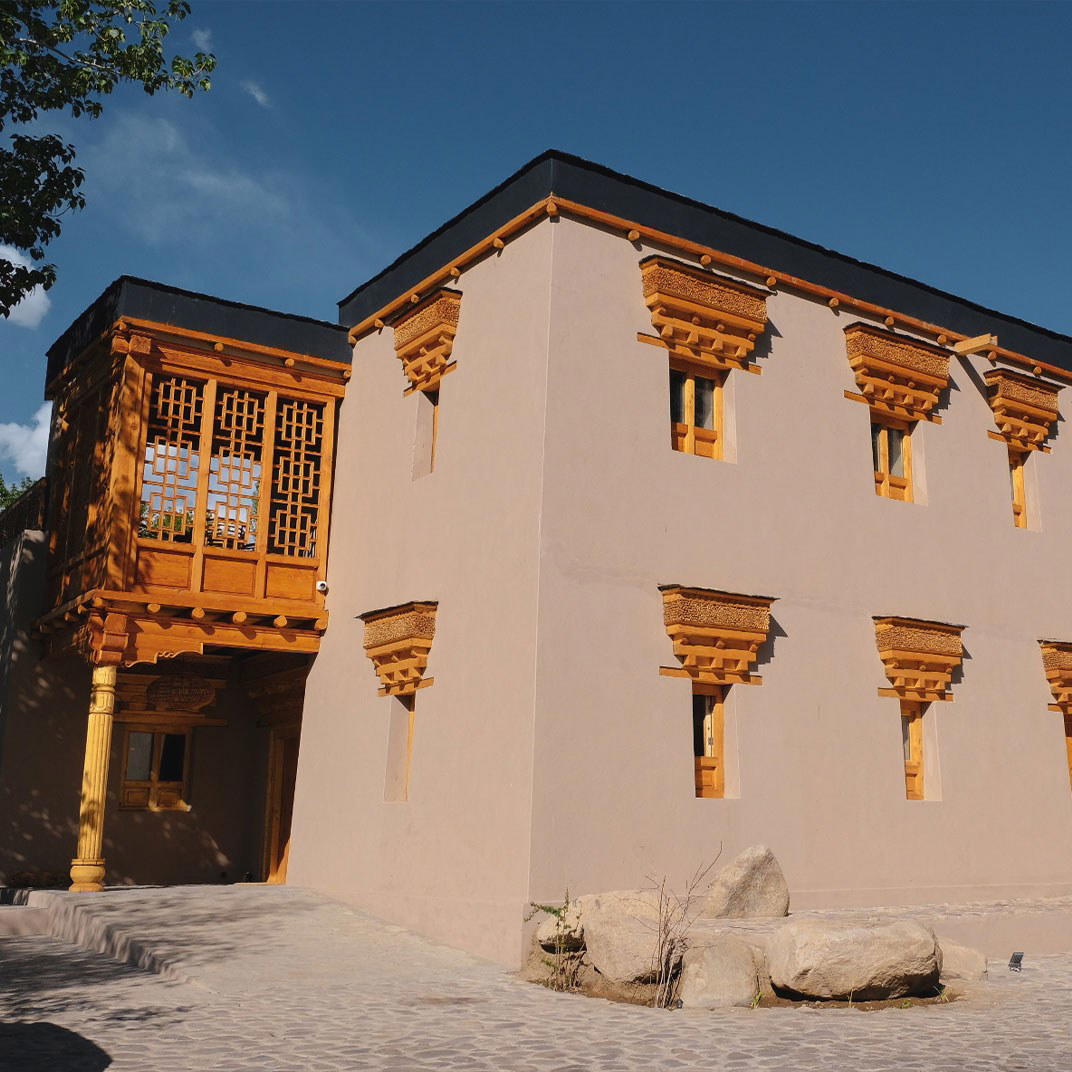
Stone, Timber, and Altitude: How Ladakh's Built Tradition Shapes Its Leading Stays
Arriving in Leh from the airport or the long road north from Manali, the city resolves slowly from its surroundings. The Indus Valley sits at roughly 3,500 metres, and the light here has a quality that lower-altitude destinations cannot replicate: hard, clear, and directional in a way that makes mud-brick walls and timber latticework read differently than they would anywhere else. The built environment of Ladakh is inseparable from its geology. Traditional Ladakhi architecture draws on rammed earth, poplar wood, and flat rooflines designed for a landscape where snowfall is dry and infrequent rather than heavy and wet. These are not aesthetic choices, they are centuries-old responses to an extreme climate, and the properties that engage seriously with that tradition produce a different guest experience from those that impose a generic luxury vocabulary onto the altitude.
Dolkhar Ladakh is a 5-star hotel on Lower Tukcha Road, opposite the Community Hall in Leh, with 7 rooms and a nightly rate from USD 125. Its Michelin Selected recognition places it among the properties that are judged for coherence of place and material quality. Michelin's hotel selection at this level typically signals properties where the sense of environment and material integrity are doing meaningful work.
The Architecture of Restraint in High-Altitude Hospitality
Across India's premium hotel market, the tension between imported grandeur and regional material honesty has produced two distinct cohorts. Properties like The Leela Palace Jaipur, The Oberoi Amarvilas in Agra, and Taj Lake Palace in Udaipur operate within a tradition of palatial grandeur, where the architecture is itself a historical argument. In Ladakh, no such palatial tradition applies to contemporary hospitality. What applies instead is something more austere and, in its own way, more demanding: the discipline of building in a fragile high-altitude environment where materials must be sourced with care, construction seasons are short, and anything that reads as incongruous against the landscape becomes immediately visible.
Smaller design-led properties in the Himalayan and Karakoram belt have increasingly recognised restraint as the right architectural register for this terrain. The properties that do well in this context tend to use local stone and timber as primary rather than decorative materials, maintain low profiles that do not compete with the surrounding ridgelines, and orient interior spaces toward the light conditions that make Ladakh distinctive. Dolkhar Ladakh's position on Lower Tukcha Road places it within walking distance of Leh's central bazaar and the old town quarter, which means the architecture of the property exists in direct dialogue with the vernacular fabric of the city, an advantage that more peripheral resort developments don't have.
This proximity to the urban core also changes how a stay functions practically. Guests can move between the property and the market streets, the palace ruins above town, and the main Jokhang temple precinct on foot rather than by vehicle, which at altitude matters. Acclimatisation is a real constraint for first-time visitors to Leh: most physicians recommend at least 48 hours of limited exertion after arrival, and a centrally located property that allows slow, pedestrian exploration of immediate surroundings serves that process better than a resort requiring transport for every excursion.
Leh's Hotel Tier and Where Dolkhar Sits Within It
Ladakh's premium accommodation market has expanded significantly since the region gained Union Territory status in 2019, with international attention and infrastructure investment both accelerating. The resulting hotel landscape now ranges from large-footprint resorts on the outskirts of Leh to smaller, owner-operated properties closer to the old city. Michelin Selected status in 2025 signals that Dolkhar Ladakh is operating with a level of physical and service consistency that aligns it with the editorial tier rather than the volume tier of this market.
For context on what Michelin's hotel selection process typically weights: the designation tends to reward properties where the physical environment, material quality, and sense of place are coherent rather than properties that simply offer high room counts or extensive spa facilities. In a city like Leh, where the environment is itself the primary attraction, that weighting makes the selection particularly meaningful. Properties selected in the broader Indian context include options as varied as Ananda in the Himalayas in Narendra Nagar and Suryagarh in Jaisalmer.
Travellers considering Ladakh within a broader India itinerary often sequence it with Rajasthan or the Himalayan foothills. Properties like Amanbagh in Ajabgarh, Suján Jawai in Pali, and Suján Sher Bagh in Ranthambhore offer comparative reference points for what design-led, environment-first hospitality looks like in other Indian ecosystems. Ladakh operates at an entirely different register, altitude, aridity, and Buddhist cultural heritage rather than royal Rajput lineage or wildlife corridors, but the underlying editorial principle is consistent: the property should be a serious interpreter of its landscape, not a generic delivery mechanism dropped into an extreme location.
Planning a Stay: Timing, Access, and Practical Realities
Leh is accessible by air from Delhi, Mumbai, and several other Indian cities, with flights operating year-round though subject to weather disruptions, particularly in winter. The overland routes via the Manali-Leh Highway and the Srinagar-Leh Highway are typically open between May and October, with the precise dates varying by snowfall each year. The high season runs roughly from June through September, when temperatures in the valley are manageable and most of Ladakh's monastery festivals and high-altitude passes are accessible. Shoulder season visits in May and October offer thinner crowds and sharper light, though some peripheral attractions may be limited.
For acclimatisation reasons noted above, a minimum three-night stay in Leh is advisable before attempting day trips to higher elevations such as Pangong Lake, the Nubra Valley, or Khardung La. A centrally located property like Dolkhar, within the Leh city boundary, supports this by keeping options open within easy walking range during the adjustment period. Booking in advance is advisable for peak summer months: Leh's premium accommodation supply is limited, and demand from both domestic and international travellers has increased markedly since 2020.
Travellers arriving from longer Indian itineraries that include coastal or plains properties, The Taj Mahal Palace in Mumbai, Alila Diwa Goa, or Kumarakom Lake Resort in Kerala, should expect a significant shift in register at Leh. That shift is, for most visitors, precisely the point. Ladakh does not soften its environment for its guests. The properties that succeed here are the ones that have understood that and built accordingly.
Quick Comparison
Comparable venues nearby, for context on price, style, and recognition.
| Venue | Cuisine | Price | Awards | Notes |
|---|---|---|---|---|
| Dolkhar LadakhThis venue — the venue you are viewing | Sustainable boutique villa resort inspired by local Ladakhi culture and orchards. | $$$$ | 5-Star | Not listed |
| Aurika, Nehru Place, New Delhi | Large upper-upscale urban lifestyle hotel with extensive event and leisure facilities in a major commercial district. | $$$$ | 5-Star | Nehru Place |
| Taj Theog Resort & Spa, Shimla | Lodge-style luxury resort blending contemporary architecture with mountain tranquility. | $$$$ | 5-Star | Theog |
| Taj Exotica Resort & Spa, Goa | Luxurious beachfront resort with colonial-inspired architecture sprawled across 56 acres of lush greenery | $$$$ | 5-Star | Benaulim |
| Taj Green Cove Resort & Spa, Kovalam | Luxury tropical resort combining contemporary Balinese design with traditional Kerala architecture on a hillside setting. | $$$$ | 5-Star | Kovalam |
| Samode Palace | Heritage palace hotel blending Rajput-Mughal architecture with contemporary luxury | $$$$ | 5-Star | Samode |
Recognition history
Dated appearances from independent guides and award organizations, with the underlying list record or original source where available.
Michelin Selected
Michelin
At a Glance
- Quiet
- Scenic
- Rustic
- Elegant
- Intimate
- Romantic Getaway
- Wellness Retreat
- Weekend Escape
- Historic Building
- Panoramic View
- Terrace
- Spa
- Wi Fi
- Restaurant
- Room Service
- Concierge
- Sauna
- Free Parking
- Mountain
- Garden
- Spa
- Wi Fi
- Restaurant
- Room Service
- Concierge
- Sauna
- Free Parking
Tranquil and immersive with natural light, traditional elements, and a peaceful Himalayan escape amid verdant foliage.