Truk Stop (Chuuk)
Our verdict
Truk Stop (Chuuk) serves Pacific Island Seafood & Steakhouse cooking with waterfront views, local sourcing, and a beer program in a casual, lively hotel restaurant.

Pearl is the En Primeur Club membership app — saves, bookings, and concierge access live there. Same editors, same standards.
The menu
What to order
- Mushroom Sauce Steak
- Fresh Tuna
- Local Plate
- Grilled Fish
Where the Pacific Comes to the Table
Weno Town sits at the administrative center of Chuuk State, itself one of the most geographically dispersed island groups in Micronesia. The archipelago comprises more than 40 islands scattered across a lagoon that, for divers and maritime historians alike, carries a significance disproportionate to its population. What that geography produces, in culinary terms, is a food culture shaped almost entirely by what the ocean and the land immediately provide. Truk Stop, addressed at 1993 Weno Blvd, occupies a position within this context that any visitor to the island will quickly come to understand: it is one of the few established dining and accommodation facilities on Weno that serves an international clientele arriving primarily for the diving or for research purposes.
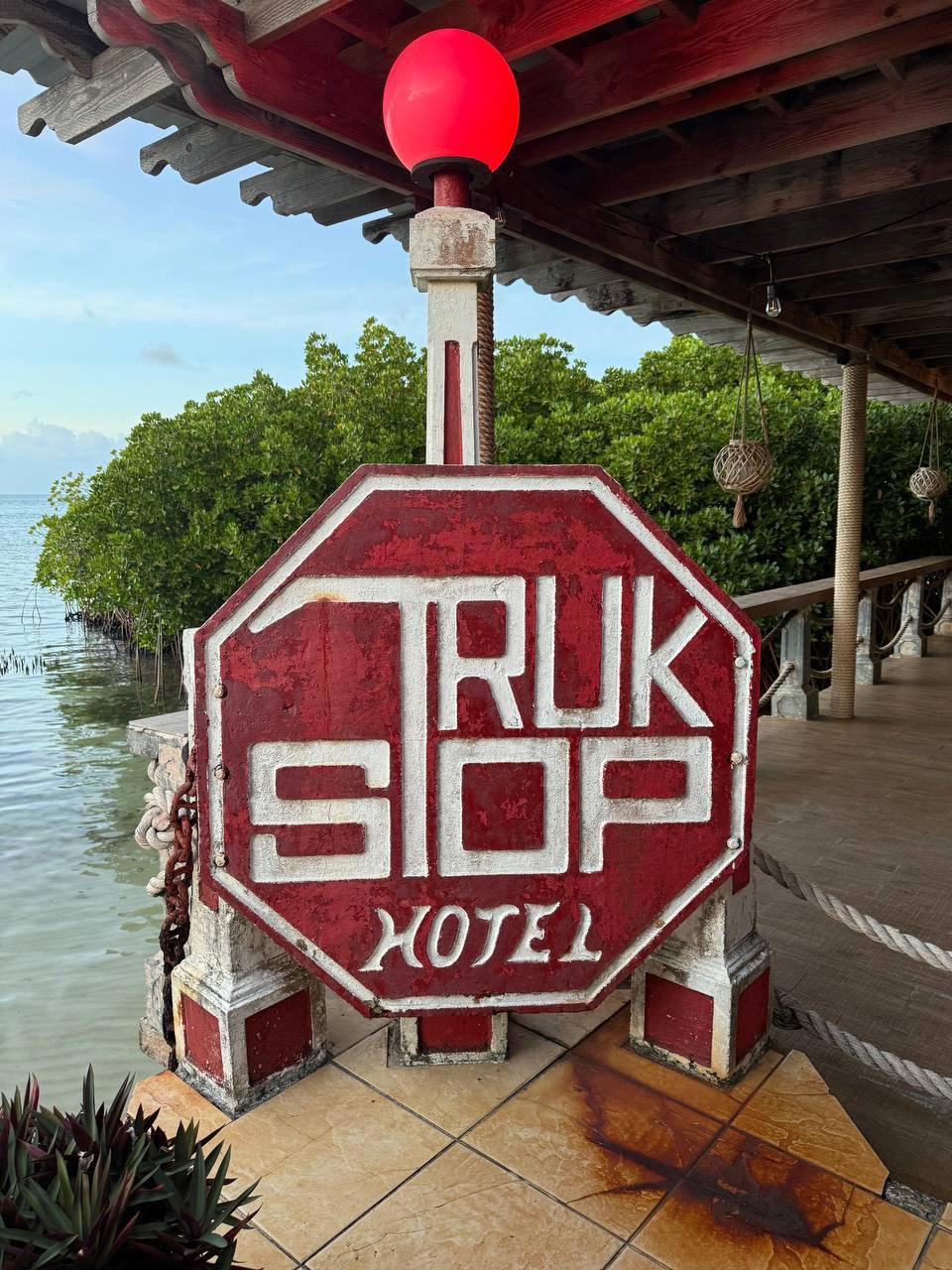
The building itself sits along one of Weno's main throughways, close enough to the waterfront that the salt-heavy air is a constant presence. This is not a setting engineered for ambience in the way a resort property might be. The Pacific here is not decorative backdrop; it is the operative fact around which everything else on the island is organized. That distinction matters when thinking about where food on Chuuk actually comes from.
Ingredient Sourcing at the Edge of the Pacific
Micronesia's food supply chain is one of the more logistically consequential in the region. Chuuk, like much of the Federated States of Micronesia, relies on a combination of imported shelf goods and whatever the local fishery and small-scale agriculture can yield. The island does not have the diversified agricultural base of larger Pacific nations, and supply chains run through infrequent cargo services and limited air freight connections via Guam and Honolulu. What this means practically is that dining on Weno requires a degree of adaptation to what is available rather than what is planned.
For a property like Truk Stop, that supply reality shapes the dining experience in ways that high-production resort kitchens in Hawaii or Palau can largely avoid. Fresh fish is the most reliable locally sourced ingredient in this part of Micronesia, given the productivity of the surrounding lagoon and open Pacific waters. Visitors arriving from internationally recognized dining destinations, whether that means Le Bernardin in New York City or Aponiente in El Puerto de Santa María, which has built an entire culinary program around marine ingredients, will find the approach here defined more by pragmatism than by philosophy. The ingredient is the point not because of a stated sourcing ideology but because geography leaves few alternatives.
This is worth understanding before arrival. The interest of eating in a place like Chuuk is not that the kitchen is applying techniques comparable to those at Amber in Hong Kong or 8 1/2 Otto e Mezzo Bombana. The interest is that the ingredients reaching any Weno kitchen tell a story about trade routes, island logistics, and the Pacific food economy that no amount of high-concept menu writing could replicate. Truk Stop is where that story intersects with the practical need to feed divers, researchers, and travelers passing through one of the remotest populated points in the Pacific Ocean.
The Diving Camp Model and What It Means for Dining
Chuuk's primary draw for international visitors is the wreck diving. The lagoon holds one of the most concentrated collections of Second World War-era shipwrecks in the world, a result of Operation Hailstone in February 1944, when US forces struck the Japanese fleet at anchor. That historical fact has defined Weno's hospitality infrastructure for decades, and Truk Stop sits within a category of property that has evolved specifically to serve that diving clientele.
Dive-camp hospitality across the Pacific tends to follow a consistent pattern: functional accommodation, reliable meal service timed around boat departures and returns, and a common-table format that encourages conversation among guests. This is a different model from the curated dining environments at properties built around gastronomy, whether that is Lazy Bear in San Francisco or Atelier Crenn. The audience at Truk Stop is coming for what is beneath the water, and the dining operation exists to support that primary activity rather than to compete with it as a destination in its own right.
That framing is not a criticism. Properties that serve extreme-travel audiences in genuinely remote locations perform a function that no amount of fine-dining infrastructure can replicate: they make it possible to access experiences that are otherwise inaccessible. Truk Stop has been part of that access infrastructure for Chuuk's dive community for long enough that it appears consistently in dive-travel planning resources for this part of Micronesia. For a broader comparison of what seriously committed dining programs look like in other regions, Arpège in Paris or Arzak in San Sebastián represent the other end of the hospitality spectrum, which helps calibrate expectations before arrival at Weno.
Planning a Visit: What the Logistics Require
Getting to Weno requires flying through either Guam or Honolulu on United Airlines Micronesia service, then connecting through Pohnpei or Kosrae depending on routing. Flight frequency to Chuuk is limited, and schedules shift seasonally. Travelers accustomed to same-week booking habits applicable in cities with dense hospitality infrastructure, whether they are looking at Alinea in Chicago or Atomix in New York City, will need to rethink their planning horizon entirely. Dive seasons and inter-island transport schedules make advance booking essential, typically several weeks to months ahead depending on the time of year and intended dive itinerary.
Direct contact with the property, or reference to current dive-travel operators who coordinate accommodation on Weno, is the more reliable path to confirmed logistics. You can find additional context and venue coverage in our full Weno Town restaurants guide.
For travelers comparing options across other dive-oriented Pacific destinations, or who want reference points for high-credential dining that contextualizes what remote Pacific hospitality is and is not, properties like Alain Ducasse at Louis XV in Monte Carlo, Benu in San Francisco, or Azurmendi in Larrabetzu represent what the opposite end of the access-and-infrastructure spectrum looks like. Truk Stop belongs to a different category entirely, one where the value proposition is proximity to an irreplaceable natural and historical site rather than the refinement of the dining program itself.
Frequently asked questions
Is Truk Stop (Chuuk) okay with children?
Weno Town is a small administrative hub, and Truk Stop sits within a community-oriented setting rather than a high-end or nightlife-driven one. Families do pass through Chuuk, though the destination is overwhelmingly oriented toward adult wreck divers. Children accompanying diving groups will find the environment low-key rather than resort-calibrated.
What kind of setting is Truk Stop (Chuuk)?
Truk Stop occupies a working waterfront position in Weno Town, the main population center of Chuuk State at 1993 Weno Blvd. The setting is functional and dive-camp-adjacent rather than decorative: the draw is proximity to Chuuk Lagoon and the logistical services that surround it, not atmosphere engineered for leisure travelers.
Does Truk Stop (Chuuk) offer dive trip coordination or services for visiting wreck divers?
Truk Stop is located at 1993 Weno Blvd in Weno Town, the administrative center of Chuuk State, positioning it as a practical hub for divers accessing Chuuk Lagoon's wreck sites. The venue has historically served the dive camp model that structures most international visits to Chuuk. Visitors planning a wreck diving itinerary should confirm current operational services directly, as Weno's infrastructure operates on a different service cadence than larger Pacific tourism destinations.
What should I eat at Truk Stop (Chuuk)?
What is well-established about Chuuk broadly is that the food supply chain runs through import logistics from Guam and Honolulu, so expect a menu shaped as much by availability as by local tradition. Fresh seafood sourced from surrounding Pacific waters is the most reliable regional anchor.
What part of town is Truk Stop (Chuuk) in?
Truk Stop (Chuuk) is located at 1993 Weno Blvd, Weno Town Chuuk 96942, Weno Town.
How far ahead should I plan for Truk Stop (Chuuk)?
Getting to Weno requires routing through either Guam or Honolulu on United Airlines Micronesia service, with onward connections through Pohnpei or Kosrae depending on scheduling. Flight frequency is limited, so air bookings should be locked months in advance, particularly around peak dive season. Coordinating arrival logistics before confirming any on-the-ground arrangements in Weno is the practical sequence.
What is Truk Stop (Chuuk) known for?
Truk Stop is the established presence in Weno Town closest to the diving operations that define why international visitors come to Chuuk at all. The lagoon holds one of the most concentrated collections of Second World War-era wrecks in the Pacific, making Chuuk a reference point among technical and recreational divers worldwide. Truk Stop functions as the operational base for that community.
Details
- Lively
- Scenic
- Casual
- Well Known
- Casual Hangout
- Group Dining
- Family
- After Work
- Special Occasion
- Waterfront
- Live Music
- Hotel Restaurant
- Private Dining
- Beer Program
- Local Sourcing
- Waterfront
- A La Carte
- Family Style
- Beer
- Local Beverages
Current opening hours
- Monday
- 7 AM–10 PM
- Tuesday
- 7 AM–10 PM
- Wednesday
- 7 AM–10 PM
- Thursday
- 7 AM–10 PM
- Friday
- 7 AM–10 PM
- Saturday
- 7 AM–10 PM
- Sunday
- 7 AM–10 PM
Hours can change for holidays and private events. Last verified .