Cornus







1 Michelin Star · La Liste Top Restaurants · Star Wine List
Our verdict
Cornus holds a Michelin star and a place in La Liste's top restaurants (82pts, 2026), operating from the Eccleston Yards development on the edge of Belgravia. Chef Gary Foulkes, formerly of Angler, leads a kitchen focused on south-west British seafood and game, handled with technical restraint. The set lunch with £20 corkage is among the more considered value propositions in London's upper dining tier.

Pearl is the En Primeur Club membership app, where members save venues, book tables and use the concierge.
The menu
What to order
- Cornish lobster with hand-rolled spaghetti and caviar
- Newlyn cod with girolles and fondant potato
- Truffle gnocchi
- Pigeon from Brittany with chestnut purée
- Mille feuille
- Chocolate barquette
Finding Your Way to Eccleston Yards
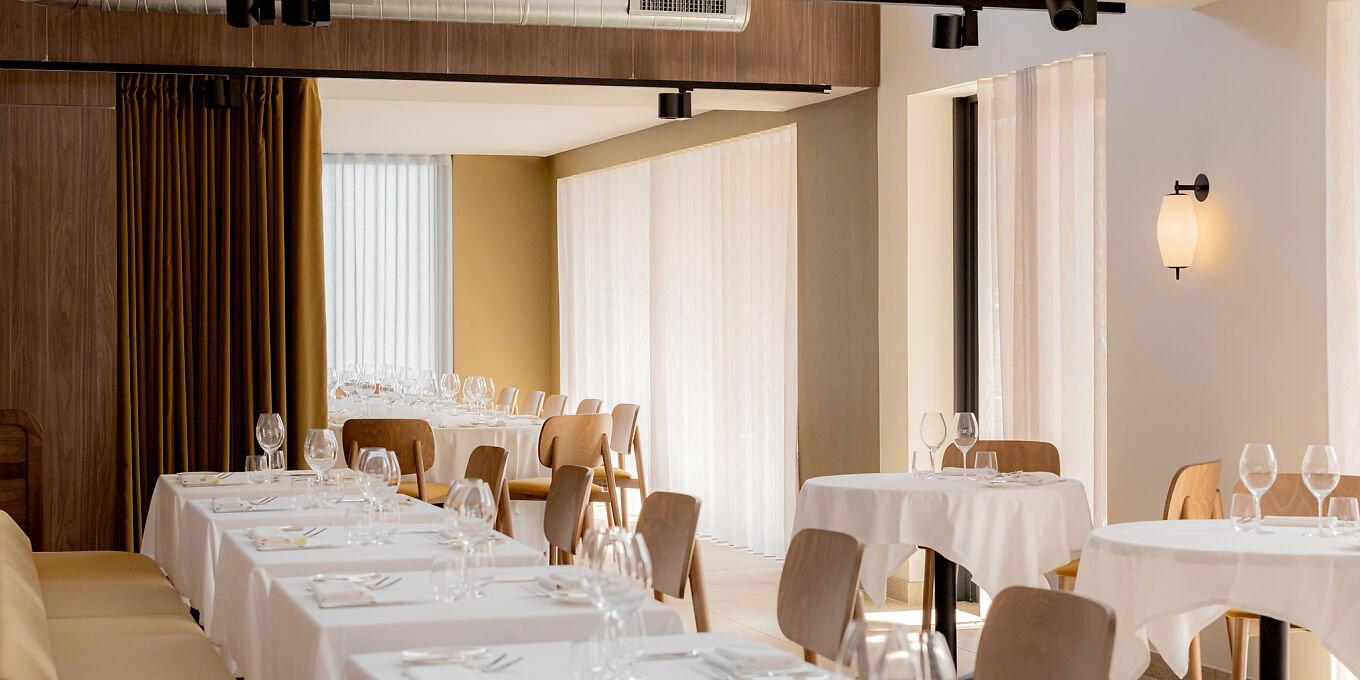
The approach matters at Cornus. Eccleston Yards, the converted industrial site between Victoria station and Belgravia, is not the kind of destination that announces itself from the street. The Ice Factory building sits at the top of the development, and the restaurant occupies its upper floor: a spare, contemporary room with minimalist decor, exposed lighting rails, and a long marble-topped counter. Linen-laid tables, natural light, and the deliberate absence of ornament signal what kind of meal is coming. Several Zagat-style reviewers have noted the room can feel 'bare and unrefined' relative to the price point, but this is a restaurant that has chosen restraint as a design principle, not an economy. If the neighbourhood between Belgravia and Victoria has historically lacked serious dining destinations, Cornus is a direct answer to that gap.
The Ritual of the Meal: Pacing, Sequence, and Intent
Modern British cooking at the upper tier has settled into a recognisable grammar: produce-led, technique-precise, and paced to let individual dishes breathe rather than cascade. Cornus follows this logic with some discipline. The meal moves through its stages without theatre or excess showmanship, but the kitchen's restrained approach is not the same as a neutral one. The decision to anchor the menu around south-west British seafood, Devon crab, Newlyn cod, red mullet, and supplement it with game cookery reflects a considered editorial position about what British larder cooking should look like in 2024 and beyond.
The sequence reads as considered from the first course. Opening assemblages here establish flavour logic rather than simply filling time before a main event: the interplay of savoury and lactic elements, or the pairing of intricately prepared proteins with powerful reductive sauces, sets a register that the kitchen sustains across the meal. Fish cookery sits at the centre of what the kitchen does most confidently, with south-west coast sourcing that places Cornus in a peer group alongside restaurants that treat provenance as a culinary argument rather than a marketing footnote. Game, handled with the same technical assurance, extends the menu's seasonal range. Pastry carries its own weight: the profiteroles finished tableside with hot chocolate sauce have drawn specific attention in multiple reviews, which in this kind of cooking is a statement about the seriousness applied to every course, not just savoury ones.
The wine program is part of the ritual rather than an afterthought. Head of wine Melania has built a list with genuine global reach, with glasses from £8.50 and a selection that climbs to premier-league bottles. Sussex Brut from Wiston Estate appears as the house fizz, a choice that signals the list's intent as clearly as any fine wine section. The lunchtime corkage policy of £20 per bottle is an unusual concession in this price tier and changes the calculation for anyone prepared to bring their own.
Where Cornus Sits in the London Tier
London's Michelin-starred Modern British category is competitive and clearly stratified. At the leading end, two- and three-star operations like CORE by Clare Smyth operate with maximalist investment in service architecture and tasting menu depth. Cornus, with its single star awarded in 2024 and La Liste ranking of 82 points in 2026 (up from 90 points in 2025, reflecting the scoring methodology's evolution), positions itself differently: the produce-led approach and the existence of a set lunch menu suggest a restaurant more interested in accessibility within its tier than in building a fortress of exclusivity.
The team behind Cornus, David O'Connor and Joe Mercer Nairne, built their reputation at Medlar in Chelsea, a restaurant that occupies a similar philosophical position: serious cooking, without the ceremony of a tasting-menu operation. Cornus is described by multiple reviewers as 'all the things you love about Medlar, but dialled up a notch,' and the Opinionated About Dining ranking of 410th in Europe (2025) places it inside a credible pan-European reference frame rather than solely a London one. Chef Gary Foulkes, recruited from Angler at the South Place Hotel, brings a background in seafood-forward fine dining that aligns precisely with the kitchen's stated priorities.
In direct comparison with neighbourhood-adjacent peers: The Ritz Restaurant operates in a far more formal register with a significantly different dining ritual built around classic French service tradition. Dorian and Ormer Mayfair compete in overlapping territory in the Mayfair and Belgravia area, each with their own approach to the Modern British or European category. The Harwood Arms in Fulham offers a single-star experience at a more accessible price point, though the format and register are entirely different. These comparisons matter because they frame the decision: Cornus is priced at ££££ and expects to be judged against that bracket, but it builds its meal around fewer flourishes and more produce confidence than many competitors in the same tier.
The Modern British Tradition: Produce as Argument
The current generation of Modern British kitchens operates within a tradition that has been steadily refining its terms since the 1990s. What distinguishes the better operations is the decision to treat sourcing as a culinary stance, not a provenance label. The south-west coast seafood that runs through Cornus's menu connects it to a broader network of British kitchens that have made specific regional supply chains central to their cooking logic, from Moor Hall in Aughton to Gidleigh Park in Chagford and further afield to operations like L'Enclume in Cartmel and Le Manoir aux Quat' Saisons in Great Milton.
What separates Cornus from some of its peers is the kitchen's stated refusal to overcomplicate what the ingredients are already doing. Red mullet in a potently rich bisque with precision-tuned salsa verde and a single saffron-tinted potato is a dish designed to make one argument clearly, not several simultaneously. This kind of cooking asks the diner to pay attention in a different way from a maximalist tasting menu, and the pacing of the meal is constructed around that expectation. For context on how other Modern British kitchens handle the same produce-led brief, Hide and Fox in Saltwood and Ben Wilkinson at The Pass in Horsham offer instructive regional comparisons, while Hand and Flowers in Marlow and The Fat Duck in Bray represent the tradition's other poles, from pub-rooted accessibility to invention-led spectacle.
Planning the Visit
Cornus is at 27c Eccleston Place, London SW1W 9NF, on the upper floor of the Ice Factory in Eccleston Yards. Victoria station is the nearest rail and Underground connection. The development is a short walk but not immediately visible from the main station exits, so allow extra time on a first visit.
| Venue | Star Rating | Price Tier | Format | Value Angle |
|---|---|---|---|---|
| Cornus | Michelin 1 Star (2024) | ££££ | À la carte + set lunch | Set lunch + £20 corkage |
| CORE by Clare Smyth | Michelin 3 Stars | ££££ | Tasting menu | No lunch corkage |
| The Harwood Arms | Michelin 1 Star | £££ | À la carte | Lower base price point |
| Dorian | Not starred | £££ | À la carte | Mid-tier Belgravia area |
The set lunch with £20-per-bottle corkage is the most efficient entry to the restaurant's cooking at this price level. À la carte dinner represents the full register of the kitchen's ambition. Service is described across multiple reviews as 'engaging' and 'faultless,' operating with the kind of polish that does not draw attention to itself.
For broader London planning: our full London restaurants guide, our full London hotels guide, our full London bars guide, our full London wineries guide, and our full London experiences guide cover the city's wider options across categories.
Frequently asked questions
Does Cornus work for a family meal?
At ££££ pricing in London, Cornus is not calibrated for casual family dining; it is a Michelin-starred destination where the pace, price, and format are structured around a dedicated meal rather than a relaxed group occasion.
What is the atmosphere like at Cornus?
If you find formal dining rooms with heavy decor and dense theatrical service comfortable, Cornus may read as understated to the point of sparse. If, on the other hand, you are drawn to Michelin-starred cooking in rooms that prioritise the plate over the setting, the minimalist space inside a converted Belgravia development will suit the meal's register well. The awards profile (one Michelin star, La Liste leading restaurants, 82 points in 2026) confirms the kitchen's standing; the room is deliberately secondary to it.
What should I eat at Cornus?
The kitchen's confidence is most apparent in its seafood, drawing on south-west coast sourcing that runs through the menu from Devon crab to Newlyn cod. Gary Foulkes, who came to Cornus from Angler, applies similar technical precision to game cookery. Reviewers have singled out the pastry section specifically; the profiteroles finished at the table with hot chocolate sauce have appeared in multiple independent assessments as a marker of the kitchen's consistency across all courses. The three-course set lunch, backed by the Michelin star and independently confirmed by OAD (ranked 410 in Europe, 2025), represents the clearest introduction to the cooking at a price point that accounts for the £20 lunchtime corkage option.
Budget and Context
Comparable venues nearby, for context on price, style, and recognition.
| Venue | Cuisine | Price | Awards | Notes |
|---|---|---|---|---|
| CornusThis venue (the venue you are viewing) | Modern French Fine Dining | $150–200 | 1 Michelin Star · La Liste Top Restaurants | Not listed |
| Galvin La Chapelle | Modern French Fine Dining | $30–50 | 1 Michelin Star · AA Rosettes 3 Rosettes | Spitalfields, Modern French Fine Dining |
| St. Barts | Modern British Tasting Menu | $150–200 | 1 Michelin Star · Star Wine List | Smithfield, Modern British Tasting Menu |
| La Trompette | Modern French Fine Dining | $100–150 | 1 Michelin Star · Star Wine List | Chiswick, Modern French Fine Dining |
| Portland | Modern British Fine Dining | $100–150 | 1 Michelin Star · Star Wine List | Marylebone, Modern British Fine Dining |
| Club Gascon | Modern Southwest French | Not listed | 1 Michelin Star · AA Rosettes 3 Rosettes | Smithfield, Modern Southwest French |
Recognition history
Dated appearances from independent guides and award organizations, with the underlying list record or original source where available.
Michelin 1 Star
Michelin
La Liste Top Restaurants
La Liste
Star Wine List
Star Wine List
Harden's Top 100 UK Restaurants #45
Harden's
Opinionated About Dining Top Restaurants in Europe Recommended
Opinionated About Dining
Full recognition history (11 entries)
La Liste Top Restaurants
La Liste
Michelin 1 Star
Michelin
National Restaurant Awards Top 100 #58
National Restaurant Awards
Opinionated About Dining Top Restaurants in Europe Ranked #410
Opinionated About Dining
The Good Food Guide GFG Very Good
The Good Food Guide
Michelin 1 Star
Michelin
Continue exploring
More in London
Restaurants in London
All restaurants in London →
Bars in London
All bars in London →
Hotels in London
All hotels in London →




Cornus
The wine
- Wine program
- Deep wine list
- Extensive wine list
- Sommelier-led
- Corkage allowed
- Craft cocktails
Details
- Elegant
- Sophisticated
- Intimate
- Special Occasion
- Date Night
- Business Dinner
- Celebration
- Open Kitchen
- Standalone
- Design Destination
- Extensive Wine List
- Sommelier Led
- Corkage Allowed
- Craft Cocktails
- Local Sourcing
- Sustainable Seafood
- Farm To Table
- Tasting Menu
- A La Carte
- Set Menu
- Wine Pairings
- Craft Cocktails
- Sommelier Recommendations
Current opening hours
- Monday
- 12–2:30 PM, 6–9:30 PM
- Tuesday
- 12–2:30 PM, 6–9:30 PM
- Wednesday
- 12–2:30 PM, 6–9:30 PM
- Thursday
- 12–2:30 PM, 6–9:30 PM
- Friday
- 12–2:30 PM, 6–9:30 PM
- Saturday
- 12–2:30 PM, 6–9:30 PM
- Sunday
- Closed
Hours can change for holidays and private events. Hours as of .
Refined and relaxed with soft, warm lighting; described as elegant but not stuffy, with a down-to-earth atmosphere that avoids typical fine-dining formality. Staff dress informally, contributing to a welcoming rather than ostentatious feel.