Chez Jemal
Terjit sits at one of the Sahara's rare freshwater oases, and Chez Jemal operates within that singular context — a place where what's on the table is shaped entirely by what the desert and the palms around it can provide. For travellers reaching this remote corner of Mauritania, it functions as both a meal and an orientation point for the landscape itself. See our full Terjit restaurants guide for broader context.
Pearl is the En Primeur Club membership app — saves, bookings, and concierge access live there. Same editors, same standards.
- Address
- Terjit, Mauritania
- Directions
- Get directions
 Saves & bookings on Pearl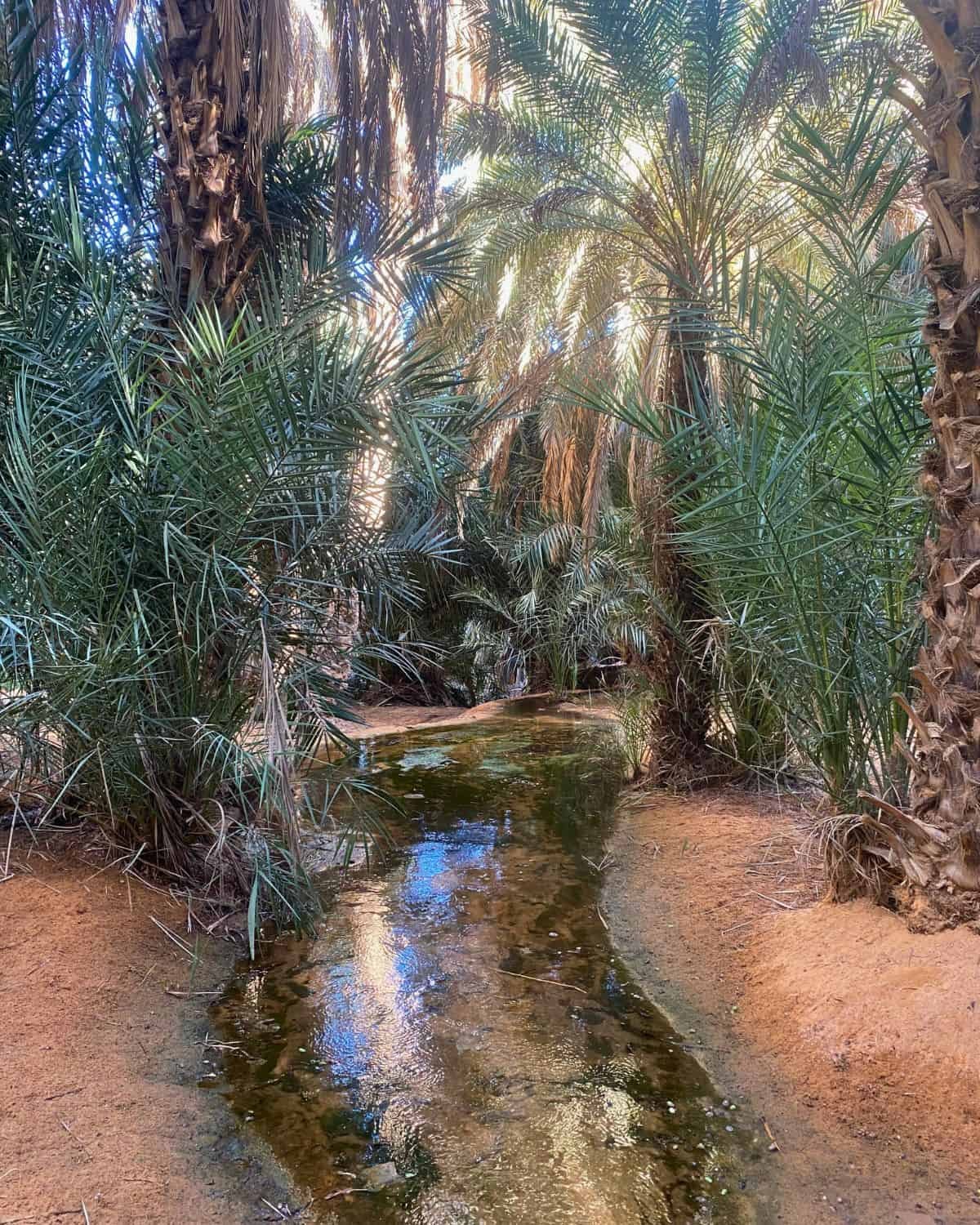
Eating at the Edge of the Sahara
Terjit is not a dining destination in any conventional sense. The oasis sits roughly 50 kilometres from Atar in the Adrar region of Mauritania, accessible by piste rather than paved road, and the journey itself filters the crowd to travellers who already understand that getting there is most of the point. At the bottom of a sandstone gorge, date palms press against a narrow ribbon of spring-fed pools, and the temperature drops several degrees the moment you descend from the plateau. It is in this environment that Chez Jemal operates, and the setting shapes everything about what eating here means.
West Africa's Saharan interior has almost no restaurant culture in the European or urban sense. Food in this region has always been tied to what the land and the caravan routes could sustain: millet, dates, dried fish traded from the coast, camel and goat raised locally, and tea ceremonies that function as the primary social architecture of a meal. Chez Jemal sits within that tradition rather than outside it. The venue is not importing a format from Nouakchott or replicating anything found further along the coast at places like Atlas Restaurant in Nouadhibou or Marbella in Nouadibou. The reference points here are local, and deliberately so.
Where the Ingredients Come From
The ingredient sourcing logic at Terjit's oasis is, by necessity, radically short-chain. Date palms are the structural crop of the Adrar region, and the dates harvested from Terjit's own grove are among the few agricultural products the site generates directly. Goat and camel are herded across the wider Adrar, and meat at this latitude arrives from nearby pastoral communities rather than a supply chain with any significant distance in it. The absence of refrigeration infrastructure across much of this region is not a constraint so much as a design condition: what is available is what is recent, local, and seasonal in the most literal sense of that word.
This kind of sourcing stands at the opposite pole from the controlled-origin philosophy of Europe's most deliberate kitchens. When Atelier Moessmer Norbert Niederkofler in Brunico builds a menu around Alpine producers, or when Reale in Castel di Sangro anchors itself to the Apennine larder, the motivation is philosophical and deliberate. At Terjit, the constraint is geographical and logistical — but the outcome has something in common with those more celebrated kitchens: the food tells you exactly where you are. That clarity of place is rarely available at this price point anywhere, including at Dal Pescatore in Runate or Uliassi in Senigallia, where the sourcing ethos is equally precise but the context is European and the infrastructure is substantial.
The Format and the Feel
Hospitality in the Saharan tradition centres on tea: three glasses, each progressively sweeter, served slowly as a gesture of welcome and patience. Any meal at Chez Jemal exists within that cultural rhythm rather than competing with it. The pace is not a service shortcoming — it reflects a different understanding of what a meal is for. Travellers arriving with the expectation of a structured, timed dining experience should recalibrate before they sit down.
The physical environment reinforces this. The gorge at Terjit creates natural shade, the palms filter light through the afternoon, and the spring water running nearby is audible from the eating area. This is not atmosphere manufactured for tourism; it is the actual landscape, and the meal is set inside it. For a sense of how dramatically different the format is from high-design destination dining in other traditions, consider the contrast with Le Bernardin in New York City, Atomix in New York City, or HAJIME in Osaka, where every spatial element is controlled and intentional. At Terjit, the space pre-exists the venue, and the venue simply occupies it.
Visitors making the trip from Atar typically arrive in the late morning or early afternoon, when the light in the gorge is at its most workable and the heat on the plateau above is at its most severe. The practical advice for anyone planning a visit is to arrange transport from Atar with a local guide, confirm availability in advance, Terjit receives visitors in waves tied to the broader Mauritanian travel calendar, with the cooler months between November and February carrying the highest traffic, and treat the meal as part of a half-day excursion rather than a standalone dining event. There are no confirmed booking systems, no published contact details in the public record, and no website. Arrival and negotiation happen on the ground.
Terjit in Its Regional Context
Mauritania sits outside almost every established international food media circuit. There are no Michelin inspectors working the Adrar, no 50 Best voters passing through Terjit, and no James Beard equivalents for West African Saharan cooking. The more useful comparisons are with remote destination experiences that exist outside institutional validation altogether, places where the point is access and context rather than technique and execution.
For readers who have used EP Club to track venues like Waterside Inn in Bray, Piazza Duomo in Alba, Le Calandre in Rubano, Quique Dacosta in Dénia, or Jordnær in Gentofte, Chez Jemal asks for a different kind of attention. The question is not whether the kitchen is technically ambitious, it is whether the experience of eating in this oasis, in this desert, at this remove from anything resembling a city, means something. For most people who make the journey, the answer is yes. See our full Terjit restaurants guide for other options in the area and broader practical planning. For reference points in community-rooted American dining formats, Lazy Bear in San Francisco and Emeril's in New Orleans represent a different tradition of hospitality built around the host-guest relationship, which is not entirely foreign to what Chez Jemal offers in its own register. And for the high-craft end of place-specific sourcing in southern Europe, Quattro Passi in Marina del Cantone provides a useful contrast in how a kitchen can be shaped by its immediate geography.
Planning Your Visit
Terjit is approximately 50 kilometres southwest of Atar, reachable by 4x4 on unpaved desert tracks. There is no public transport serving the oasis. The cooler dry season (November through February) is the practical window for most international visitors, as summer temperatures in the Adrar regularly exceed 40°C. Chez Jemal has no published phone, no website, and no reservation system accessible remotely, the operating model is entirely on-site. Travellers should plan the visit as part of a guided Adrar itinerary originating in Atar or Nouakchott, and confirm that Chez Jemal is operational at the time of travel before making the oasis a fixed point in any itinerary.
Quick Comparison
| Venue | Cuisine |
|---|---|
| Chez JemalThis venue — the venue you are viewing | This venue |
At a Glance
- Rustic
- Quiet
- Casual Hangout
- Group Dining
- Family
- Hotel Restaurant
- Standalone
- Garden
- Mountain
Rustic, oasis-set, and traveler-focused, with a basic camp/guesthouse feel rather than a polished dining room.